
The first decision is not “which transfer pricing model.”
If you sell in Europe or Australia today and want to expand to the U.S., the first question is not about transfer pricing. It is about where you will operate.
Will you keep selling only through your foreign company? Or will you add a U.S. company because marketplace rules, liability, banking, or exit goals require it?
Once that decision is made, transfer pricing becomes the wiring that moves cash between the two companies without inviting an IRS problem.
What is transfer pricing?
Transfer pricing is just pricing between related entities. Your foreign company and your U.S. company are related. Every transaction between them needs to be priced as if they were strangers.
Done right, it lowers audit risk, keeps your books clean, and can legally shift routine profit back to your home country. Done wrong, it triggers audits, penalties, double taxation, and lost time.
The IRS does not care which marketplace you sell on. It cares whether the pricing between your related companies makes sense and whether you can prove it.
Who needs this
Brands doing roughly $1M to $20M that plan to enter the U.S. via Amazon, TikTok Shop, Walmart, or DTC. Companies that already sell in the EU or AU and are adding a U.S. company for credibility, insurance, KYC, or retail partnerships.
If you only have one company, transfer pricing does not apply to you yet. If you add a U.S. entity later, it kicks in immediately.
There are three common models
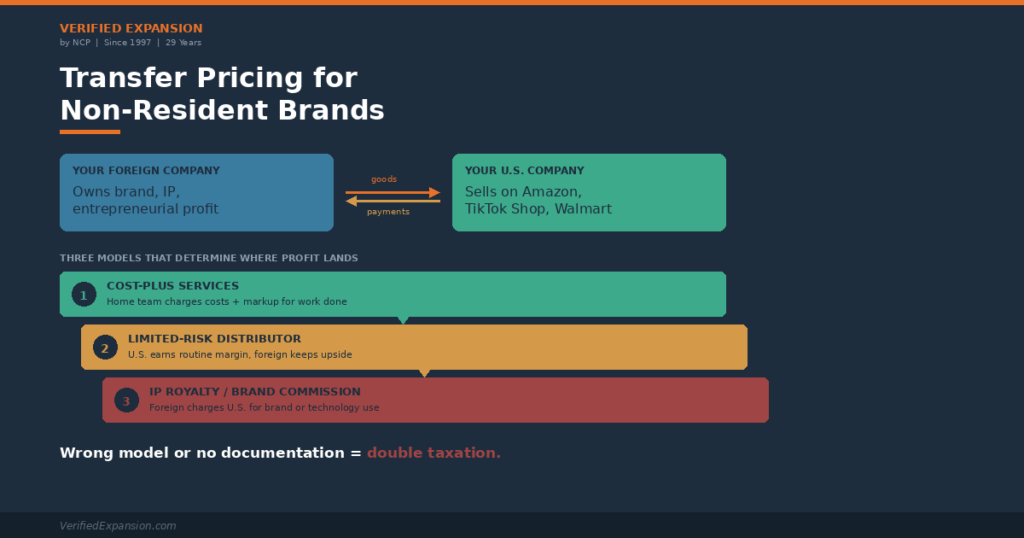
The transfer pricing world uses three structures for ecommerce expansions. Each one answers a different question about where profit should land and why.
Cost-Plus Services. Your foreign company provides services to your U.S. company and charges its costs plus a markup. Used when the home team runs management, creative, ads, or operations for the U.S. arm.
Limited-Risk Distributor. Your U.S. company buys from your foreign company at wholesale and resells in the U.S. The U.S. earns a routine margin. The foreign company keeps the entrepreneurial upside. This is the default for most ecommerce expansions.
IP Royalty or Brand Commission. The foreign company owns the brand or technology and charges the U.S. company for using it. Useful when the U.S. buys from factories directly but relies on foreign-owned IP.
The right model depends on your facts. Which entity owns what, who does the work, and how the money actually flows. Picking the wrong one, or picking the right one without documentation, creates the same problem.
The trap we see every month
A foreign brand adds a U.S. entity to onboard to the marketplace. The platform asks for an EIN and a “discount percentage.” They pick a round number and start shipping.
No intercompany agreement. No memo. Invoices that do not match the story in the tax return.
That may be fine for the platform’s onboarding checklist. It is not fine for the IRS.
Passing a marketplace KYC check does not equal tax compliance. If you pick a discount or a fee without a paper trail that explains why the number makes sense, you are hoping no one asks. Hope is not a compliance strategy.
What goes wrong without documentation
The IRS can reclassify payments between your related entities. Your home country tax authority can also tax them. This creates double taxation that compounds every time money moves.
The most common failures are not about picking the wrong model. They are about having no agreement behind the pricing, no memo that supports the numbers, and no year-end adjustment to bring actual results in line with the policy.
When your tax return, your intercompany invoices, and your agreement all tell different stories, you have a problem that gets more expensive every year you ignore it.
What proper documentation looks like
You need three things. A signed intercompany agreement that matches reality. A short transfer pricing memo that supports the numbers and provides penalty protection if examined. And a year-end true-up that aligns actual results with the target.
Paper it once, refresh the memo annually, and true-up at year’s end. That is the entire ongoing obligation. It is not complicated. But it does need to be done.
CEO Blueprint: get the structure right first
The CEO Blueprint ($1,250) is where we sequence this correctly.
Two calls with Scott Letourneau, MSCTA®. A written plan up to 10 pages delivered in 3 business days. Specialist matching to the right transfer pricing expert based on your structure.
On the first call, Scott will:
Map your marketplace plan. Amazon, TikTok Shop, Walmart, DTC, and the KYC realities of each.
Decide your entity path. Stay foreign or add a U.S. company based on taxes, liability, banking, and exit goals.
Identify where transfer pricing fits. Which model matches your facts, what documentation you need, and who should build it.
Match you to a transfer pricing specialist. Not a generic referral. A personal introduction to the right expert with transparent, reasonable fees.
You leave with a recording, a transcript, and a written plan you can execute with confidence.
This post is educational information, not legal or tax advice. Consult a licensed CPA, tax attorney, or transfer pricing specialist for guidance specific to your situation.