
Most U.S. TikTok Shop accounts never make a sale.
They die in verification. Not because the product is weak. Not because the content is bad.
Because the KYC, tax, and entity story looks risky to TikTok’s systems.
Last updated: July 2026. Reflects TikTok’s published reasons for onboarding failures, February 2026 shipping policy reversal, March 2026 identity verification updates, and the official shift from “Primary Business Representative” to “U.S. Business Representative.”
 Here is what brands keep learning the hard way.
“I already have an LLC and EIN” is not readiness.
It can actually get you rejected faster.
Now you have a paper trail for TikTok to review. If the details do not align, the system flags you as inconsistent.
In recent paid verification reviews, we saw the same pattern show up in different ways.
- The founder had a legitimate business, but the addresses did not match across documents and submissions.
- The founder had “help,” but the U.S. Business Representative role was misunderstood.
- The setup looked fine to the founder. To TikTok, it appeared misaligned.
TikTok does not grade intent. It grades consistency.
If you run a real brand, that is not a minor paperwork issue. That is delayed launch momentum, frozen cash flow, inventory sitting idle, and a platform that quietly flags you as higher risk before you ever scale.
This guide breaks down the five stages where U.S. TikTok Shop accounts fail, what TikTok is actually checking, and what the recent platform changes mean for your verification timeline.
We will show you where accounts break. The specific methodology for fixing each stage is what we use in our engagements.
Before you buy anything, start with the free readiness page: The U.S. Business Representative Readiness Page. That page walks through what the role is, who can fill it, how to ask, and what protections to put in place. Then claim the 27-Step U.S. Business Representative Blueprint from that page.
Where TikTok Shop Is Heading in 2026
Two major shifts happened in the first two months of 2026. Both affect verification directly.
The U.S. Joint Venture
On January 22, 2026, TikTok closed its U.S. joint venture (TikTok USDS Joint Venture LLC).
The new entity is majority-American-owned. Approximately 50% is held by a consortium of new investors including Oracle, Silver Lake, and MGX. Around 30% is held by affiliates of existing ByteDance investors. Roughly 20% is retained by ByteDance.
TikTok’s U.S. entities now manage commercial activities including e-commerce and advertising. Oracle serves as the trusted security partner under an audited program aligned with NIST and ISO standards.
Here is the only takeaway that matters for operators.
This is not a “verification gets easier” moment.
When platforms restructure and tighten corporate controls, they standardize enforcement. That means less tolerance for grey-area setups and more scrutiny on the exact places brands usually cut corners.
The Shipping Reversal
In late January 2026, TikTok Shop announced it would phase out independent seller shipping starting in late February.
Full transition to platform-managed logistics was expected by the end of March.
The pushback was immediate. Brands began pulling product assortments, reducing promotions, and threatening to exit.
On February 18, 2026, TikTok reversed the decision.
Seller Shipping remains unchanged. Previously shared deadlines are not being enforced.
Sellers who touched warehouse settings, shipping templates, or fulfillment integrations during the confusion are now triggering what we call a “trust reset.”
That means TikTok is re-verifying the account’s operational legitimacy based on a change event, not a violation. Read our trust reset breakdown.
Fulfilled by TikTok (FBT) remains the platform’s long-term priority. This reversal buys sellers time. It does not buy an exemption.
Bottom line: plan for stricter KYC in 2026.
What TikTok Actually Checks During U.S. Verification
TikTok Shop operates under strict U.S. KYC and tax rules. But here is what most sellers get wrong about the process itself.
TikTok verifies less than you think, and that is the trap.
Exactly one document gets uploaded during standard verification: the U.S. Business Representative’s government ID. Everything else, the entity name, the business address, the EIN, is typed into fields and matched directly against IRS records. TikTok does not pull your Secretary of State filing. It does not verify your bank account. A smaller surface means every element weighs more.
In February 2026, TikTok published its most specific list of onboarding failure reasons to date: business name mismatches, street address mismatches against IRS or business documents, wrong or illegible documents, and name mismatches on the ID.
Every one of these is a data consistency failure, not a missing document.
And the IRS match is only the document layer. A legitimate, accurate ID can still fail on the trust layer: the device and network the account is built on, the sequence information is entered in, and the roles established at setup. The rules for surviving both layers are exact, and they are applied for you inside the guided build.
For U.S. Residents
That usually means an LLC, S corporation, or C corporation.
The owner or executive acts as the U.S. Business Representative, using a U.S. ID and residential address.
For Non-Resident Owners
The rules tighten significantly.
- TikTok expects a W-9, not a W-8. In practice, that usually means a U.S. corporation or partnership.
- A single-member LLC treated as foreign-owned can be incompatible with the W-9 posture TikTok expects.
- A foreign UBO with a passport and residential address, plus a U.S. entity and U.S. Business Representative, can raise questions about U.S. trade or business, effectively connected income (ECI), and treaty permanent establishment.
TikTok only cares about risk and payout.
Tax authorities care about where profits are taxed.
Our work sits at the intersection.
The Five Stages Where U.S. TikTok Shop Accounts Fail
Selling on TikTok Shop U.S. takes five stages. Any single stage done wrong stops the whole thing, and most providers only sell you one.
These are the same five stages, in the same order, that The Verified Path runs for you in one engagement. Here is what each one looks like when it goes wrong.
Stage 1: No U.S. Business Representative, or the Wrong One
The real question at Stage 1 is rarely “did I pick the right person.” It is “I do not have a person, and how do I get someone on board?”
TikTok requires a U.S. Business Representative who can:
- Provide a government-issued ID
- Prove a residential address
- Control the phone number linked to the account and two-factor logins
- Complete selfie or live verification checks
- Respond quickly to review requests
TikTok also requires clean UBO data for anyone who ultimately owns 25% or more of the entity.
In March 2026, TikTok confirmed that the U.S. Business Representative who appears in the verification video must be the same person whose information was used during registration.
This is not a suggestion. It is an exact-match requirement.
And the candidate matters more than most operators know: if your Representative serves other shops, their linkage becomes yours. Trouble on a shop you have never seen can trigger re-verification on the one you own. One person, properly onboarded, exclusive to your account.
This is the stage with the highest failure rate in the entire process.
Most sellers skip it entirely and plug in a friend as their U.S. Business Representative. That shortcut is why their accounts die later.
Our approach at Stage 1 is not just paperwork. The 16-page Conversation Scripts, the 30-page Onboarding Packet, three template agreements (Scope of Authority, Hold Harmless and Indemnification Addendum, Independent Contractor Agreement), the volunteer-path agreement, and the First-90-Days role discipline rules exist because how you bring your one candidate into the role determines whether they say yes, sign clean paperwork, and stay for the life of the shop.
The U.S. Business Representative Is Where Most Applications Die
Start with the free readiness page. It walks through what the role is, who can fill it, how to ask, and what protections must be in place.
Read the U.S. Business Representative Readiness Page
Stage 2: The Wrong Tax Lane (the W-9 Trap)
TikTok Shop requires a W-9, not a W-8. That single form decides more than most sellers realize.
For U.S. brands, the strategic questions at Stage 2 include entity type selection (LLC taxed as an S corp vs. a C corp), alignment with the owner’s personal tax planning, and separation of product liability and insurance.
For foreign-owned brands, Stage 2 is where the real risk sits. A single-member LLC owned by a foreign person is a disregarded entity: the foreign owner cannot sign a W-9 as a U.S. person, and passing verification on the wrong lane is worse than failing, because the platform then files 1099-K income against a structure that cannot legally certify the form it was built on.
The wrong structure can create U.S. effectively connected income. It can trigger a permanent establishment in your home country. It can force filings in multiple countries with no plan. It can build a one-off mess that works for TikTok but breaks when you expand to Amazon, Shopify, or Walmart.
Our CEO Blueprint maps this before you form anything.
If Stage 2 is wrong, tightening documents later is expensive damage control. Entity selection and tax planning must happen before your SS-4 is filed. Amendments after the fact restart bank KYC, confuse TikTok’s records, and push your launch back by 2 to 4 months.
Stage 3: Entity and IRS-Record Mismatch
The typical pattern: someone forms a quick LLC in whichever state sounds trendy, grabs a cheap virtual address without thinking about KYC, and hopes all the names line up. Then they type their business information into Seller Center.
This does not fool TikTok. The entity name, the EIN, and the business address you type are matched directly against IRS records: whether the EIN connects to a real business with a responsible party, whether the address makes sense for the claimed activity, and whether the Representative and UBO structure looks like a regular operating business or a nominee arrangement.
TikTok validates business identity against IRS records directly, and the letter-matching rules are exact. Matching them before you ever submit is part of the guided build.
Stage 4: The Setup and Trust Layer (Where “Verification Failed” Happens)
Once you see “verification failed,” you are in surgery, not theory. You will rarely get a clear explanation. You get a generic message and a chance to resubmit.
Under the surface, failures tend to fall into three categories.
Trivial but fatal errors. Spelling mistakes. Date format issues. Missing suite numbers. Expired documents. TikTok does not fix these for you. They just say no.
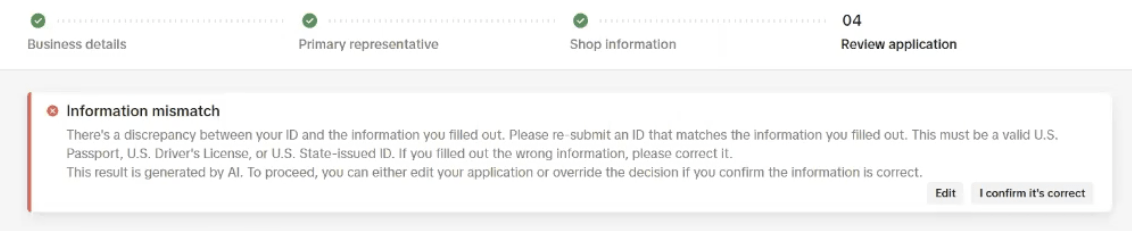
A real guided case, May 2026: the AI-generated mismatch error, with the override decision no one warns you about.
Document misalignment. What you typed does not match what the IRS has on record. The risk engine detects noise. Noise looks like fraud. TikTok may also require additional proof documents mid-review, and most sellers learn which ones the hard way, in the middle of a live review clock.
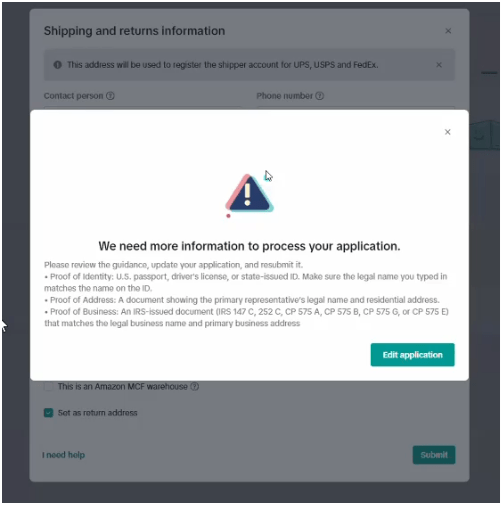
The mid-review document demand, arriving after submission, on a live clock.
Trust-layer failures. This is the category most sellers never see coming, because their documents were correct. A legitimate, accurate ID can still fail: foreign IP logins, a VPN session flagged by TikTok, information committed in the wrong sequence, roles never properly established, and major mid-build changes all read as suspicious activity. Every one of them is avoidable. The guided build exists so you avoid all of them.
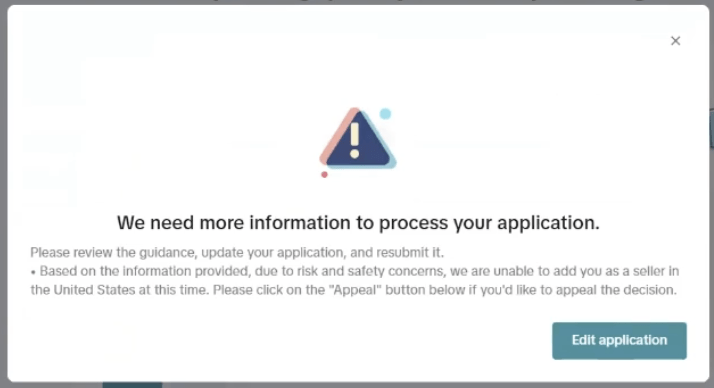
The trust-layer rejection: ID accepted, facial verification passed, rejected anyway. May 2026, real case.
If you are at Stage 4, the question is not “what did I do wrong?” The question is whether the problem is fixable within your current structure or whether the structure itself needs to change before resubmission. That distinction determines everything about what happens next.
We built three rescue levels for exactly this moment.
- Start with the Verified Diagnostic if you want the specific failure reason in writing and will handle the fix yourself.
- Move to the Verified Rescue if you want us to review your corrected package before it goes back to TikTok.
- Choose the Verified Rescue Complete for complex cases with multi-entity structure, prior account history, or when a second failure is not an option.
Stage 5: The First 90 Days (Approved Is Not the Finish Line)
Most sellers stop watching the clock the day they are approved. That is exactly when the trust window opens.
Your Account Health Rating starts at 100, and the first 90 days decide whether the account stabilizes or dies young. A foreign IP login from your home country can trigger re-verification. A banking or payout change in week three can freeze settlement. A Representative who was never briefed on their first-90-days role goes quiet at the worst possible moment. And the INFORM Consumers Act clock, covered below, starts running the day you are approved.
A clean submission you cannot keep alive is worth nothing. Stage 5 is why the done-for-you engagement includes 90 days of post-approval coverage, not just a submission.
What Happens After You Fail a Stage: Resubmissions, Appeals, and Rebuilds
TikTok allows limited resubmissions for onboarding rejections. They do not publish a cap or a timeline. Most brands waste their attempts.
Three distinct paths exist after a rejection. Using the wrong one costs you time you do not have.
- Resubmission: The Submit button is still available in Seller Center. You can correct documents and resubmit.
- Identity Verification Appeal: Your identity verification formally failed and TikTok shows an Appeal button in Seller Center.
- Seller Policy Violation Appeal: Your shop was already approved and active but received a policy violation through Shop Health (30-day window for the first, 15-day window for the second).
Confusing them routes you to the wrong process.
The most common mistake: sending the same documents and stating, “Everything is correct, please review again.”
From TikTok’s perspective, nothing has changed. The risk assessment remains the same. An effective resubmission is a structured case that shows the earlier risk signal no longer applies, not a customer service request. Building that case is exactly what the rescue tiers do.
Sometimes, the right advice is uncomfortable. Stop resubmitting. If the underlying structure is the problem, additional attempts do not improve your odds. They train the system to recognize that this profile is not worth the risk.
That is when a rebuild is on the table. You may need one if the original entity type will never match the KYC profile you need, the address has been flagged in too many failed attempts, the Representative is overexposed across unrelated accounts, or multiple denials have trained the system that this profile is not credible.
TikTok’s system has memory. Every failed submission, every flagged address, every denied profile leaves a trace. The platform does not start fresh just because you do. Most sellers who attempt a rebuild on their own make the problem worse: they reuse data points the system has already locked and trigger duplicate-account detection without knowing which element caused it.
A successful rebuild requires knowing exactly which data points are burned and which are salvageable. That analysis is case-specific, and it is the rebuild work inside The Verified Path: a 30-minute strategy call with Scott on tax and entity architecture, the full Representative onboarding, entity formation or SMLLC tax election, the guided account build, and the 90-day post-approval support window.
If your case involves multi-entity structure, treaty analysis, or permanent establishment questions, start with the CEO Blueprint before you buy the execution package.
The Tax Risk That Arrives After Verification
Getting past TikTok’s front gate is only half the game.
The moment you hold a U.S. EIN and file a W-9, you enter the U.S. tax system.
Multi-Member LLC (Partnership)
The IRS sees a foreign partner earning U.S. income. Withholding is required under IRC § 1446 before any distribution.
What it costs you: Up to 37% withheld at the source. Cash leaves the business before you see it. During your highest-growth phase.
C Corporation
The IRS sees a U.S. entity earning taxable income. Dividends to foreign shareholders trigger a second layer of withholding.
What it costs you: 21% corporate tax plus 5-30% dividend withholding. Two bites. Same dollar. Treaty dependent.
Single-Member LLC (Foreign Owner, Disregarded)
The IRS sees a foreign person who signed a W-9 certifying they are a U.S. person. They are not.
What it costs you: IRS perjury risk. Not a tax bill. A federal compliance violation that compounds every year you sell.
These rates apply when TikTok Shop income is effectively connected with a U.S. trade or business (ECI). If you maintain U.S. inventory, use U.S. fulfillment, appoint a U.S. Business Representative with operational authority, and make regular sales into the U.S. market, the IRS has a strong basis to treat that income as ECI. The withholding amounts are prepayments, not final tax. Your actual liability may be lower after deductions, losses, or treaty positions are applied on a properly filed U.S. tax return.
However, TikTok Shop requires a W-9. It does not accept W-8BEN or W-8BEN-E.
That means treaty-based reductions do not apply at the point of withholding. They only apply when the appropriate U.S. tax returns are filed reflecting the foreign ownership.
The cash flow hit happens first. The treaty credit comes later.
The gap between those two events is where brands run out of operating capital.
That analysis is what we map inside our CEO Blueprint.
If you are a foreign owner combining a U.S. entity, a U.S. Business Representative with real authority, U.S. warehouses or 3PLs, and regular sales into the U.S. market, you are very likely engaged in a U.S. trade or business with effectively connected income.
That can trigger U.S. federal tax returns, withholding obligations, and treaty and permanent establishment analysis in your home country.
Our role is not to scare you away from the U.S.
It is to help you choose the right structure so TikTok Shop becomes a profit center, not a tax headache that compounds for years.
The difference between a tax problem and a tax plan is documentation.
Entity selection, transfer pricing agreements between your U.S. and foreign companies, and proper treaty filings reduce your effective rate from the worst-case numbers above to a level that makes the U.S. expansion profitable.
Without those documents in place before you start selling, you are locked into the highest rates by default.
The CEO Blueprint maps this at three levels.
- Focused covers one structure and one marketplace.
- Expansion covers foreign parent plus U.S. entity across 1 to 2 marketplaces.
- Strategic covers treaty and permanent establishment analysis, multi-state exposure, and $1M+ revenue operators.
Your situation determines your tier. Not your budget.
The Double Whammy Nobody Warns You About
Two cash-flow walls hit at the same time, and almost no one plans for both.
TikTok holds all payouts for the first 31 days after your first delivered order. No exceptions. No advance.
Meanwhile, if your entity triggers withholding, the IRS takes 21 to 37% before you receive a distribution.
You are funding inventory, ads, and fulfillment out of pocket while the platform holds your revenue and the IRS holds its share.
That is two cash flow walls hitting at the same time. In the exact window when your account needs momentum to survive TikTok’s compliance scoring.
Most brands plan for one or the other. Almost no one plans for both.
The Operational Risk That Starts on Day One
Even if verification succeeds, TikTok’s 2026 fulfillment policies create immediate operational pressure.
On-Time Delivery Rate (OTDR) is enforced at 80% minimum. Orders are measured in business days from the delivery date. FBT and Express Shipping orders are exempt from OTDR calculations.
Dispatch requirements. Orders must be scanned by the carrier and updated to In Transit within 2 business days. Failure counts as late dispatch.
Valid Tracking Rate (VTR) must stay at 95% or higher for sellers using Seller Shipping. Faster shipping options can be removed if delivery thresholds are not maintained.
Platform-managed fulfillment is expanding. TikTok’s Upgraded TikTok Shipping now centrally manages carriers, offers discounted rates, provides TikTok-generated labels, and gives exemptions from some logistics-related performance penalties if dispatched on time.
Collections by TikTok (CBT) pickup is now available in eligible areas based on warehouse location and daily order volume.
TikTok is also shifting fulfillment enforcement from product-level metrics to Voice of Customer (VoC) signals.
That means TikTok is watching how buyers feel about the experience, not just whether the package moved.
The takeaway for new sellers: verification is the first test. Fulfillment compliance is the second.
Both run simultaneously after approval. Both can freeze your account or payouts with no warning.
The Compliance Layer Most Sellers Do Not Know Exists
Most sellers think verification is a one-time gate.
Get approved. Start selling. Move on.
That is wrong.
The INFORM Consumers Act is a federal law that requires TikTok Shop to verify seller identity and business information on an ongoing basis.
High-volume sellers (200 or more transactions or $5,000 or more in gross revenue in any continuous 12-month period) must re-verify annually through TikTok’s Qualification Center.
That re-verification is not a formality.
TikTok requires the U.S. Business Representative to confirm their identity, submit a current government-issued ID, and verify that the business information remains accurate.
If the U.S. Business Representative is unreachable, their ID has expired, or any information has drifted from the originally submitted information, the re-verification fails.
The seller finds out when payouts stop or listings are restricted. Not before.
Re-verification can also be triggered outside the annual cycle by:
- Payout holds
- Changes to bank account or ownership information
- Tax form updates
- Risk flags from unusual login patterns
- IP changes
Every one of these events can pull an active, revenue-generating shop into a review that the U.S. Business Representative must personally resolve.
Accounts approved in 2024 and 2025 with informal U.S. Business Representative arrangements are now failing re-verification.
The friend who agreed to “just put their name on it” is unreachable. Their documents have changed. Their phone number is different.
The account is frozen with no simple recovery path.
This is why we treat the U.S. Business Representative as a permanent compliance function, not a one-time setup step.
The 16-page Conversation Scripts, 30-page Onboarding Packet, template agreements, and role boundaries we build inside our TikTok Shop verification programs are designed to survive re-verification, not just pass the initial review.
The Financial Cost of Every Week You Wait
Top-performing TikTok Shop sellers generate $30K to $70K in gross sales per week.
Each seven-day verification delay costs $10K to $100K in lost revenue, plus expired ad credits that TikTok only grants during the first weeks of a SKU’s lifecycle.
TikTok Shop, with access to an estimated 170 million U.S. users, is having its Amazon-2010 moment.
Cheap traffic. Affiliates willing to post for the cost of a sample. First-mover advantages that compound weekly.
None of that matters if you cannot get verified.
DIY Versus Done-For-You
The DIY path.
- Six to eight weeks per IRS or bank error
- Guess how to ask a family member or friend to be your Rep, and lose them
- U.S. Business Representative bears personal liability with no protection
- Guess at U.S. tax rates and entity consequences
- No support after submission
- Limited resubmissions. No rehearsal.
Done-for-you with NCP | Verified Expansion.
- Tax plan before LLC formation. Entity, EIN, and bank aligned from day one.
- 16-page Conversation Scripts. The exact framework to get your candidate to say yes and stay through re-verification.
- Signed indemnification agreement. U.S. Business Representative vetted and protected.
- Tax-Trap Matrix and phased rollout plan before you file anything.
- Advanced email support for 30 to 90 days depending on package.
- We prepare the submission so it passes on the first attempt.
When TikTok tightens the rules again, the sellers who prepared properly will already be live, ranked, and review-rich.
The others will still be emailing support.
FAQs
Q: How long does TikTok Shop verification take in the United States?
A: Most straightforward approvals happen within a few business days once all documents are correct and consistent. Structural conflicts, misaligned data, or failed submissions can extend this into weeks or months. The biggest time killer is not TikTok’s review speed. It is resubmitting flawed applications that restart the clock each time.
Q: Can a non-U.S. resident open a TikTok Shop with a W-9?
A: In many cases, yes, but only through a U.S. entity that is treated as a U.S. taxpayer. A single-member LLC owned by a foreign individual is generally incompatible with TikTok’s W-9 requirement without creating IRS compliance risk. The right entity type depends on ownership, operations, and your broader cross-border tax plan.
Q: Why did my TikTok Shop verification fail?
A: Most failures come from one of three causes. Simple errors in names, addresses, or document formatting. What you typed not matching what the IRS has on record. Deeper structural issues with the entity type, tax classification, or U.S. Business Representative and UBO story. TikTok rarely tells you which one triggered the rejection.
Q: How many times can I resubmit after a TikTok Shop rejection?
A: TikTok allows limited resubmissions for onboarding rejections. They do not publish a cap or a specific timeline. Each attempt has to present a materially changed case, and resubmitting the same documents with no changes wastes an attempt. After multiple failed resubmissions, your options narrow significantly.
Q: Do I need a U.S. company to sell on TikTok Shop U.S.?
A: For a full U.S. TikTok Shop presence with W-9 and U.S. payouts, you need a U.S. entity that can pass KYC and handle U.S. tax obligations. How that entity is structured depends on whether you are a U.S. resident or foreign owner, what other marketplaces you sell on, and how profits will flow back to the ultimate owner.
Q: What is the difference between the Verified Rescue tiers?
A: Three levels, all for stuck accounts. Verified Diagnostic gives you the specific failure reason in writing and a fix list in the correct order. You handle the resubmission yourself. Verified Rescue adds a documented review of your corrected package before it goes to TikTok, plus a final walkthrough of the exact submission. We stay with you through one full resubmission or verification appeal cycle. Verified Rescue Complete is for complex cases: multi-entity structure, prior account history, or high-stakes launches where a second failure is not an option.
Q: What is the difference between Verified Rescue Complete and The Verified Path?
A: Verified Rescue Complete is for buyers whose account is already stuck and needs recovery. The Verified Path is the done-for-you engagement for buyers who have not submitted yet, or whose entity itself needs to change (foreign-owned SMLLC needing tax election, wrong state of formation, or no entity at all).
Q: What does “Information mismatch: there’s a discrepancy between your ID and the information you filled out” mean on TikTok Shop?
A: TikTok’s AI compared the ID image against the typed application and could not reconcile them. Sometimes the data genuinely differs. Sometimes the image itself is the problem: TikTok rejects scanned, angled, blurry, cropped, edited, or screenshotted IDs, and a scanner copy of a passport can trigger this error even when every field matches. Which one you are facing determines the fix, and guessing wrong spends an attempt.
Q: Should I click “I confirm it’s correct” when TikTok flags an information mismatch?
A: Not blind. The override tells TikTok’s system you are certain, and a wrong confirmation converts a fixable image problem into a risk signal on the profile. Before overriding, you need to know whether the AI misread a correct submission, or whether there is a real discrepancy or a capture problem underneath. That judgment call is exactly the kind of decision a diagnosis answers before you spend it.
Q: What does “due to risk and safety concerns, we are unable to add you as a seller” mean?
A: It is the trust-layer rejection. Correct documents and a passed facial verification can still end here, because this flag is about how and where the account was built and accessed, not the paperwork. It is the hardest category to self-diagnose and the one where blind resubmission does the most damage. Start with a diagnosis before touching Submit again.
Q: Does the 2026 TikTok U.S. joint venture change verification requirements?
A: The joint venture (TikTok USDS Joint Venture LLC) closed in January 2026. It does not make verification easier. Platform restructuring historically leads to standardized enforcement, which means tighter KYC, less tolerance for grey-area setups, and more scrutiny on entity, address, and U.S. Business Representative alignment.
Q: What happened with the TikTok Shop shipping policy change in February 2026?
A: TikTok announced a plan to phase out independent seller shipping in late January 2026. After significant seller pushback, TikTok reversed the decision on February 18, 2026. Seller Shipping remains unchanged. However, the verification system did not pause. Sellers who changed warehouse settings during the confusion are still triggering verification reviews.
Q: What is the INFORM Consumers Act?
A: It is a federal law that requires TikTok to re-verify seller identity and business information on an ongoing basis. High-volume sellers must re-verify annually. If the U.S. Business Representative is unreachable or documents have changed, re-verification fails, and the seller discovers the problem when payouts stop. Accounts set up in 2024 and 2025 with informal U.S. Business Representative arrangements are now failing re-verification months after approval.
Q: What are TikTok Shop’s new fulfillment requirements for 2026?
A: On-Time Delivery Rate must stay at 80% or higher. Orders must be scanned and updated to In Transit within 2 business days. Valid Tracking Rate must stay at 95% or higher for Seller Shipping. Fulfillment enforcement is shifting toward Voice of Customer signals, meaning TikTok now evaluates buyer experience, not just tracking data.
Stop Guessing. Get Verified the Right Way.
Most U.S. TikTok Shop accounts fail before launch.
The ones that win treat KYC, tax, and structure as seriously as product and creatives.
Have not submitted yet? The Verified Path runs all five stages, in the right order, in one engagement: the Representative onboarding, the tax structure with Scott, the entity, the guided account build, and 90 days of post-approval coverage.
See The Verified Path · $2,497
Building your Representative decision first? Start with the free U.S. Business Representative Readiness Page. If you need hands-on help, our verification team can evaluate your situation and route you to the right tier.
Read the U.S. Business Representative Readiness Page
Already stuck, rejected, or mid-resubmission?
If you are not sure whether to resubmit, appeal, or rebuild, we can quickly identify the problem and map the fix.
See all of our TikTok Shop verification programs and the CEO Blueprint for full tax and treaty strategy.
This post is for educational purposes and is not legal or tax advice. TikTok Shop policies and enforcement practices can change without notice. Always verify current requirements through official TikTok Shop Seller Center documentation. Nevada Corporate Planners | Verified Expansion has been helping businesses with U.S. entity structuring since 1997.