
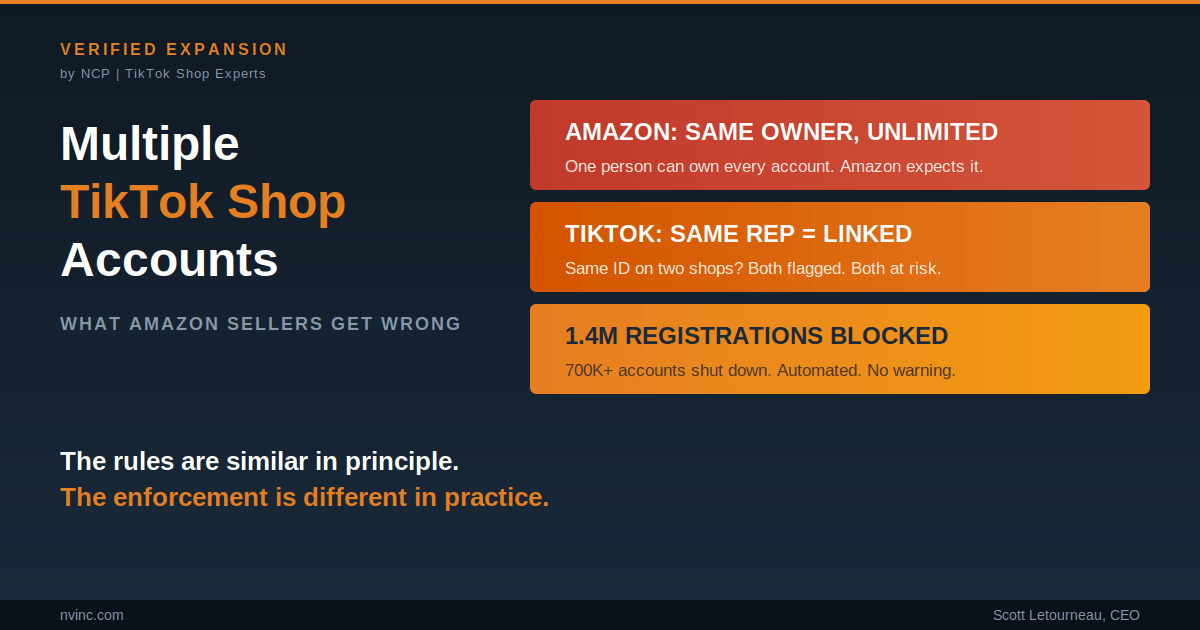
TikTok blocked 1.4 million seller registrations in a single six-month period. Over 700,000 active seller accounts were shut down for fraudulent activity in that same window. The detection is automated; it runs continuously and does not send a warning first.
Updated April 2026. This post reflects TikTok’s current Seller Enforcement Policy, connected account detection practices, Amazon’s current multi-account policy, and the official shift from “Primary Business Representative” to “U.S. Business Representative.”
Most of those sellers were not committing fraud. They were running multiple shops with shared phone numbers, shared devices, shared bank accounts, or the same U.S. Business Representative listed on accounts that were supposed to be independent. TikTok’s system does not distinguish between a legitimate brand expanding into a second product line and a bad actor spinning up shell accounts. The signal pattern looks identical.
If you are an Amazon seller, this will feel unfamiliar. Amazon lets you manage account health, submit Plans of Action, and talk to a human. TikTok’s enforcement is more automated, less transparent, and significantly harder to reverse. The sellers who assume the Amazon playbook works on TikTok are the ones losing shops they spent months building.
This post breaks down what TikTok actually allows, what triggers cross-account enforcement, and where the structural risk sits for sellers running more than one shop. Whether you are launching your second brand or cleaning up a rejected first application, the rules here will save you from the mistakes we see every week.
There Are Real, Strategic Reasons to Run More Than One TikTok Shop
Not every seller needs more than one TikTok Shop. But for the brands that do, the upside is real.
Separate brand identities. A beauty brand and a wellness brand targeting different audiences should not share a storefront. Different content strategies, different creator partnerships, different customer bases. Two shops, two brands, two independent growth engines.
Risk isolation. If one shop catches a policy violation, an isolated second shop is protected. But only if the two shops are structurally independent. If they share any identity signals, TikTok treats them as connected, and a violation on one can freeze payouts on both.
DTC vs affiliate separation. One shop optimized for organic TikTok traffic, another built for creator-driven affiliate campaigns. Different commission structures, different fulfillment models, different content cadences.
Multi-entity strategy for non-resident brands. A foreign-owned C-Corp for TikTok Shop and a separate LLC for Amazon. Different tax positions, different W-9 requirements, different banking. Two entities, two shops, one coherent expansion plan.
Acquisition or partnership. You acquire a brand or partner with a product line that needs its own TikTok presence. It should run under its own entity, not bolted onto your existing shop.
These are real, strategic reasons. TikTok supports them. Up to five seller accounts per verified business entity, and additional shops through separate legal entities with their own EINs.
The problem is never the number of shops. The problem is how those shops are connected behind the scenes.
Amazon Penalizes Unauthorized Multi-Account Structures. TikTok Penalizes Risky Account Linkage. Here Is Why That Distinction Matters.
On Amazon, the current Seller Code of Conduct states that sellers with a legitimate business need can operate multiple selling accounts without prior approval. Legitimate reasons include owning multiple brands with different storefronts, manufacturing products for separate companies, or expanding into different regional marketplaces. Amazon recommends that all existing accounts be in good standing before opening another. If one related account is not in good standing, Amazon can deactivate the others.
A critical detail that Amazon sellers take for granted: one individual can be the verified beneficial owner on an unlimited number of seller accounts across separate entities. Amazon knows you own both accounts, and that is expected. The restriction is not on ownership but on admin access. Each account must have its own unique admin email that has never been associated with any other Amazon account. Adding the same admin email to a second account is one of the most common triggers for a related-account suspension, and experienced Amazon consultants identify it as among the hardest to reverse. Each account also requires a separate physical phone number (VOIP numbers are no longer accepted for new accounts), a separate bank account, a separate credit card, and a separate EIN under a separate legal entity. Up to 120 secondary users can access an account through separate logins with defined permission levels, but the admin credentials must never be shared across accounts.
One additional Amazon rule that has no equivalent on TikTok: sellers cannot list the same product on two accounts under different entities. Amazon treats this as anti-competitive buy box manipulation. Each account must carry distinct product offerings.
On TikTok, the rules appear more permissive on the surface. TikTok allows up to five seller accounts per verified business entity, and there is no formal approval process. But TikTok’s Seller Enforcement Policy states that if a seller account is suspended, banned, or terminated, TikTok reserves the right to take enforcement actions against connected accounts. Connected accounts are identified by shared contact information, phone number, email address, payment details, or bank account.
Both platforms track signals. Both platforms can extend enforcement across linked accounts. Both platforms have appeal mechanisms. The practical difference is in three areas that matter for your expansion.
First, Amazon’s enforcement is more transparent. Amazon provides Account Health visibility, a documented appeal process, and human-reviewed escalation paths. Amazon also offers Account Health Assurance for sellers who maintain their score above 250, which provides a 72-hour window to appeal before suspension takes effect. TikTok’s enforcement is more automated, the rejection reasons are vaguer, and the appeal window is narrower: 30 days for the first appeal, 15 days for the second, and all decisions after the second appeal are final.
Second, TikTok’s linked-account enforcement is more aggressive. On Amazon, if Account A has a violation, Account B must resolve the issue through its own appeal process, and Account A must typically be reinstated first before Account B can be reactivated. The path is documented. On TikTok, enforcement can hit connected accounts based on another account’s suspension, even if the connected account has no independent violations.
Third, and most important for non-resident brands: TikTok has a representative layer that Amazon does not. On Amazon, one person can be the verified beneficial owner across an unlimited number of accounts under different entities. That is expected and transparent. On TikTok, a foreign brand must use a U.S. Business Representative whose identity is locked to the account at verification. That representative’s government ID, phone number, and face in the verification video are all bound to the account. If the same representative appears on two accounts under different entities, TikTok may classify those accounts as connected and apply cross-account enforcement. This risk does not exist in Amazon’s architecture.
If you are an Amazon seller expanding to TikTok, the mistake is not that you lack experience with multi-account compliance. The mistake is assuming the enforcement logic works the same way. The rules are similar in principle. The enforcement is different in practice. And the representative layer adds a structural risk that Amazon sellers have never had to manage.
TikTok’s Account Risk Engine Checks 7 Signal Layers. One Overlap Is Enough.
TikTok’s account risk engine cross-references seven layers of data. Any overlap between accounts that claim to be independent can trigger a linkage flag.
Identity layer: Government-issued ID, phone number, email address, bank account.
Technical layer: Device fingerprint, IP address, EIN and legal entity name.
If even one of these signals appears on two seller accounts under different entities, TikTok’s system classifies those accounts as connected. Connected accounts share enforcement. One violation, one suspension, one fund hold on Account A puts Account B at risk.
The specific mitigation for each signal layer is part of what we train U.S. Business Representatives on before submission. The point here is simpler: the detection is automated, it runs continuously, and it goes far deeper than most sellers expect.
Your U.S. Business Representative Is the Highest-Risk Node in a Multi-Shop Setup
For U.S.-based brands, the representative is usually the owner or an executive. One person, one shop, clean and simple.
For non-resident brands, the representative is always a separate person. A friend, a family member, a 3PL team member, or a paid service provider. That creates a structural vulnerability that U.S.-based brands do not face.
Here is the scenario we see most often with multi-shop sellers.
A foreign brand owner has a successful first TikTok Shop. A second brand is ready to launch. The owner forms a new LLC with a new EIN. Opens a new bank account. Everything looks independent on paper.
But the same U.S. Business Representative is listed on both shops. They log in to both Seller Center accounts on the same device. They use the same phone number. They complete both video verifications with the same face from the same location.
TikTok’s system now sees one human operating two “independent” shops. It does not distinguish between a legitimate representative serving multiple brands and a bad actor running shell accounts. The signal pattern looks identical.
If either shop receives a violation, both shops are at risk.
This is not a hypothetical. TikTok blocked 1.4 million seller registrations in a single six-month period. The platform shut down over 700,000 seller accounts for fraudulent activity in that same window. The detection is running at scale.
The rule for multi-shop sellers is simple: one U.S. Business Representative per shop when the shops are under different entities. If a single representative must appear on more than one account, the representative must understand exactly how TikTok’s identity linking works and which signals must be isolated. That understanding is not something you pick up from a blog post. It requires specific training on device protocol, phone number isolation, address consistency, and video verification sequencing.
A Second Application After a Rejection Makes Everything Worse
The most expensive mistake we see is not the multi-shop strategy. It is the panic rebuild.
A seller submits their first TikTok Shop application. It gets rejected. The rejection message is vague. Instead of diagnosing the failure, the seller creates a new account with a different email and resubmits with the same LLC and EIN.
TikTok’s system now sees two applications sharing overlapping identity data. The legal name matches. The EIN matches. The address matches. The original rejection is no longer just a failed application. It is a linked-account flag across both submissions.
Every piece of identifying data from a first application stays in TikTok’s system. A second application using any of those data points inherits the risk profile of the first. You are not starting fresh. You are compounding the problem.
This pattern is not unique to TikTok. Experienced Amazon consultants report the same failure mode: sellers who fail verification in a new marketplace are sometimes told by support reps to “just create a new account,” which compounds the problem by creating overlapping identity data across multiple failed applications.
On Amazon, a rejected application can usually be resubmitted with corrections through a documented appeal process. On TikTok, a rejected application followed by a second application using overlapping data can permanently contaminate the EIN, the representative’s identity, and the entity’s platform history. TikTok does offer appeals (up to two per violation within stated timelines), but the automated enforcement is less transparent, and the recovery path after multiple failed submissions is significantly narrower.
The correct response after a first rejection is to stop, diagnose, and fix the structural problem before resubmitting. Not to open a new account.
Anti-Detect Browsers Do Not Fix Structural Problems
A growing category of tools markets itself to sellers who want to run multiple TikTok Shop accounts without being detected. These anti-detect browsers spoof device fingerprints and rotate IP addresses.
They do not solve this problem. TikTok’s linked-account detection goes beyond browser fingerprints. It cross-references identity documents, bank accounts, EINs, legal names, phone numbers, and video verification faces. No browser tool can fake a different government ID, a different EIN, or a different face. If you need a tool to hide what you are doing, the architecture is wrong.
What a Trained U.S. Business Representative Understands That an Untrained One Does Not
Most TikTok Shop verification failures are not document failures. They are representative failures. The person submitting the application does not understand what TikTok’s system is checking, what their identity is being locked to, or what they cannot do after submission.
Here is what separates a first-pass approval from a rejection that limits every future attempt:
Identity lock. The representative’s identity is bound to the shop at verification. It cannot be transferred, swapped, or reused on another account under a different entity without creating a linkage risk.
Device protocol. The device used for submission and video verification becomes part of the account’s signal profile. A device used by any other TikTok account carries that history into the new submission.
Document alignment. The representative’s name, address, and ID must match the entity records, IRS records, and bank records exactly. Not approximately. Formatting differences, abbreviations, and middle name inconsistencies are among the most common rejection triggers, according to TikTok, published in February 2026.
Video verification continuity. The same person who registers the account must appear in the verification video. TikTok confirmed in March 2026 that this is an exact-match requirement. A representative who signs the documents but sends someone else for the video will fail.
Each of these areas has specific protocols that must be followed before submission. Getting them right is the difference between a verified shop and a contaminated application that follows your entity through every future attempt.
What to Do If Your Application Was Already Rejected
Do not submit a second application using the same EIN, representative, or address. Every resubmission attempt using overlapping data trains TikTok’s system to classify your profile as high-risk.
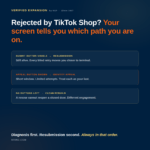
The correct response depends on what your rejection screen says.
“Account application was not approved” with a Submit button: The account is still alive. You can resubmit with corrected information. But you need to diagnose the specific mismatch first.
“Identity verification failed” with an Appeal button: The failure is at the identity layer. The fix may require correcting the alignment between your representative’s documents and the information in Seller Center.
“Account application was rejected” with language about the account being unavailable: The application is dead. Recovery requires a structurally different approach.
In all three cases, the first step is the same: stop submitting and assess the structural problem.
The Cost of Guessing Is Not a Delay. It Is a Permanent Structural Limitation.
A failed TikTok Shop application does not cost you a week. It costs you a contaminated EIN, a burned representative identity, and a risk profile that follows your entity through every future submission on the platform.
For a brand doing $30,000 to $70,000 in gross sales per week, each seven-day verification delay costs $30,000 to $70,000 in lost revenue, plus expired ad credits that TikTok only grants in the first weeks of a SKU’s lifecycle.
Most sellers who DIY their verification burn 60 to 90 days and spend $800 to $2,000 on incorrect formations and filings before they call us. By then, the options are narrower, and the fix is more expensive.
Your U.S. Business Representative is either exclusively on your account or understands exactly how to maintain signal isolation across multiple accounts. There is no safe middle ground.
The sellers who get this right share three things in common: their entity documents match character-for-character across every system, their U.S. Business Representative is trained on the specific protocols before submission day, and their account architecture is built for re-verification 12 months later. The sellers who get it wrong share one thing: they submitted before the structure was ready.
Want to Avoid These Mistakes and Get Your TikTok Shop Verified Correctly the First Time?
We built our verification services for this exact problem. Entity formation, EIN alignment, banking, U.S. Business Representative training, document consistency, and submission-day protocols. One attempt. Done right. No guessing.
Whether you are launching your first U.S. TikTok Shop or expanding to a second brand with a multi-shop architecture, our services cover every stage from Seller Verified ($697) through full Expansion A-to-Z ($2,497).
View Our TikTok Shop Verification Services
Already Have a Situation That Needs a Conversation?
If you are a foreign-owned or U.S.-based brand dealing with a rejected application, a representative who may be overexposed across accounts, or a multi-shop expansion that needs clean architecture, we invite you to book a discovery call with our team.
On the call, we will learn about your specific situation, identify the structural issue, and provide a recommendation for our support, along with fees and a timeframe. No strategy is provided on the discovery call. It is a focused diagnostic to determine whether and how we can help.
This is educational content based on our experience working with TikTok Shop and Amazon verification for U.S. and non-resident sellers since 2024. It is not legal or tax advice. Platform policies are subject to change. Always verify current requirements in TikTok Seller Center and Amazon Seller Central before submitting an application.