
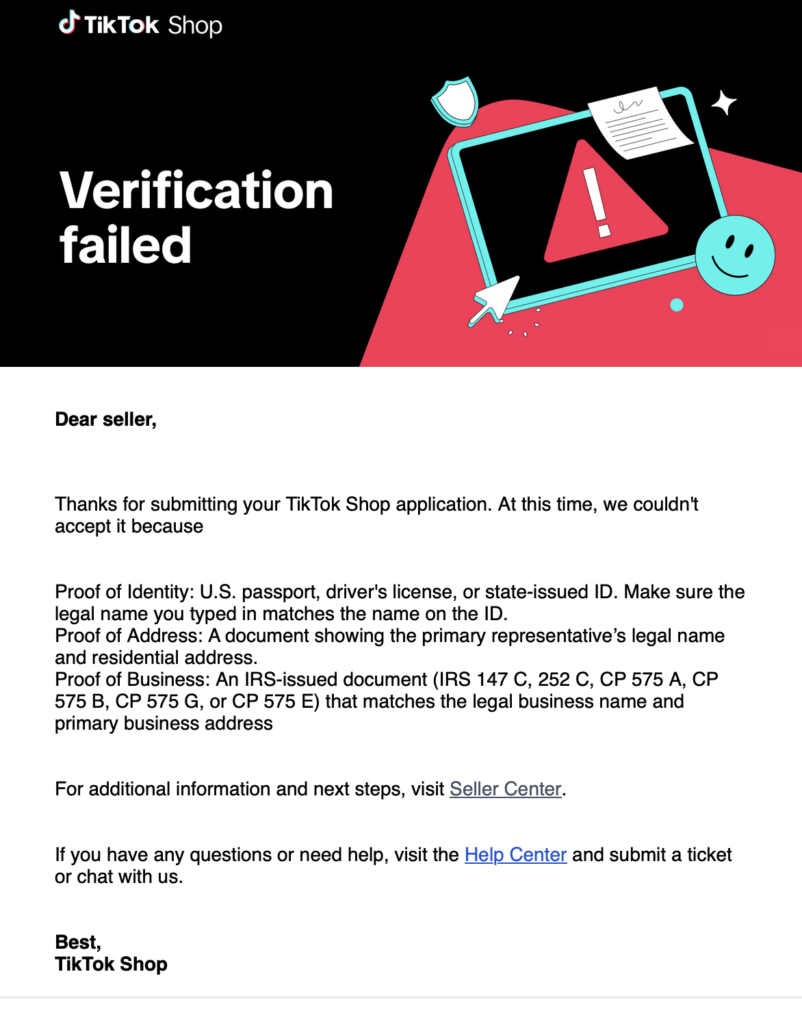
Your passport is real. Your entity’s IRS records are correct. Your documents are clean.
You still got rejected on your TikTok Shop account setup.
Updated July 2026. This post reflects the change to TikTok Shop’s verification flow in early-to-mid May, the two-layer reader-and-risk system that drives the failures, and TikTok’s official capture-quality instruction.
If that describes you, you are not confused, and you are not doing anything wrong. Something changed in the TikTok Shop onboarding flow in 2026, and almost nobody is explaining it accurately. This post does.
It is not a list of tricks. There are no tricks. It is a clear explanation of what changed, why the obvious fixes backfire, and what is actually at stake when you get this wrong now versus a year ago.
The One Thing That Changed and Why It Explains Everything
Around early to mid-May 2026, that fallback was removed.The flow is now ID document upload only. Passport, passport card, US driver’s license, state ID, or permanent resident card. Nothing else.This is the part that reframes the whole market. Setups that worked in 2024 and early 2025 often worked because that safety net was silently catching scan failures. The net is gone. A document-read failure is now terminal inside the flow, with no recovery option. This is a platform change. It is not your process degrading, and it is not bad luck.
If you know people who set this up easily a year ago, this is why their experience does not match yours.
Why “My Documents Are Real” Is True and Still Not Enough
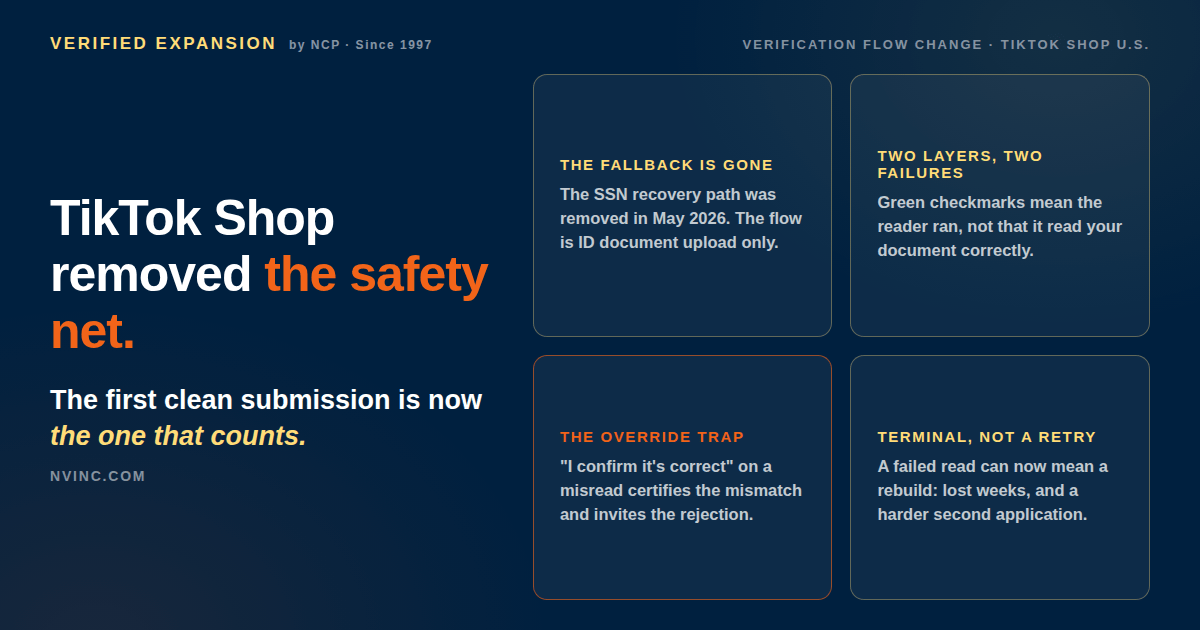
TikTok’s representative ID verification is not one check. It is two systems, and they fail in different ways.
Layer one reads the document. It extracts the name, date of birth, and ID number. When it works, you see green checkmarks. Here is the trap most people miss: green checkmarks mean the reader ran, not that it ran correctly. The checkmarks confirm that the system extracted something. They do not confirm that the extracted content matches your actual document.
Layer two runs at submission. It compares, scores, and decides. This is a separate system, and it is the one that throws the discrepancy warning.
So you can have a perfectly legitimate passport, get green checkmarks, and still be rejected, because the reader dropped a character (a missing letter in a name, a misread digit in a date of birth) and the second layer flagged the result as inconsistent at submission.
Two layers. Two failure modes. One confusing screen makes it look like your document was the problem, even though it was fine.
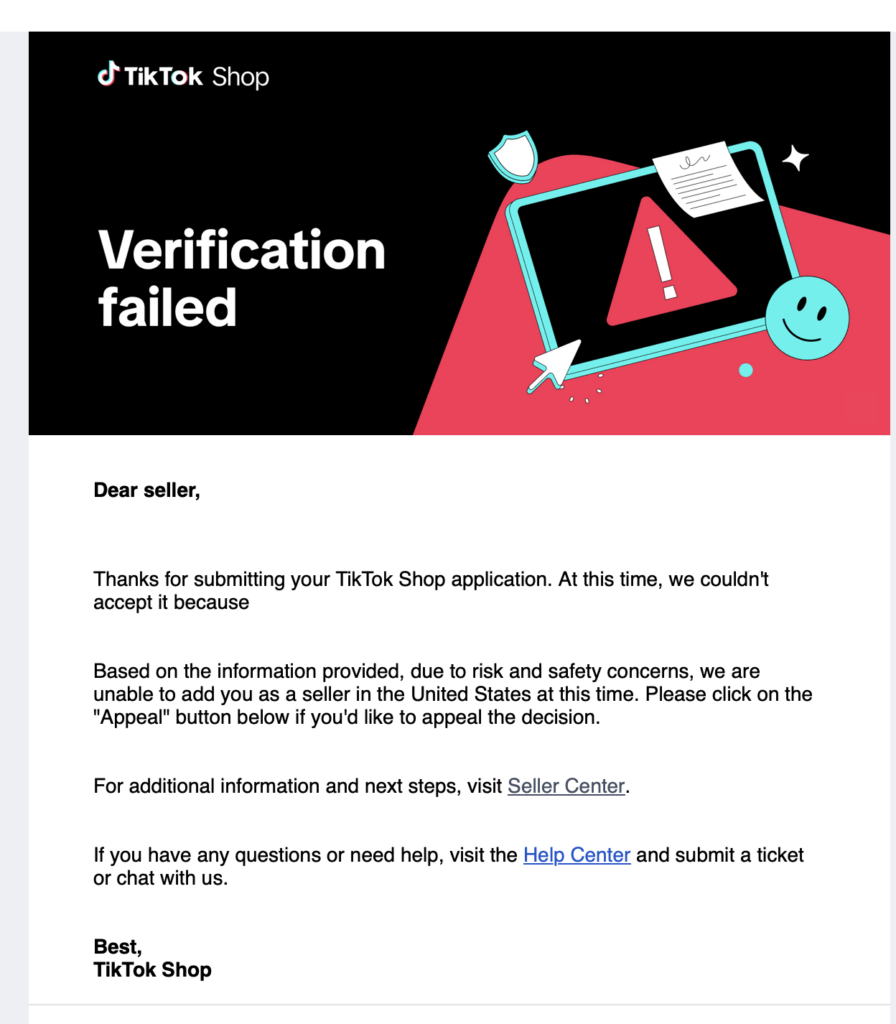
And the risk-and-safety rejection is its own category past both layers. In our case files, a representative has passed the document read and the facial verification and still ended at “due to risk and safety concerns, we are unable to add you as a seller.” That rejection is not about the documents at all. It is about how and where the account was built and accessed, scored separately from everything above. It is the trust layer, and it is Stage 4 of the five stages where U.S. accounts fail.
TikTok itself now instructs sellers not to submit angled ID documents. That is TikTok officially acknowledging the capture-quality problem this two-layer system creates. The instruction is real and useful. It is also nowhere near sufficient, because angled is only one of several ways a clean document gets misread by the reader, and the reader’s misread is what feeds the failure at layer two.
Why the Obvious Fixes Make It Worse
When sellers hit this, they reach for two instincts. Both backfire.
Instinct one: click “I confirm it’s correct” and proceed. When the reader has misread your information, that button does not tell TikTok your document is fine. It certifies that the mismatched information is correct. That pushes the application straight into the risk layer, which rejects it and forces an appeal. We have watched this happen in real cases. The rejection was immediate.
Instinct two: hand-correct the field and submit. When you fix the visible text on screen, you fix what a human sees. You do not fix what the engine extracted internally. The system keeps its own bad reading. The mismatch persists. Editing the field has never resolved this in the cases we have worked. Only a cleaner capture that the reader gets right on the first pass actually resolves it.
This is why sellers describe the process as broken. They are being asked to solve an invisible scoring problem with the only two tools the screen gives them, and both tools quietly increase risk.
What This Is NOT (And Why That Matters)
Honest diagnosis means ruling things out, not just naming fears. Two common theories are wrong, and we want you to stop spending energy on them.
Your passport address does not cause this. US passports have no address field. TikTok cannot query passport application data. The passport check and the address check are independent. The real address risk lives at the proof-of-address step, where your typed residential address must match your proof document exactly, never against the passport.
Your entity type selection is not the cause. A single-member LLC taxed as a C-Corporation correctly selects “Corporation” in the flow. TikTok matches the entity name, EIN, and address against the IRS letter, not your tax classification. The entity step is not where legitimate non-resident sellers are failing in 2026. The primary representative ID step is where issues pop up.
We say this plainly because most of the market is guessing at causes.
Guessing wastes the limited number of attempts you have to verify your TikTok Shop account.
The Real Stakes Are Different Now
A year ago, a document-read problem was an inconvenience. There was a recovery path. Now there is not.
When TikTok Shop’s verification fails terminally, you are not looking at a retry.
You are often looking at a rebuild: a new entity (in some rare cases), a new application, and the risk that a rushed second attempt creates linkage and trust problems the first attempt never had. The cost moved from an annoying delay to weeks of lost selling time, new formation cost, and a materially harder second application.
That is the part that should change how you approach the first attempt. You used to get room to iterate. You no longer do. The first clean submission is now the one that counts.
Who This Actually Applies To
This is a non-resident and foreign-document problem first. You should read everything above as directly relevant if any of the following describe you.
You are a foreign-owned brand expanding a real brand into TikTok Shop US.
Your representative has the correct U.S. passport, driver’s license, state ID, or now a permanent resident card, but there are still issues with verification.
You do not have a US SSN to fall back on.
Your name, or your representative’s name, contains characters or formatting that document readers commonly mishandle.
If that is you, the removed safety net was the very mechanism that protected you. It is gone.
What We Do Not Claim
We do not claim to know TikTok’s internal scoring logic. Anyone who tells you they have decoded TikTok’s risk model is selling you confidence, not accuracy.
Here is what we do know, and it is enough: what changed in the flow and when, what behavior reproducibly fails, which theories are dead ends, and how to prepare a representative identity submission so the reader gets it right on the one attempt that now counts. That is a preparation and sequencing discipline, not a trick, and it is exactly the work that used to be optional and is now decisive.
Need Help With a Failed Verification?
Diagnosis first. Resubmission second. Always in that order.
If you have already failed, we built three rescue levels for exactly this moment, and every one starts with the same thing: the specific reason TikTok turned you down, on your actual case, in writing.
- Verified Diagnostic — the written diagnosis: the failure layer, and your fix list in the correct order. You handle the correction and resubmission yourself.
- Verified Rescue — everything in the diagnosis, plus a documented review of your corrected package before it goes back to TikTok. We stay with you through one full resubmission or verification appeal cycle.
- Verified Rescue Complete — for complex cases: multi-entity structure, prior account history, or launches where a second failure is not an option. Two full cycles.
Have not submitted yet? Then you are reading this at exactly the right moment, because the whole point of the change above is that the first clean submission is now the one that counts. The Verified Path is our done-for-you engagement built on that premise: the Representative onboarding, the tax structure, the entity, the guided account build where the capture and sequencing discipline is applied for you, and the first 90 days after approval. And if a rescue reveals your case is actually a rebuild, every dollar you paid credits in full toward it.
If your situation involves entity restructuring, tax elections, or treaty questions beyond TikTok Shop, start with the CEO Blueprint before any execution package.
Not Sure What You Are Dealing With? Start With a Conversation.
If you just hit a rejection, or you have not yet submitted and want to make sure the first attempt is the right one, book a discovery call with our team. Tell us what stage you are at in your process. We will learn about your specific situation and let you know how we can help, from getting your U.S. Business Representative in place, to tax planning, to setting up the full structure that gets you not just verified but active through the critical first 90 days, along with the fees and timeframe involved. No strategy is provided on the discovery call. It is a focused diagnostic conversation.
Book a Discovery Call
Verification Failure Questions, Answered
Q: Why is my TikTok Shop verification failing in 2026 when my documents are real?
A: TikTok’s representative ID verification runs in two layers. A document reader extracts your information, and a separate risk layer compares and scores it at submission. The reader can misread a legitimate document, show green checkmarks anyway, and the risk layer can then reject the submission as inconsistent. The document being real does not prevent a misread.
Q: What changed in the TikTok Shop onboarding flow in May 2026?
A: Around early-to-mid May 2026, the fallback that let a representative enter their SSN when document reading struggled was removed. The flow is now ID document upload only. A document-read failure no longer has an in-flow recovery path.
Q: Can I enter my SSN if the TikTok Shop document reader fails to read my ID correctly?
A: No. The SSN recovery path that previously let a representative continue past a failed document read was removed around early-to-mid May 2026. The flow is now ID document upload only, and a misread ID has no in-flow recovery. The document must be captured cleanly enough that the reader gets it right on the first pass.
Q: Should I click ‘I confirm it’s correct’ if the reader misread my ID?
A: No. When the reader has misread your information, that button certifies that mismatched data is correct. It pushes the application into the risk layer, which commonly produces an immediate rejection and forces an appeal.
Q: Does my passport address cause the TikTok Shop verification mismatch?
A: No. US passports have no address field and TikTok cannot query passport application data. The passport check and the address check are independent. Address matching matters at the proof-of-address step, never against the passport.
Q: Which forms of ID does TikTok Shop accept for a U.S. Business Representative in 2026?
A: The accepted forms of ID are US Passport, US Passport Card, US Driver’s License, State ID, or Permanent Resident Card. The flow is document upload only. TikTok also explicitly instructs sellers not to submit angled ID documents, an acknowledgment of the capture-quality problem that drives many failed reads.
Q: What is the real cost of a failed TikTok Shop verification in 2026?
A: With the SSN recovery path removed, a document-read failure is now terminal inside the flow. The likely cost is no longer an annoying delay. It is a rebuild that includes a new entity, new formation cost, weeks of lost selling time, and a materially harder second application because the rejection is now part of your history. The first clean submission is now the one that counts.
This is educational content based on our experience working with TikTok Shop verification for U.S. and non-resident sellers since 2024. It is not legal or tax advice. Platform policies are subject to change. Always verify current requirements in TikTok Seller Center before resubmitting an application.