
Most sellers think TikTok Shop verification fails because they uploaded the wrong file.
That is not the real problem.
The real problem is that TikTok no longer reviews your shop as a simple application. It is reviewing it like a compliance file. And once the INFORM Consumers Act comes into effect, the platform is under federal pressure to collect, verify, refresh, and, in some cases, publicly disclose seller information on every product listing page.
Here are the numbers that should get your attention.
In January 2026, Senator Dick Durbin released enforcement data collected from 46 online marketplace companies. The findings: nearly 40,000 high-volume third-party seller accounts have been suspended across those marketplaces for INFORM Act violations. Only about half were later reinstated after coming into compliance.
That means roughly 20,000 sellers lost their accounts and never came back.
Separately, nearly 3 million non-high-volume seller accounts were suspended or removed across those same marketplaces for selling stolen, counterfeit, or unsafe goods. That is a broader marketplace enforcement number, not an INFORM-specific figure. But it tells you something important about the direction of platform compliance: marketplaces are suspending accounts at scale, and the INFORM Act is one of the primary legal tools that gives them the framework to do so.
Those numbers are marketplace-wide, not TikTok-specific. But that is exactly why they matter here.
TikTok’s own March 2026 INFORM policy (updated March 7, 2026, in TikTok Shop Seller Center) ties compliance directly to its Seller Enforcement Policy. That means the same federal law that triggered the first-ever FTC enforcement action (a $2 million penalty against Temu in September 2025) is now hardwired into the verification, re-verification, and enforcement workflow inside TikTok Shop Seller Center.
This is not a background rule. It is an operational compliance layer that determines whether your shop stays live, gets paid, and survives its next annual review.
Whether you are a U.S.-based brand opening your first TikTok Shop or a foreign-owned brand building a U.S. presence from scratch, the compliance machinery is the same. And the cost of getting it wrong is the same: payment delays, listing freezes, fund holds, and account deactivation.
That is why the smartest sellers start with the end in mind.
Not just “how do I get verified?” But “how do I build a file that survives annual re-verification, public address disclosure, video identity checks, and enforcement reviews for the life of the shop?” The initial submission is not the finish line. It is the first checkpoint in a compliance lifecycle that runs as long as the shop is active. The entity, EIN, address, representative, and documentation must be engineered for that lifecycle from day one, not patched after the first rejection or the first annual review notice.
I recorded a short video walking through how the INFORM Act affects TikTok Shop compliance, why your U.S. Business Representative matters, and what happens when the file cannot verify:
Watch: INFORM Act Impact on Your TikTok Shop Account
Scott Letourneau | Verified Expansion by NCP
What the INFORM Act Actually Does (And Why TikTok Cannot Ignore It)
The INFORM Consumers Act became law in June 2023. It requires online marketplaces to collect, verify, and keep current certain information about high-volume third-party sellers. For legal entities, the FTC says marketplaces must collect a working email, phone number, and either a government-issued ID for an individual acting on behalf of the seller, or a government-issued record or tax document showing the business name and physical address.
The law also requires annual certification that the seller’s information is still accurate, and mandates that the marketplace disclose seller contact information (including a physical address) on product detail pages for sellers with at least $20,000 in annual gross revenue.
The “high-volume seller” threshold is lower than you think
TikTok’s current INFORM policy defines an impacted seller as one who has completed 200 or more separate sales of new or unused products and earned at least $5,000 in gross revenue in any continuous 12-month period during the past 24 months.
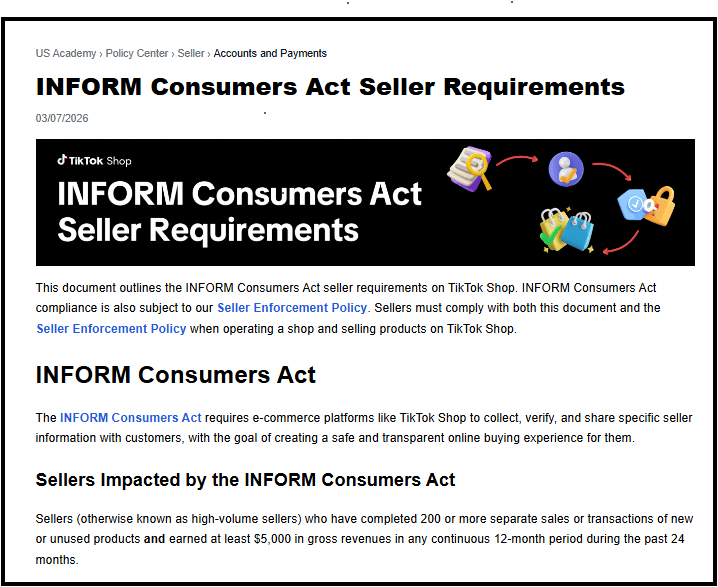
That is not a big seller. A brand doing 50 units per week at a $25 average order value hits the threshold in one month. A U.S. brand already selling on Amazon that adds TikTok as a second channel could cross it within weeks.
Once crossed, TikTok says the seller will receive annual system notifications to verify information in the Qualification Center. Failure to respond triggers payment delays, listing delays, or suspension until the information is confirmed and approved.
The penalty pressure lands on marketplaces, and marketplaces push it onto sellers
An important distinction: the FTC can pursue civil penalties of up to $53,088 per violation against the marketplace, not the individual seller. That is a marketplace compliance obligation, not a direct seller fine.
But when a marketplace faces $53,088 per violation for failing to verify, disclose, or suspend non-compliant sellers, its cheapest option is to enforce aggressively. Suspend first, ask questions later. That is exactly what the data shows: marketplaces are suspending tens of thousands of seller accounts rather than risk absorbing the penalty exposure themselves.
State attorneys general also have independent enforcement authority. The incentive to over-enforce rather than under-enforce is strong, and that pressure flows directly to every seller whose file is not clean.
TikTok blends everything into one verification stack
TikTok uses one integrated verification workflow for onboarding, identity verification, tax collection, fraud prevention, and INFORM compliance. A new seller who has not yet crossed the 200-sale/$5,000 threshold can still feel the effects of INFORM-style enforcement because TikTok is running all of these checks through the same pipeline.
TikTok’s registration guide says that if the submitted information cannot be verified, the platform may request proof of address, proof of business, proof of ID, or a Letter of Authorization. The compliance pressure starts before you make your first sale.
Amazon Already Showed What INFORM Enforcement Looks Like
If you want to know what happens when a marketplace flips the INFORM switch, look at Amazon in the summer of 2023.
The INFORM Act took effect on June 27, 2023. Amazon began contacting sellers months in advance, but the real wave hit in late May when thousands of third-party sellers saw: “Your account is at risk of deactivation.”
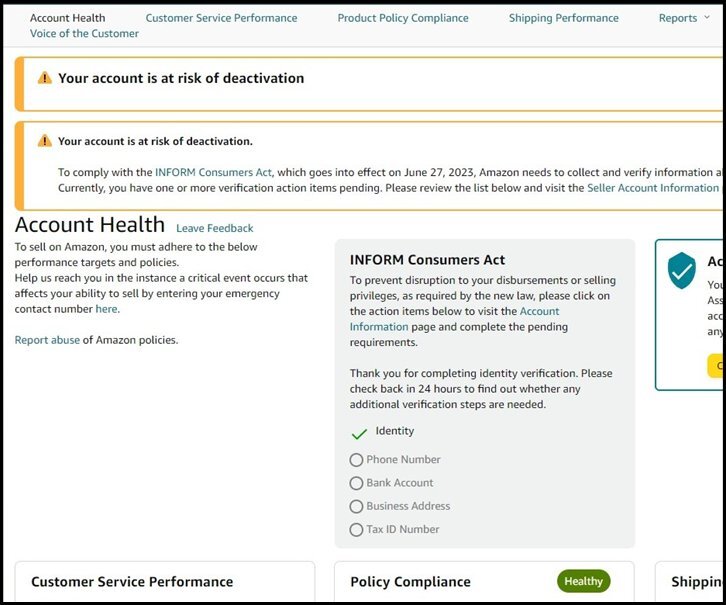 The INFORM Act also requires Amazon to display verified business information (business name or individual name) on the public Seller Profile Page. This aligns with data from the Amazon tax interview. Compliance became public-facing.
The pattern has repeated every year since. The sellers who sailed through were the ones whose files were already clean. The ones who scrambled were the ones with mismatches, outdated records, or missing documents.
TikTok’s first major re-verification wave has not hit yet. But TikTok’s Seller Enforcement Policy gives the platform the same authority to suspend, restrict, and deactivate. The lesson from Amazon is simple: build the file before the wave, not during it.
We covered Amazon’s INFORM rollout in detail here: Amazon’s Reverification Under the INFORM Consumer Act.
Why Your U.S. Business Representative Is Now a Central Compliance Role
This is where many sellers break, and where the difference between DIY and expert guidance shows up fastest.
TikTok distinguishes between two roles that many sellers treat as one:
Ultimate Beneficial Owner (UBO): A person who directly or indirectly owns at least 25% of the equity interest in the company. Non-U.S. passports can be used for UBO verification.
U.S. Business Representative: Someone based in the United States who is authorized to conduct business on behalf of the company. Can be anyone from the CEO to an entry-level marketing employee.
These are not the same role. A foreign owner can be the UBO. But the shop still needs a U.S.-based representative tied to account operations and verification. For U.S. brands, the representative is typically the owner or officer, but that person’s information still has to align perfectly with every other piece of the file.
What TikTok collects about the representative
For corporation or partnership registration, TikTok collects: legal name, date of birth, physical residential address, and last four digits of SSN or ITIN. The primary business address must be in the United States. Every business owner and representative must be at least 18 with an accepted U.S. identity document.
That is five data points that must match across Seller Center, the IRS record, the state formation filing, and the bank account. One inconsistency creates a crack. TikTok’s verification system is designed to find cracks.
The video re-verification trap
TikTok’s identity re-verification guide says the business representative (the person whose information was used at registration) must appear in any verification video. If your representative is a name on a form rather than a real, available person who understands their role, you are walking into a failure that cannot be fixed by uploading a better document. This applies to U.S. brands too: if the listed representative has left the company or is unprepared, the shop is exposed.
What proper representative onboarding requires
Getting this right requires four things in sequence:
First, identify the representative before the entity is formed. Their address, SSN or ITIN, and identity documents must be confirmed before the EIN is filed, because the SS-4 address and Seller Center must align.
Second, give the representative formal authorization: an Operating Agreement (LLC) or corporate resolution (C-Corp) naming them in a role with authority to act.
Third, ensure the representative understands what TikTok may ask: annual re-verification, video verification, and timely response to compliance notices.
Fourth, confirm their contact information (phone, email) is active and monitored. The federal 10-day compliance clock starts when TikTok sends the notice, not when someone reads it.
That is four layers of coordination before the shop is submitted. When sellers handle this alone, they typically get two or three right and miss the one that triggers a failure six months later during re-verification.
The W-9 Trap and the Document Gap
One of the most expensive misunderstandings: a seller uploads a W-9, sees a green checkmark in Seller Center, and assumes they are INFORM-compliant.
They are not. TikTok’s current INFORM policy specifically says W-9 forms are not accepted for INFORM compliance. Neither are IRS website screenshots, SS-4 applications, tax returns, or e-file confirmations.
What TikTok does accept: a photo ID of the authorized representative, an IRS-issued tax document (CP 575, 147C, or 252C) showing business name, EIN, and address, or a qualifying state or local business registration document.
The operational problem is that the document most sellers need (the CP 575 EIN confirmation) is mailed by the IRS to the address on the SS-4 application. If that address was wrong, or the mail was lost, the seller has an EIN but no acceptable INFORM document. The backup (a 147C letter) requires calling the IRS on the 267-941-1099 line, which averages 60-90 minutes of hold time. That gap can last 30 to 60 days.
This is why the EIN application must be engineered for INFORM compliance from the start.
What Happens When TikTok Cannot Verify Your Shop
For new shops, TikTok may request additional proof of address, proof of business, proof of ID, or a Letter of Authorization. The application is not automatically dead, but TikTok does not publish a hard rule for how many retries you get. Each failed resubmission with inconsistent information compounds the credibility problem.
For live shops and annual re-verification, the consequences escalate fast. TikTok’s INFORM policy says your shop is at risk of payment delays, listing delays, and suspension. The Seller Enforcement Policy goes further: fund withdrawal restrictions (45, 90, or 365 days), account deactivation, and in cases of fraud, permanent fund withholding.
The connected accounts rule
TikTok considers accounts connected if they share contact information, phone, email, or bank account. If one account is suspended, TikTok reserves the right to take enforcement actions against connected accounts. One failed shop can take down every shop linked to the same representative, bank account, or contact details.
The disclosure rule
For sellers above $20,000 in annual revenue, TikTok must disclose your contact information, including a physical address, on every Product Detail Page. The address tied to your shop is not just an internal field. It becomes customer-facing. If it looks like a UPS Store suite number, that affects brand trust. If it does not match your IRS record, that creates re-verification friction. Address strategy must be planned from day one.
The federal 10-day rule
Once TikTok sends a compliance notice, the seller has 10 days to respond before the marketplace must suspend future sales activity. That clock starts when TikTok sends it, not when the seller reads it. If the notice goes to an email nobody monitors, or a representative who is unreachable, the clock runs anyway.
The Compliance Lifecycle: Why This Gets Harder, Not Easier
Opening a TikTok Shop does not create one compliance obligation. It creates a cascade. The entity must be formed correctly. The EIN must be filed with the right address. The representative must be onboarded. The IRS must issue the right documents. The bank account must align. Seller Center registration must match everything. INFORM documentation must be a specific type. The address must support public disclosure. The representative must be available for annual re-verification.
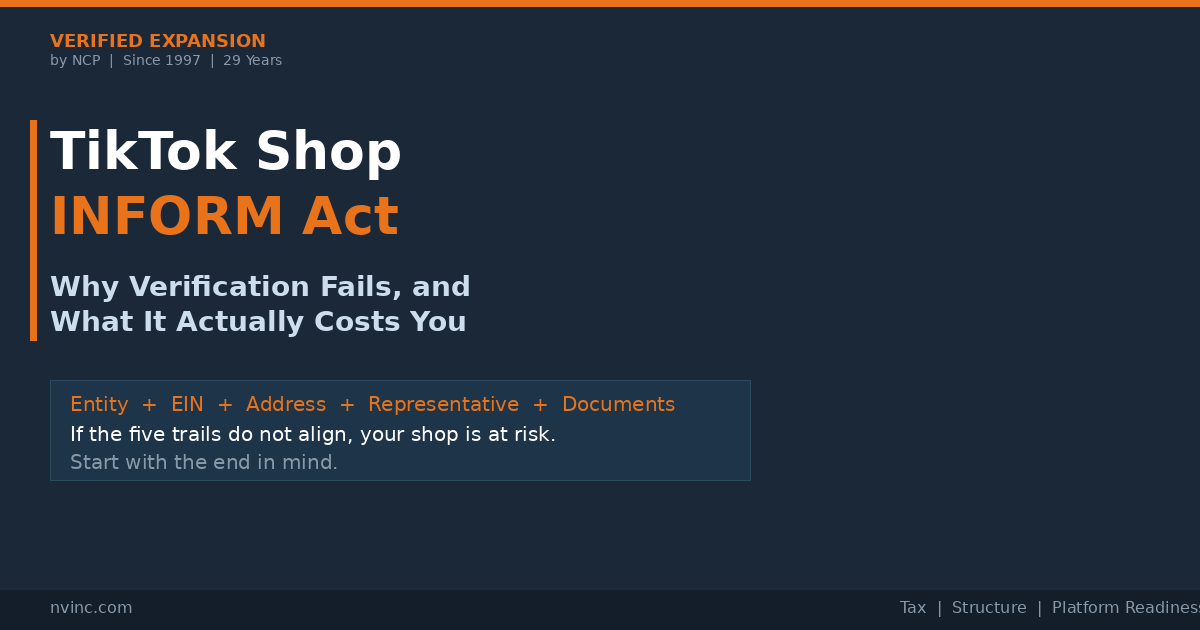 A shop that passes initial verification but racks up policy violations in the first 90 days can still lose selling privileges. A shop that sails through year one but misses the annual INFORM re-verification notice gets suspended.
Enforcement is accelerating. The FTC explicitly says marketplaces can go beyond the INFORM statute (the Act is a floor, not a ceiling). TikTok’s 2026 fulfillment changes add parallel compliance pressure. The complexity is compounding.
That is why “start with the end in mind” is not a slogan. It is the architecture.
The Sellers Most at Risk
The highest-risk sellers are the ones who look “almost compliant.”
Foreign-owned U.S. entities with a weak U.S. Business Representative. The representative was a convenience hire, not a strategic decision. Their information does not align. They are unreachable during re-verification.
U.S. brands that expanded to TikTok without checking INFORM requirements. They assumed TikTok was similar to Amazon or Shopify. Their documents, address, or representative setup does not meet TikTok’s specific standards.
Sellers who used a W-9 as their INFORM document. The tax profile looks complete. The INFORM file is empty.
Shops where the entity, EIN, address, and representative records do not match. Every mismatch is a friction point during verification.
Sellers who failed once and are patching instead of rebuilding. Each failed attempt may reduce the runway for recovery.
These sellers feel close. Close is what gets people rejected twice.
The Five Trails: What Must Align Before You Submit
Before another upload, another rejection, or another “we already sent them that” email, pressure-test five alignment trails. These apply whether you are a U.S. brand or a foreign-owned entity.
Trail 1: The Entity Trail
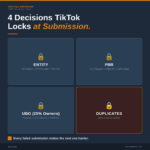
Does the legal business name match exactly across TikTok Seller Center, IRS records, state formation records, and bank account records? Selecting “Corporation” when your entity is a disregarded LLC creates an irreversible mismatch.
Trail 2: The EIN Trail
Do you have an IRS-issued document TikTok actually accepts? Not a W-9. Not an SS-4. An actual CP 575, 147C, or 252C showing business name, EIN, and business address.
Trail 3: The Address Trail
Does the registered business address match across TikTok, IRS, and state records? Can it support public disclosure once you cross $20,000 in revenue?
Trail 4: The Representative Trail
Is the U.S. Business Representative authorized, document-ready, and available for video verification? Will they respond within 10 days to a re-verification notice? Do they have a Letter of Authorization?
Trail 5: The Ownership Trail
Does UBO information fit the entity structure without creating contradictions? For foreign owners: is the passport, ownership percentage, and formation record consistent?
If those five trails do not align, you do not have a shop file. You have a rejection file.
Get the File Right Before TikTok Reviews It for You
If your TikTok Shop involves a U.S. company, a foreign owner, a U.S. Business Representative, a failed verification attempt, or an upcoming annual re-verification, do not guess your way through another submission.
NCP and Verified Expansion work with U.S. and non-resident ecommerce brands to build a verification file that is aligned for submission, re-verification, and platform scrutiny.
We do not build shops for the first 90 days. We build shops that stay clean at year two.
Get Your TikTok Shop File Reviewed Before You Submit
Or visit our TikTok Shop Verification Services page to see the full scope of what we do for sellers at every stage.
This post is educational and does not constitute legal or tax advice. Consult a licensed attorney or tax professional for guidance specific to your situation.
Think your shop is “probably fine”?
That is exactly how sellers end up with payment delays, listing restrictions, suspended sales activity, and locked funds. Across online marketplaces, nearly 40,000 high-volume seller accounts were suspended for INFORM violations. About half never came back. TikTok is subject to the same federal law.
Book a Discovery Call with Verified Expansion
Not ready for a call? Start here.
Get the free guide: “The 5-Trail Verification Checklist for TikTok Shop Sellers.”
Get the Free TikTok Shop Blueprint
Related Reading
Frequently Asked Questions
What is the INFORM Consumers Act, and how does it affect TikTok Shop, sellers?
The INFORM Consumers Act is a federal law that requires online marketplaces like TikTok Shop to collect, verify, and disclose certain information about high-volume third-party sellers. On TikTok Shop, sellers who have completed 200 or more sales and earned at least $5,000 in gross revenue in any continuous 12-month period must verify information annually through the Qualification Center. Non-compliance can result in payment delays, listing restrictions, or shop suspension.
Does TikTok Shop accept a W-9 for INFORM compliance?
No. TikTok’s current INFORM policy explicitly states that W-9 forms are not accepted. Acceptable documents include a photo ID of the authorized representative, an IRS-issued tax document (CP 575, 147C, or 252C), or a qualifying state or local business registration document.
What is the difference between a UBO and a U.S. Business Representative on TikTok Shop?
TikTok defines a UBO as a person who owns at least 25% of a company’s equity. A U.S. Business Representative is a separate role: someone based in the U.S. authorized to conduct business on behalf of the company. A foreign owner can be the UBO, but the shop also needs a U.S.-based representative for account operations and verification.
What happens if TikTok Shop cannot verify my INFORM compliance documents?
For new shops, TikTok may request additional proof. For existing shops: payment delays, listing delays, fund withdrawal restrictions (up to 365 days), and shop suspension or deactivation. Connected accounts may also face enforcement actions.
How often does TikTok Shop require INFORM re-verification?
At least once a year through the Qualification Center. Failure to update on time may result in payment delays, listing delays, or suspension.
Can my connected TikTok Shop accounts be affected if one shop fails INFORM verification?
Yes. TikTok considers accounts connected if they share contact information, phone, email, or bank account. If one is suspended, connected accounts may face enforcement actions.