

Updated October 2026 for Amazon’s November 2, 2026 rule change.
Amazon’s commercial liability insurance rule changes on November 2, 2026. For products in Amazon’s enhanced-safety categories, the $10,000 monthly sales threshold no longer applies. If you list children’s products, supplements, cosmetics, lithium battery products, small kitchen appliances, mattresses, tires, helmets, or anything else on that list, you need $1 million per occurrence and $1 million aggregate in coverage from the first listing. Whether the ASIN sold $80 last month or $80,000, the rule is the same. It applies to listings already live.
If you run a foreign-based brand selling one of those products, you have probably already made the first call, and it probably went nowhere. That is normal. The policy itself is the small problem. The bigger one is which company the policy can cover. If your home market says no, a U.S. policy means a U.S. company running your Amazon account. That is a tax decision in two countries, and the order you make it in decides what it costs.
This post is here to give you one thing before November 2: certainty about which route is yours, so the next move is the right one.
What Changed in Amazon’s Insurance Requirements
Amazon’s existing rule stays in place. Once gross proceeds from Amazon.com pass $10,000 in a month, you have 30 days to carry commercial liability insurance with $1 million per occurrence and aggregate, products and completed operations included, naming Amazon.com Services LLC and its affiliates and assignees as additional insured.
As of November 2, two things are new.
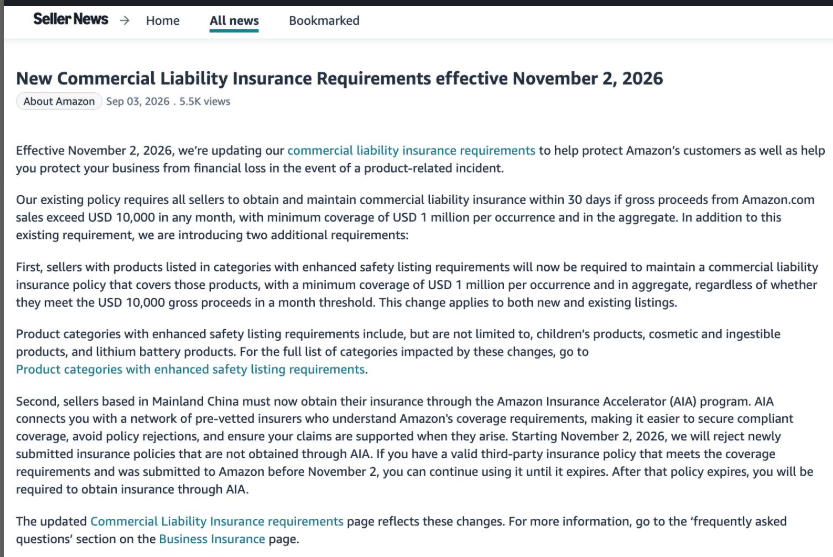
Amazon’s announcement, Seller Central, September 3, 2026. Two changes: the threshold ends for enhanced-safety categories, and Mainland China sellers must use the Insurance Accelerator.
The threshold is gone for enhanced-safety categories. A listing in one of those categories needs the full policy regardless of volume, new or existing. Sellers who need new or updated coverage receive an email. Seller notices give 45 days to provide proof, and Amazon says affected listings may be deactivated until acceptable proof is on file.
Sellers based in Mainland China must buy through the Amazon Insurance Accelerator. Newly submitted policies from Mainland China sellers that did not come through the Accelerator will be rejected. A valid policy submitted before November 2 stands until it expires.
Keep the two rules separate. The China rule is about where you buy the policy. The category rule is about whether you need one at all, and it applies to a UK supplement brand or an Australian children’s brand exactly the way it applies to a seller in Shenzhen. Sellers outside Mainland China keep their choice of insurer.
The Enhanced-Safety Categories Amazon Has Named
If any of your ASINs sit in these groups, the revenue threshold no longer protects you.
What to watch
Amazon says the list will keep expanding and does not claim it covers every product with enhanced-safety requirements. The list above is a summary. Account Health shows the ruling on your specific ASINs, and that ruling is the one that counts.
November 2 Starts the Clock. Your Notice Sets the Deadline.
Most coverage of this rule stops at November 2. That date starts the requirement. It is not your deadline.
Seller notices give 45 days to provide proof. A notice that lands in early November runs out in mid-December, during the highest-revenue weeks of the year. Find your notice in Seller Central, count 45 days, and write the date down.
Then count backward. If your home insurer will cover the company on your account, a policy can be in place in days. If it will not, the U.S. route takes about seven weeks to set up, and Amazon’s own review can add weeks after that.
Know your date before you choose your route.
Prefer to watch? The short version, including the order that keeps the switch from costing more than the policy.
Start With Your Home Market
The first call is to the insurer who already covers your business at home. Many will decline U.S. product liability on these categories. Ask anyway, and get the answer in writing. Then ask a specialist broker in your own country. Some place U.S. product liability for foreign-based brands selling on Amazon, including through the Lloyd’s market in London.
Why the Reason You Need It Is the Reason You Get Declined
Amazon put your product in an enhanced-safety category because the product carries real risk. Lithium can catch fire. Supplements get swallowed. Children’s products get used by children. That risk is why Amazon now requires $1 million in coverage from the first sale. It is also the exact risk a standard carrier is paid to avoid. The same fact drives both decisions. In our experience, that is why so many first applications come back declined, and it catches U.S. brands in these categories too, not only foreign ones.
A decline tells you which insurance market handled your application. Standard carriers have conservative appetites and routine exclusions for these products. A specialist market exists for the risks standard carriers will not write, and a broker licensed for it can reach it. The decline describes the market that handled you. It is no verdict on your business.
One trap on the way to a cheaper quote. Amazon’s review checks the paperwork: the insured name matches the account, the limits, the additional insured, the dates. It does not read your exclusions. The underwriter does, on the day of a claim. A policy bought on a vague product description to bring the premium down may pass Amazon and still exclude a battery, a supplement, or a children’s product. We have tested this ourselves. The gap shows up at the moment it costs the most. Describe what you actually sell, and expect the honest quote to be higher than the vague one.
Home comes first for one reason: a policy on the company already on your Amazon account changes nothing structural. No new entity, no new tax interview, no account transition.
Then look at the whole number. In 2021 the quotes we saw for supplements, children’s items, cosmetics, and sporting goods ran $1,000 to $10,000 a year, with about $3,500 typical. Specialist pricing today can sit at the top of that range or above it. That sounds expensive until you compare it with forming a U.S. company, insuring it, moving the Amazon legal entity, going through verification again, changing banking, moving inventory, retaking the tax interview, and adding U.S. tax filings every year. The expensive home policy is often the cheap option.
One more number. If the affected ASIN does $2,000 a month and the only available policy runs $4,000 a year, the honest answer may be to pull the listing. A U.S. company only makes sense for a brand with enough revenue in the category to carry one.
And check what you already hold. Amazon cannot tell the difference between a policy rated for an online retailer and one rated for an importer or manufacturer. The carrier can, and it matters at claim time. A private-label brand importing its own product carries the product exposure itself.
A U.S. Policy Means a U.S. Company Running Your Account. That Is a Tax Decision.
An insurance policy covers the company that sells the product. A U.S. policy covers a U.S. company. In our experience, U.S. carriers will not write a foreign company as the named insured on these products.
For a U.S. policy to pay a claim, the U.S. company has to be the business. It has to be the legal entity on your Amazon account, the seller of record, the owner of the inventory, and the company Amazon pays. A U.S. company that appears only on the certificate while your foreign company sells every unit gives you a document, not coverage.
Here is where most sellers go wrong. They hear “U.S. company” and order one online. Forming the company is the easy part. The moment it becomes the seller on your account, the profit from your U.S. sales lands in a new U.S. taxpayer. Which country taxes that profit, at what rate, and whether your home country taxes it again depends on how the two companies are set up before the switch. A brand doing $5 million or $10 million a year in the U.S. can see its overall profitability change by a real amount, up or down, on decisions made in the first week. From a treaty country, there is a workable answer. From a non-treaty country, every dollar that comes home carries a cost that planning can shape and a rushed switch cannot.
None of this is work for the week before your 45-day window closes. It is the reason to find your route now.
That one change moves far more than the policy.
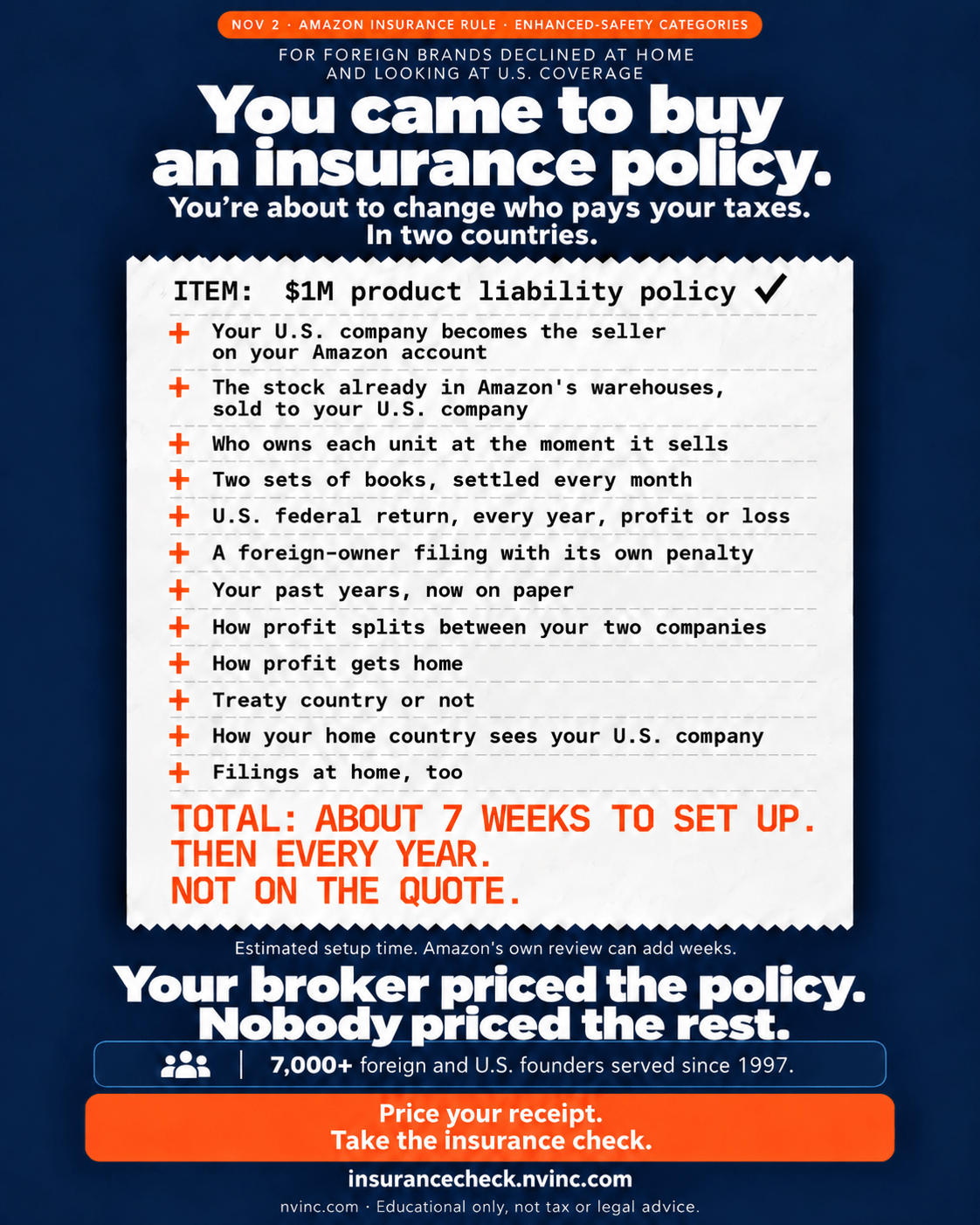
The Switch Is a Tax Decision
Moving your Amazon account to a U.S. company changes who files where and who pays what, in the U.S. and at home. Same sales, same 21% U.S. corporate rate, and two very different tax bills depending on the order.
Switch first, plan later. The tax interview changes. Amazon pays the U.S. company while your foreign company still owns the stock. Profit can land in the U.S. with no reason to be there. Your home country may tax the U.S. company too. And your past years in the U.S. are now on paper.
Plan first, then switch. Every tax decision made before anything is on paper. Your home country’s answer in writing before you move. One switch, on a date you chose.
The facts that decide which bill you get: whether your country has a tax treaty with the U.S., how your home country treats a U.S. company you own, where your U.S. company is actually managed, how profit splits between your two companies, and how profit gets home. None of these appear on an insurance quote.
Do not let an insurance requirement choose your U.S. tax structure by accident.
For our clients, the broker for the U.S. company’s policy is Well Insurance. Matt Lovell has placed Amazon product liability since the 2021 rollout and knows what Amazon’s reviewers accept. A U.S.-based brand declined by a standard carrier can go to him directly. A foreign-based brand that needs the U.S. company first comes to us for the structure, then to Matt for the policy on it. Structure first, policy second. In that order, the certificate matches a company that actually runs the business, and the tax position was chosen rather than inherited.
If a U.S. Company Already Holds Your Amazon Account
Nothing structural changes for you. Your job is a policy on that company that covers the products you actually sell, in the categories Amazon names, with the insured name matching the account. If a standard carrier declined you, the specialist market is the next call, and the premium will reflect the product. The rest of this post is for foreign-based brands whose company is the one on the account.
How Long the U.S. Route Takes
Done in the right order, the setup takes about seven weeks:
- Tax planning on your facts: about one week
- Forming the U.S. company: one to two business days
- The U.S. tax ID for a foreign-owned company: about four weeks
- U.S. banking: about one week
- Binding the policy: a few days
- Updating the Amazon account and uploading the certificate: a few days
The four-week wait is not idle time. The decisions between your two companies get made inside it, before the account moves.
After that, Amazon reviews the new taxpayer and the new legal entity on the account. That part belongs to Amazon, and it can add weeks. Started in mid-October, the setup alone runs to about the end of November. If your notice lands in early November, there is no slack left for a wrong first move.
Will Amazon Actually Deactivate Listings?
Amazon has said what happens: affected listings may be deactivated until compliant proof is accepted. What nobody knows yet is how consistently Amazon will apply it. In 2021 the notices went out, many sellers ignored them, and most accounts kept running.
The difference this time is structural. The rule attaches to specific ASINs rather than to a seller’s monthly total, which is far easier to enforce at the listing level than the old rule was at the account level. Enhanced-safety ASINs already sit behind a gate that deactivates them for missing documents. Adding proof of insurance to that gate costs Amazon very little. Whether Amazon uses it aggressively is something to watch. It is not a reason to gamble the fourth quarter.
Find Out Which Route Is Yours
Three questions decide it. Are your ASINs on the list? Will your home market cover the company on your account? If not, what does moving to a U.S. company change for your taxes in both countries?
You could research all three yourself, and most of what you would find is accurate for the average seller. The problem is that nothing about a foreign-based brand with stock in Amazon’s warehouses is average. What you need is the answer that applies to your facts, in the order it has to happen. You do not need to be certain of everything before you move. You need to be sure enough to take one correct first step.
The insurance check answers the first two questions and tells you which route you are likely on, and why.
When the answer points to a U.S. company, the next step is a written plan before anything changes in Seller Central.
CEO Decision Review, $1,250. One written answer on your facts: keep your company and buy the home policy, or move the Amazon business to a U.S. company, and if so, in what order and at what tax cost.
Amazon Insurance Verified, $1,997. We build the U.S. side so the policy covers the business that actually sells: the U.S. company, its tax position, and the Amazon account changes that make the certificate valid. We work with tax attorneys and CPAs on every step that needs one.
Expansion Blueprint, $2,500. For brands with open U.S. years, several sales channels, or home-country questions that all need answers at once.
Not sure where you fit? Book a discovery call with our team. We learn your situation and tell you whether and how we can help, and the fees. Strategy happens inside the paid review, not on the call.
Frequently Asked Questions About Amazon’s 2026 Insurance Requirements
Q: Do I need Amazon insurance if I sell less than $10,000 a month?
A: Beginning November 2, 2026, the $10,000 monthly threshold no longer applies to products in Amazon’s enhanced-safety categories. Those sellers need at least $1 million per occurrence and aggregate coverage regardless of sales volume. If none of your products are in a listed category, the $10,000 threshold still governs.
Q: Does the new rule apply to products I already sell?
A: Yes. Amazon’s announcement states the requirement applies to both new and existing listings.
Q: When is my actual deadline?
A: November 2 starts the requirement. Seller notices give 45 days from the notice to provide proof. Check the date of your own notice in Seller Central.
Q: Do all foreign-based brands have to use the Amazon Insurance Accelerator?
A: No. The mandatory Accelerator rule applies only to sellers based in Mainland China. The Accelerator is built for U.S.-based sellers, so most foreign-based brands outside China will not find it a route either.
Q: My home insurer declined me. Do I need a U.S. company?
A: Not yet. Ask a specialist broker in your home country first. If no one at home will write the company on your account, a U.S. policy requires a U.S. company that actually runs the Amazon business. Plan the tax side before you form it.
Q: Can I form a U.S. LLC just to hold the policy?
A: You can get a certificate that way. You will not get coverage. The policy covers the company that sells the product, and if your foreign company still sells every unit, the claim falls outside the policy.
Q: Can I use a single-member LLC that is disregarded for tax and avoid any tax impact?
A: No. A disregarded LLC has no tax identity of its own. The IRS looks through it to the owner, and the owner is still your foreign company. Amazon’s tax interview sees the same thing, so the account is still held by a foreign taxpayer with a U.S. company’s name on it. The underwriter sees it too. On top of that, a foreign-owned disregarded LLC carries its own annual U.S. filing with its own penalty. The classification of the U.S. company is the decision that makes the switch work or fail, and it has to be made before the account changes, with the tax cost in both countries in front of you.
Q: My certificate was rejected. Now what?
A: Find out which check it failed. If the insured name does not match the legal entity on your account, the fix is on the account or the structure, and no new policy solves it. If the policy itself fell short on limits, dates, or the additional insured, a broker who works with Amazon sellers can correct it. If a standard carrier declined you outright, the specialist market is the next call.
Q: What happens if I do not provide proof of insurance?
A: Amazon has said listings in enhanced-safety categories may be deactivated until compliant proof is accepted. This is a listing-level action, not an account-level one. How quickly listings return after proof is uploaded is not yet known.
Q: Should I wait until Amazon sends me a notice?
A: For an established foreign-based brand selling an affected product, no. Find out now whether your home market will cover the company on your account. If a U.S. company may be necessary, the setup takes weeks, and November and December are poor months to start.
How We Got Here: Five Years of Amazon Insurance Changes
September 2021. Amazon begins requiring $1 million liability coverage once a seller passes $10,000 in monthly gross proceeds. Foreign-based brands receive 30-day notices. Many form U.S. LLCs to obtain a certificate.
March 2022. Sellers who received notices in September and October are past 90 days with accounts still active. Enforcement proves inconsistent.
June to August 2022. Amazon briefly requires zero-deductible policies for sellers under $1 million in sales, then reverses after seller pushback. Deductibles up to $10,000 are allowed again.
February 2024. Foreign-based brands holding policies from overseas branches of U.S. carriers see those policies cancelled and reported to Amazon.
August 2024. Amazon sends mass certificate requests for non-U.S. marketplaces including Canada, the UK, and the EU.
September 2026. Amazon announces the November 2 change: the $10,000 threshold ends for enhanced-safety categories, and Mainland China sellers must buy through the Insurance Accelerator.
This is educational content based on our experience working with foreign-based Amazon brands through every version of Amazon’s insurance requirement since 2021. It is not legal, tax, or insurance advice. Scott Letourneau holds the MSCTA® (MainStreet Certified Tax Advisor) credential, and we work with independent tax attorneys and CPAs for legal and tax execution. Amazon policies and insurance underwriting change, and availability depends on the seller, product, location, and carrier. Amazon makes all seller approval, restriction, and enforcement decisions. Confirm current requirements in Seller Central before acting.