
Updated March 2026: This post has been rebuilt to focus specifically on new account onboarding verification on both platforms. Content about existing-account suspensions, TOS violations, and post-verification enforcement has been removed to avoid mixing two different processes. All platform claims are grounded in Amazon’s published Seller Registration Guide and TikTok Shop’s Seller Center documentation.
It started with a phone call from an Amazon seller doing seven figures a year.
He had been selling on Amazon for years. Built a real brand. Passed every verification Amazon ever threw at him.
Then he tried to set up a TikTok Shop.
Within 48 hours, his application was rejected. He resubmitted with what he thought were corrected documents. Rejected again. By the time he reached us, his resubmission attempts were exhausted and his window to launch on TikTok Shop before Q4 had closed.
His exact words: “I’ve been selling on Amazon since 2019. I’ve never had a verification problem I couldn’t fix. What happened?”
What happened is the same thing happening to hundreds of Amazon sellers right now. They assumed TikTok Shop’s new account verification works like Amazon’s. It does not. But not for the reasons most people think.
A note on terminology before we go further. TikTok uses three different terms for three different situations, and this post is only about the first one. “Resubmission” is for new account onboarding rejections where the seller has not been verified yet. TikTok does not call this an appeal. “Seller Policy Violation Appeal” is for active, verified shops that receive a violation through Shop Health. “Re-verification” is for active shops pulled into an identity re-check under the INFORM Act or a risk flag. This post is about onboarding. We use “resubmission” throughout.
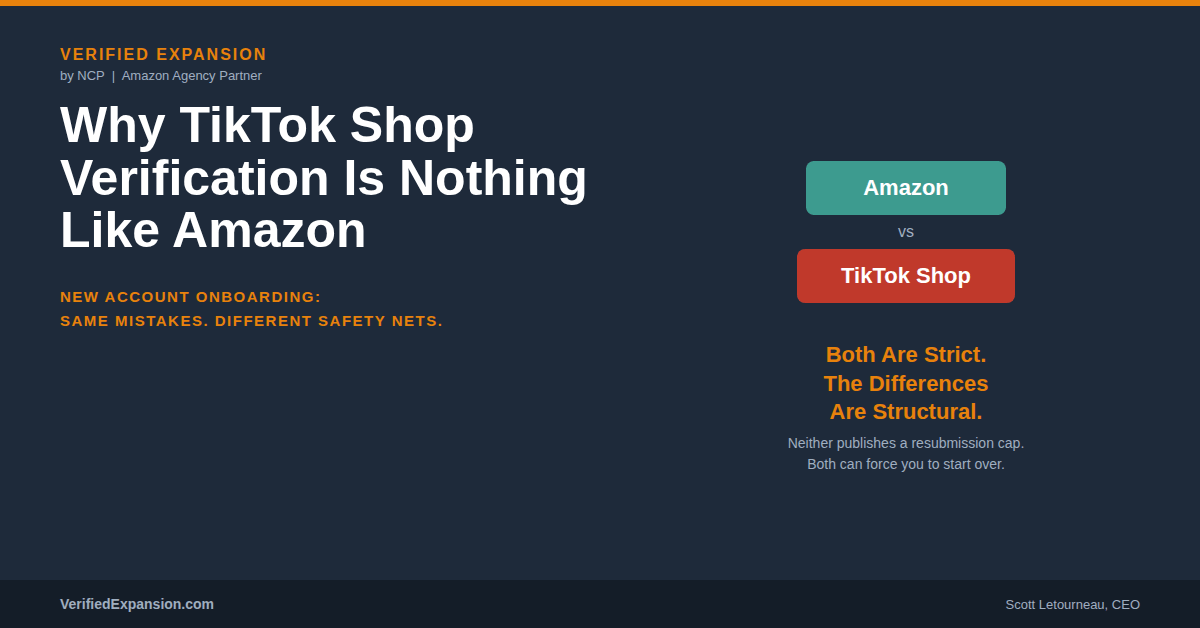
Both Platforms Are Strict. The Differences Are Structural.
If you have been selling on Amazon, the platform may have conditioned you to believe that verification problems are always fixable with enough persistence. That mental model is dangerous on TikTok Shop. But it is also not entirely accurate about Amazon.
Amazon’s own Seller Registration Guide states that “each step in the registration process is irreversible and it will no longer be possible to return to the previous step to modify the information.” Amazon’s Seller Identity Verification (SIV) process will hard-fail after too many resubmissions with invalid documents. When that happens, you are locked out and must restart registration with a new email address. Amazon’s postcard address verification (OTP) gives you exactly three attempts to enter the correct code. Miss all three, and you must restart with a new email.
Amazon is not forgiving during new account onboarding. Neither is TikTok Shop. The difference is not that one platform is lenient and the other is harsh. The difference is in the infrastructure each platform gives you between your first submission and a dead end.
 What Each Platform’s New Account Process Actually Looks Like
Amazon’s new account onboarding follows a structured, multi-step sequence: account registration (business type, address, billing), Seller Identity Verification (SIV) with document uploads, In-Person Verification (IPV) via a scheduled video call with an Amazon associate, postcard address verification (OTP), and potentially a Seller Performance Review (SPR) if changes are made after registration. At each stage, Amazon provides specific document requirements, format guidelines, and reasons for rejection through Performance Notifications. Seller Support is available during the process, and Amazon offers a gated escalation form after two valid attempts have been submitted.
TikTok Shop’s new account onboarding is a document submission and review process. You submit your entity documents, tax documents, and identity documents. TikTok reviews them against its verification criteria. If something cannot be verified, TikTok may request additional proof of address, proof of business, proof of identity, or a Letter of Authorization (LOA). TikTok has help tickets and customer support, but standard onboarding does not include a video verification step, a dedicated case manager, or a published escalation form.
Where the Two Processes Diverge
Here is what actually differs between the two platforms during new account verification, based on each platform’s own published documentation and confirmed practitioner experience.
Recovery infrastructure. Amazon provides Seller Support, Performance Notifications that explain what needs to be fixed, a video verification call (IPV) as part of the standard flow, and a gated escalation path after two valid attempts. TikTok has help tickets and customer support that can answer questions during temporary restrictions, but onboarding offers fewer structured manual-recovery touchpoints than Amazon.
Resubmission limits. Neither platform publishes an exact cap on resubmission attempts. Both platforms will lock you out after repeated failed submissions with invalid documents. On Amazon, SIV failure forces you to restart with a new email. On TikTok, sellers report that exhausted resubmissions result in a dead end with no clear path to retry. The practical difference: Amazon tells you more clearly what to fix through Performance Notifications. TikTok may tell you what went wrong, but the feedback is not always specific enough to act on without expert interpretation.
Irreversible selections. Amazon’s own registration guide warns that each step is irreversible once completed. TikTok has the same problem, but with a specific trap: TikTok Shop only offers three business type selections for U.S. SMLLCs (Individual, Sole Proprietorship, Corporation). There is no LLC option. The selection is irreversible. Choose wrong, and you cannot change it. You have to start a new application.
Document matching strictness. Both platforms require exact name matching between documents. Amazon’s SIV requires the full name on your identity document to match your registration, word for word. TikTok’s requirements are similar, but TikTok confirmed in March 2026 that the business representative who appears in the verification video must be the same person whose information was used during registration. This exact-match requirement for the PBR has no direct equivalent on Amazon.
Mid-review document requests. TikTok may request a Letter of Authorization (LOA) during the review process if it cannot verify business ownership or authorization. TikTok does not publish the LOA template in advance. Amazon does not typically require an LOA during identity onboarding, though LOAs can appear in brand registry and IP enforcement contexts on active accounts.
Address verification. Amazon verifies addresses through a physical postcard OTP with three attempts. TikTok cross-references addresses against databases. Certain address types that work on Amazon may be flagged on TikTok. The specific address matching requirements differ, and TikTok’s are not fully published in their public documentation.
The Five Traps That Catch Amazon Sellers During TikTok Shop Onboarding
We have worked with sellers across dozens of TikTok Shop onboarding failures. The same five problems keep coming up.
Trap 1: The Name Mismatch You Do Not See
Both platforms require exact name matching. Amazon’s SIV guide is explicit: “The full name of the document should match the full name on your registration.” TikTok has the same requirement, plus the PBR video match rule. A PBR who signs the documents but sends someone else for the video verification will fail. Most sellers have at least one mismatch they do not know about across their LLC registration, bank account, and platform profiles.
Trap 2: The Address That Works on Amazon But Fails on TikTok
Amazon verifies addresses with a postcard. If the postcard arrives and you enter the correct OTP, you pass. TikTok cross-references addresses against multiple databases with criteria that are stricter than Amazon’s and not fully published. Certain address types that work on Amazon are automatically flagged on TikTok. Sellers do not find out until after the rejection hits.
Trap 3: The Business Type Selection You Cannot Undo
Both platforms warn that registration steps are irreversible. But TikTok has a specific structural problem: only three business type options for U.S. SMLLCs (Individual, Sole Proprietorship, Corporation), no LLC option, and the selection cannot be changed. Sellers who select the wrong business type waste their resubmission attempts on a problem that cannot be solved with better documents. It requires starting over with a new application.
Trap 4: The Tax Document That Creates a Compliance Problem
Amazon has a clear tax interview process for foreign sellers. TikTok Shop does not. The tax document TikTok requires creates a structural compliance problem for certain entity types that are perfectly valid on Amazon. Sellers who do not catch this before submitting waste their resubmission attempts on a problem that requires changes at the entity level, not better documents.
Trap 5: The Connected Account Problem
Both platforms detect linked accounts. Amazon’s own guide warns that related-account issues can trigger Seller Performance Review. TikTok monitors shared identifiers including phone numbers, email addresses, bank accounts, and device data. A seller whose first application fails and creates a new account to try again typically links the accounts through shared identifiers. Sellers consistently report that linked accounts face stricter scrutiny on subsequent applications, though neither platform publishes the exact mechanics of how linked-account detection affects new applications.
What Sellers Get Wrong About Both Platforms
The biggest misconception is that Amazon onboarding is easy and TikTok onboarding is impossible. Neither is true.
Amazon’s own registration guide warns against rapid-fire document submissions. Amazon’s SIV process can permanently fail after repeated bad attempts. Amazon’s OTP is limited to three tries. Amazon’s escalation requires two valid prior attempts and is gated. Amazon sellers who treat new account registration casually end up locked out and forced to restart, just like TikTok sellers.
TikTok has help tickets and customer support. TikTok’s Temporary Account Restrictions documentation states that precautionary restrictions “are usually lifted within 30 days once reviews are complete and required information is verified.” TikTok is not a black box with zero recourse. It is a system with fewer manual-recovery touchpoints during onboarding than Amazon provides.
The pattern is the same on both platforms: careless first submissions create compounding problems that cost more to fix than getting it right would have cost. Both platforms warn you. Both platforms punish you. The difference is how much infrastructure sits between you and the dead end.
The Real Cost of Getting It Wrong
A brand doing $50K or more per month on Amazon is looking at TikTok Shop as a growth channel. The opportunity is real. TikTok Shop surpassed $20 billion in US GMV.
If that seller fails onboarding verification and exhausts their resubmission attempts, they are looking at:
- Weeks to months before they can attempt again, if they can attempt again at all
- Entity restructuring costs if the failure was caused by a structural problem (wrong business type, incompatible entity)
- Lost TikTok Shop revenue while competitors capture the market
- Connected-account complications if they tried to create a new account after the first one failed
The seller who “saves money” by doing it themselves often ends up spending multiples of what professional preparation would have cost. Not on the setup. On the cleanup.
Who Needs to Pay Attention
Amazon Private Label Brands ($1M+ revenue). You have a real brand. TikTok Shop is your next growth channel. Your Amazon onboarding experience, however difficult it was, gave you infrastructure that TikTok does not provide. Being locked out due to a preventable verification failure is not an inconvenience. It is a strategic loss that compounds every month you are not on the platform.
International Brands Selling Through US Entities. Your Amazon entity structure may not be compatible with TikTok Shop. The tax document trap (Trap 4) specifically targets the entity type that most international Amazon sellers use. If you do not catch this before submitting, you will waste your resubmission attempts on a problem that requires entity-level changes.
Established 3P Sellers Adding TikTok as a Channel. Your Amazon selling experience is an asset. Your Amazon onboarding experience may have been years ago, and the mental model it created (“I figured it out once, I’ll figure it out again”) is exactly the wrong approach on a platform with fewer recovery touchpoints.
The Bottom Line
Both platforms punish careless submissions during new account onboarding. Both have resubmission limits that they do not publish. Both can force you to start over if you fail enough times. Both warn against rapid-fire document submissions.
The difference is infrastructure. Amazon provides Seller Support, video verification, Performance Notifications that explain what to fix, and a gated escalation form. TikTok has help tickets and customer support, but onboarding offers fewer structured recovery paths.
On both platforms, the first submission matters more than most sellers realize. Not because the second one will not work. But every failed attempt narrows your options and makes the path forward harder. That is true on Amazon. It is even more true on TikTok Shop, where you have fewer safety nets between you and a dead end.
Getting it right before you submit is not cautious. It is the only strategy that reliably works on either platform.
Next Step
Every week, we talk to Amazon sellers who have already failed the TikTok Shop verification process. They did not fail because they are not smart. They failed because they treated it like Amazon.
By the time they call us, the damage is done. Resubmissions burned. Identity flagged. Timeline destroyed.
If you have not submitted yet, you still have options. If you already have, the options are narrower, but they may still exist.
Either way, the first step is a 15-minute discovery call. Most sellers jump straight into questions about TikTok Shop. We start differently. We ask about your ecommerce brand, your global structure, and your U.S. expansion goals first, because the right solution depends on the full picture, not just one platform.
From there, we identify where you are in the process, recommend the best-matched solution, the outcome you can expect, the timeframe, and the resources we provide to support it.