

Non-U.S. brands: know your U.S. tax exposure before you scale.
We map where your U.S. activity actually sits, in the rulebook that applies to you.
Then we align your W-8, W-9, and KYC certifications across your banks and your marketplaces, so the expensive cleanup never starts.
For brands already selling into the U.S., or about to, on Amazon, TikTok Shop, Walmart, or Shopify. One story everywhere, every reviewer reading the same facts, and no second-guessing.
Any AI can give you the average answer. Your file is not average.
Ask these in the wrong order and every answer is wrong. Most sellers start at step three.
Three ways in
Most foreign brands sell direct. The tax question follows them anyway.
Nearly every brand we see comes in one of three ways. Each one lands the same question on a different taxpayer.
Your foreign company sells direct
Amazon, Walmart, or your own Shopify store, with no U.S. entity. The U.S. tax question lands on the foreign company, in its own name. Most owners never hear it asked.
Your foreign company owns a U.S. LLC
For income tax, the IRS looks through the LLC to its owner. The question lands on the owner, and a second filing appears either way. Two owners instead of one changes the forms, not the question.
You form a U.S. corporation
Usually for TikTok Shop, U.S. payments, or U.S. insurance. The question changes shape. The entity pays its own tax, and what you take out gets taxed again. And if you run it from home, your home country may decide it lives there too.
Same inventory. Same sales. Three different sets of returns, and three different stories back home. Which one you’re in decides every answer that follows.
The gatekeeper question
You were told “Amazon is an independent agent, so there’s no U.S. tax.” That answer came out of the wrong book.
Two rulebooks sit on the table. The independent-agent argument lives in one of them. Most advisors never open the other.
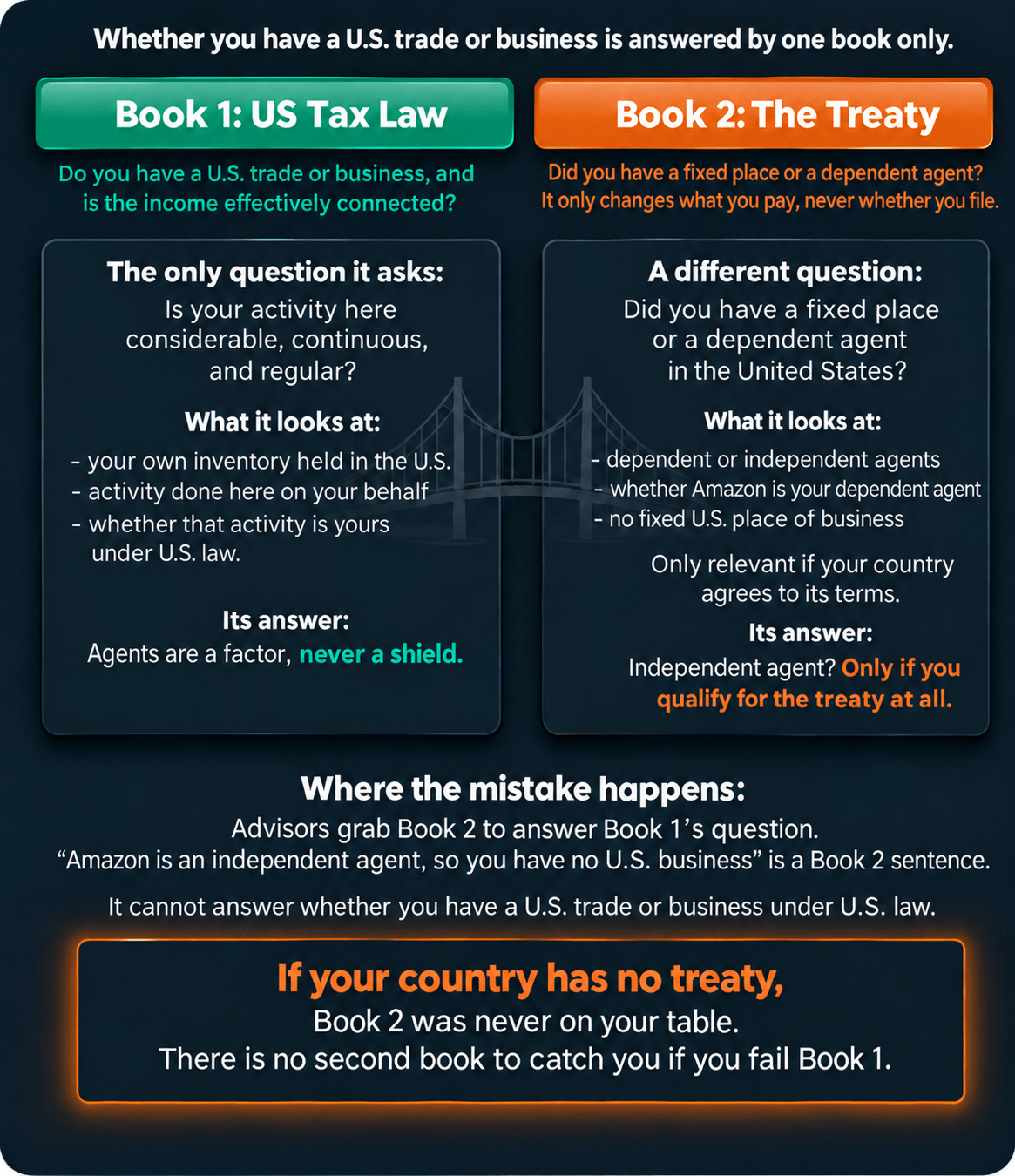
Is your U.S. activity considerable, continuous, and regular?
That is the core question, and it applies to every foreign seller, treaty country or not. It has two halves: whose activity counts as yours, and whether that activity crosses the line. Whether your agent is independent matters under the treaty. Under this book it’s a factor, never a shield.
Dependent agent, or independent agent?
This is where “Amazon is an independent agent” lives. It carries real weight under a treaty. Having a treaty and qualifying for it are two separate questions. And the treaty only changes what you pay. It never changes whether you file.
Advisors reach into Book 2 for an agent test, then use it to answer a Book 1 question.
If your company sits in a non-treaty or low-tax jurisdiction, Book 2 was never on your table at all. That doesn’t make Book 1 harder to pass. It means there is no second book to catch you if you fail it.
A court in the 1950s found a foreign seller doing business here where its goods sat in a U.S. facility and orders were filled from them. Under the treaty it found the same thing. Your file is close enough to that pattern to deserve a real answer, not a borrowed one.
Which book produced your answer? Most sellers have never been told there were two.
Things you’ve been told
Every one of these is partly true, and the missing part is where the cost sits.
The mapping cuts both ways. Some sellers have paid U.S. tax they may not have owed. That is a mapping question too.
Which of these did your current answer come from?
Why two good advisors give opposite answers
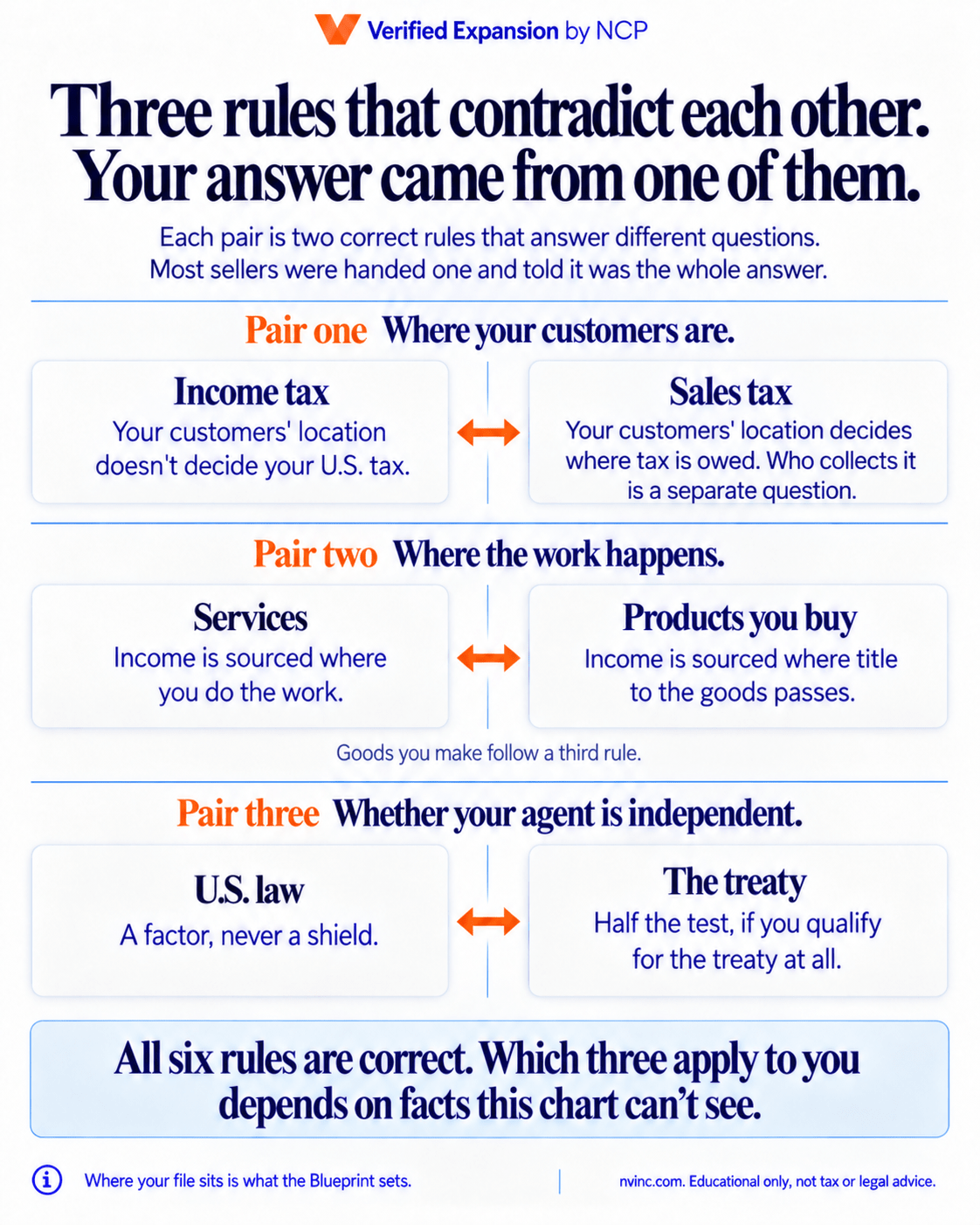
Three rules contradict each other, and your answer came from one of them.
Each pair is two correct rules that answer different questions. Most sellers were handed one and told it was the whole answer.
All six rules are correct. Which three apply to you depends on facts this page can’t see. Which one did your answer come from?
Where do you stand
Weigh your sticks instead of counting them.
The domestic test is a bundle test. No single fact passes or fails you. Two kinds of facts carry most of the weight, and they are not the same kind.
Read down the list. Mark the ones that are true of your business today.
You sell year-round and restock continuously.
Returns, prep, or repackaging happen in the United States.
A U.S. supplier dropships your orders from its own stock.
You have a staffed U.S. office or U.S. employees.
Someone in the U.S. sets prices, runs ads, negotiates, or decides on customers.
None of these creates U.S. tax by itself. Three cautions. An LLC that elects to be a corporation is its own U.S. taxpayer. A foreign-owned LLC still files, even at zero. And every address or presence you certified gets read against your tax position.
Footprint facts put your goods here, and activity facts put your judgment here.
What your particular bundle adds up to is the question the Blueprint answers against your facts, in writing. We do not guess it from a web page, and neither should you.
A 2023 Tax Court decision treated a U.S. person working on a foreign company’s instructions as the company itself acting here. It is on appeal. Platforms that require a U.S. representative put that question on your file whether you asked for it or not.
Courts have treated a foreign seller’s own goods, held in the U.S. and sold continuously, as a heavy fact since the 1950s. No court has ruled on a marketplace seller, either way.
The answer is unresolved. The cost of being wrong without a return on file is not.
What the sticks add up to
What moves the needle?
Your activities set your exposure. Your entity decides who the taxpayer is. Find the facts that are true of you today. The pointer is drawn inside the Review, against your file.
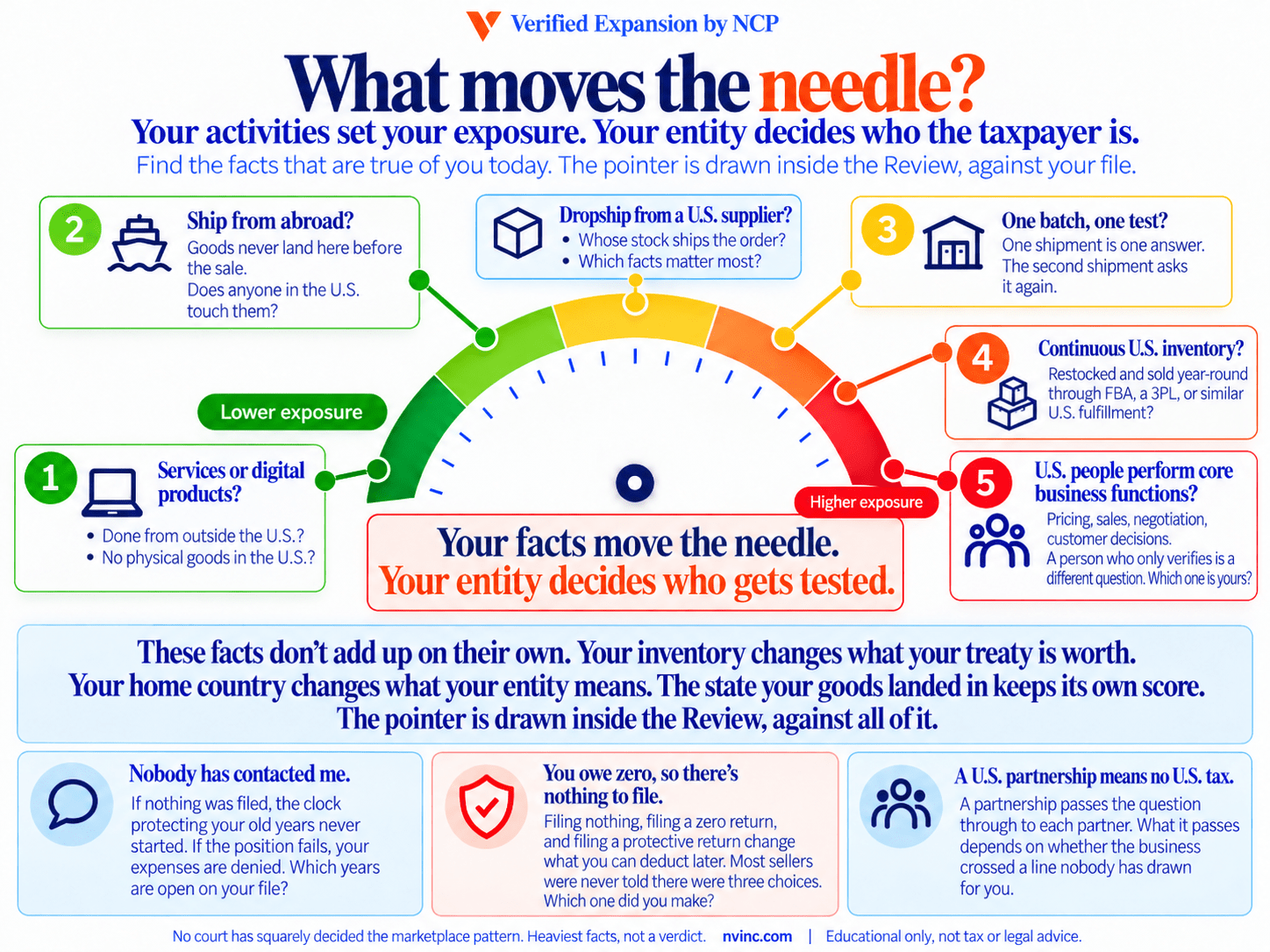
Educational only, not tax or legal advice. No court has squarely decided the marketplace pattern.
These facts don’t add up on their own. Your inventory changes what your treaty is worth. Your home country changes what your entity means.
The CEO Decision Review at $1,250 draws your pointer against all of it, in writing.
Who is actually reviewing you
Five reviewers read one file, and none of them talk to each other.
Five parties look at a foreign-owned U.S. business, independently, on their own schedule, against their own standard. None of them coordinate. Several of them report to each other.
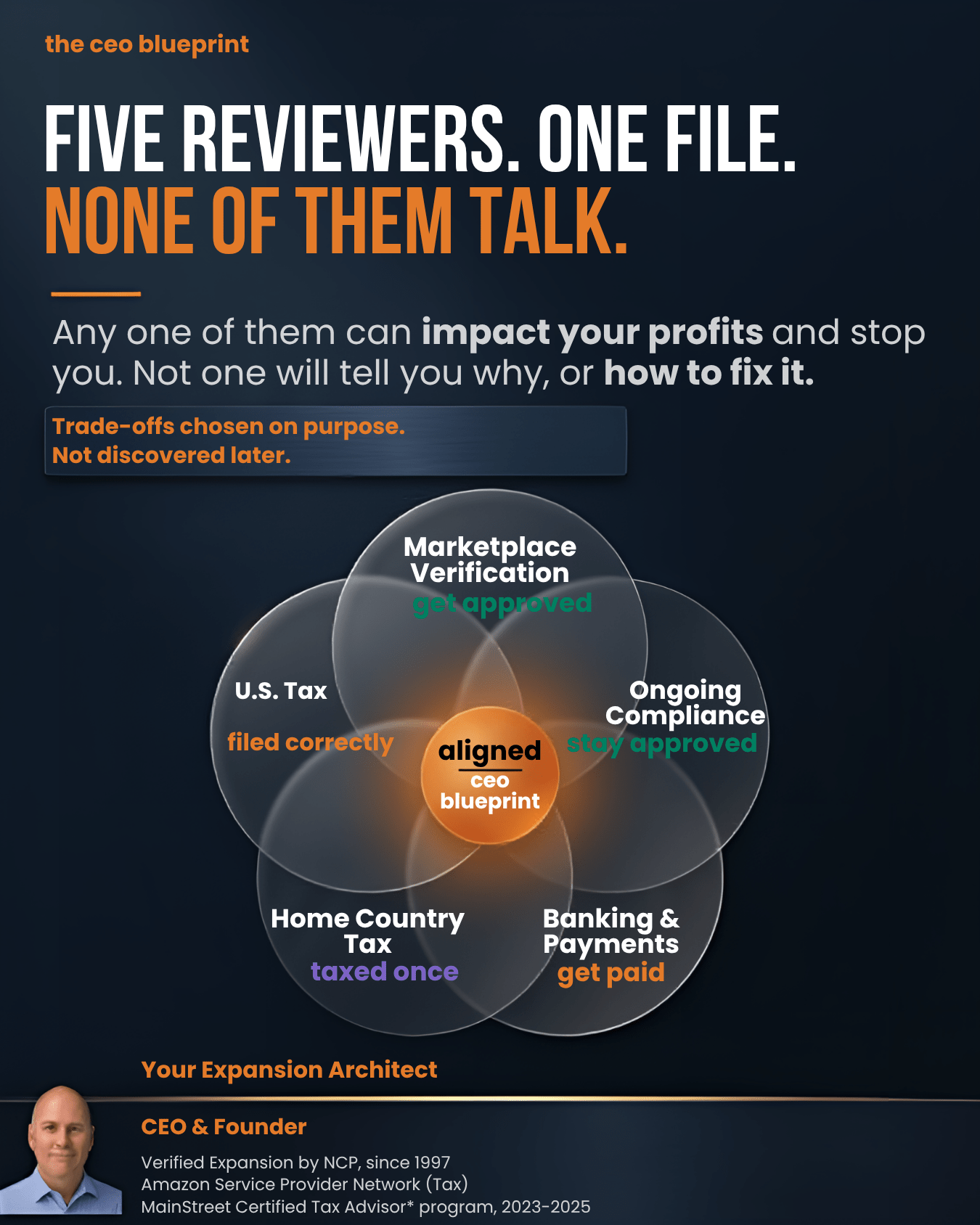
Any one of them can impact your profits and stop you. Not one will tell you how the others will react.
Trade-offs chosen on purpose. Not discovered later.
Where the failures start
The questions that live in the seams
Nothing breaks in the middle of a system. It breaks where two systems meet and each one assumed the other handled it.
State taxes run on separate clocks. Inventory in a state can create a filing there even when the federal answer is zero, and no treaty reaches the states.
These interact. Change one answer and the right structure changes. That is why there is no template, and why this gets mapped rather than guessed.
Your posture, your call
You choose the posture, and we map it and document it.
There is a defensible range, not a single right answer. Where you sit inside that range is a business decision, and it belongs to you.
Strongest authority. The quietest file, at a cost.
Well-supported positions, held together by tight documentation.
Defensible positions, disclosed where required, taken only where the facts support them.
We don’t recommend any position below reasonable basis. Any position that needs disclosure gets disclosed. Where the law is unresolved, we protect the filing position in every band.
You decide how assertive the position is. The protection is not optional. We map it, document it, and introduce you to the CPA or tax attorney whose practice matches your file. They sign the position. We make sure every one of the five reviewers is looking at the same story.

Who builds this
Scott is the navigator, and the bench is licensed.
CEO, Nevada Corporate Planners · MainStreet Certified Tax Advisor® (2023–2025)
Scott Letourneau has served 7,000+ foreign and U.S. founders since 1997 and holds the MainStreet Certified Tax Advisor® credential (2023-2025). He builds the map, then works alongside licensed international tax attorneys and CPAs who execute inside it.

Marc Schwartz, CPA & JD
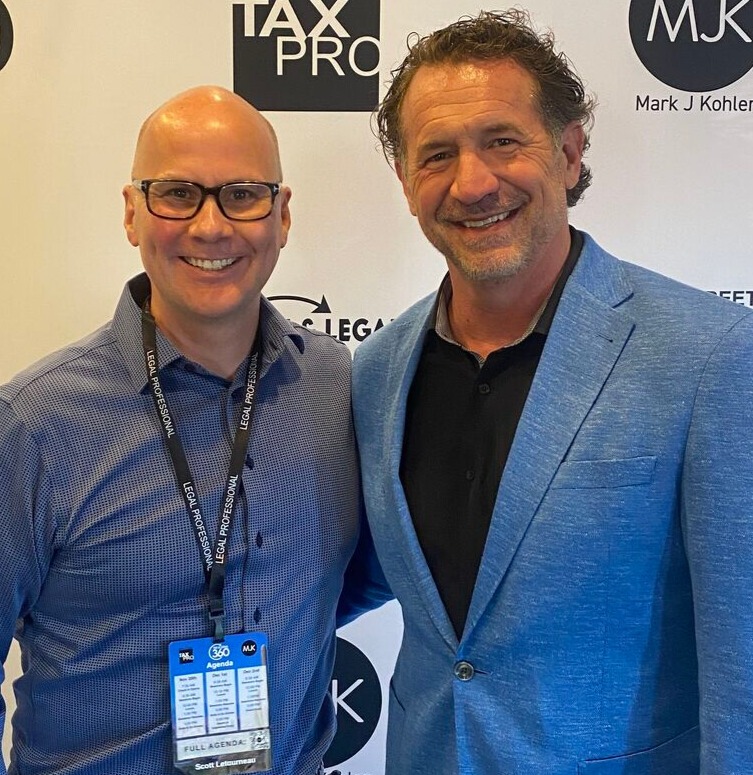
Mark J. Kohler, CPA & Attorney
5-star reviews
What founders say
Scott goes above and beyond and has been an invaluable source of expertise for a UK brand looking to grow into the US, spanning tax, operations, and business strategy.
He asked first-principle questions, uncovered my real goals, and turned months of confusion into a clear, actionable plan.
Scott has in-depth knowledge of US taxation. His advice gave me a clearer picture of my options for company structure and tax.
Know which rulebook applies to you.
One structure, one story, every reviewer reading the same facts. The CEO Decision Review at $1,250 maps your file against both rulebooks, all five reviewers, and your home country, draws your pointer, tells you which posture holds, and names the licensed professional who should sign it.
See how the CEO Blueprint maps this→
Ready now? Start the CEO Decision Review at $1,250
VERIFIED EXPANSION/by NCP | Since 1997
nvinc.com · support@launchwithconfidence.com
This page is educational and is not legal or tax advice. Positions depend on your specific facts. Scott Letourneau holds the MSCTA® (MainStreet Certified Tax Advisor) credential. Verified Expansion provides planning analysis and works with independent licensed tax attorneys and CPAs for legal and tax execution. It is not a law firm or an accounting firm and does not provide legal or tax advice.