

If you’re running a seven-figure foreign-owned brand, you already know you don’t form a US LLC just to sell into the US marketplace, one of the largest in the world.
The real question is which of a small number of specific triggers actually changes that.
If you’re selling through a channel that requires a W-9, like TikTok Shop, that’s a different strategy entirely, with its own tax planning, especially for newer sellers still building out their structure. That’s beyond what’s covered here.
What follows is for everyone else: deciding whether a US LLC makes sense when your channel doesn’t carry that requirement.
Educational only. Not legal or tax advice. Every seller’s facts are different.
The Clean Answer Most Formation Companies Won’t Give You
You do not need a US LLC just because you sell into the US marketplace, one of the largest in the world.
Selling into the US marketplace is not the same as operating a US company.
Amazon accepts foreign sellers directly, using a foreign entity and a W-8BEN. Shopify lets you run direct-to-consumer sales into the US from dozens of supported countries, using your own country’s business registration and payment processor. Stripe itself is directly available in close to fifty countries worldwide, no US entity required.
Marketplaces, and even Stripe and Shopify, are built to let a foreign business sell into the US without becoming a US business. As a result, forming a US LLC when your model already fits inside that structure adds cost and creates exposure without solving a problem you actually had.
Where Sellers Get This Backwards
The common trap: a seller hits friction (a payment processor wants a US address, or they read that “US companies build more trust”), and jumps straight to “I need a US LLC,” without checking whether that’s the actual fix.
Two business models get blamed the most. Both get blamed for the wrong reason.
Dropshipping and print-on-demand are not the risk. An independent-vendor dropship or POD setup, no owned US inventory, no US staff, no controlled US office, is often the most defensible position a foreign seller can hold. Done correctly, it’s an asset, not a liability.
What actually creates exposure is what gets bolted onto that model to satisfy a payment processor. The moment a seller adds a US office, hires US staff, or locks into one exclusive US supplier just to get a Stripe or Shopify Payments account approved, that clean position can flip. That’s the decision point. Not the business model.
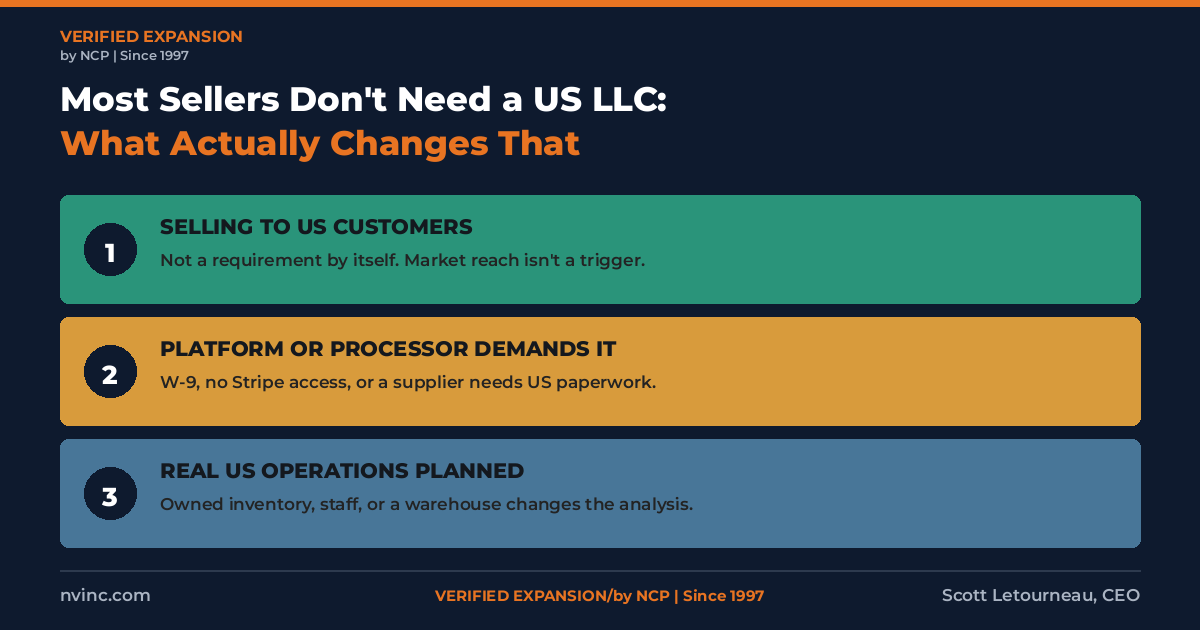
Four Real Reasons a Non-Resident Might Need a US LLC
1. The platform requires it. Some platforms won’t work with a foreign entity at all. If the platform requires a W-9 instead of a W-8BEN, you’re choosing a US tax classification, not just an entity. TikTok Shop US is the clearest example, and it’s different enough to deserve its own conversation.
2. Your country has no direct processor access. Stripe and Shopify Payments don’t cover every country. If yours isn’t supported by either, you don’t have the option to sell direct from home using a local stack, because that stack doesn’t exist for you yet.
3. A US supplier requires US business credentials. This shows up in wholesale, distributor accounts, and resale certificate situations. The marketplace might not require a US entity. The supplier might.
4. You’re building a real US commercial footprint. Owned US inventory, a warehouse, staff, insurance. If this is the actual plan, the question isn’t “do I need an entity.” It’s what structure supports it correctly.
Where a US LLC Is Usually the Wrong Move
- Selling on Amazon as a foreign seller, using the correct tax interview and identity documents
- Selling through Shopify from a country where Shopify Payments or a local processor is already live
- Print-on-demand through a global supplier with US fulfillment capacity, while you stay home
- Dropshipping through an independent US vendor, no owned inventory, no US presence
In every one of these, the seller usually operates from their own country, their own entity, their own bank account, without ever forming a US company.
If Your Country Isn’t Approved for a US Processor
A US LLC still isn’t automatically the answer.
Sellers in unsupported countries sometimes assume a US LLC is the only door in. It’s usually not the first one to check.
Digital products and SaaS can often route through a merchant-of-record model, where the platform becomes the legal seller and handles compliance directly. Established physical-goods sellers can look at global payment acquirers built for cross-border volume. Smaller or higher-risk models sometimes fit PayPal Business or a specialized high-risk processor, at a real cost in fees and reserves.
None of these are “no verification” shortcuts. Every one still checks identity, business details, and risk profile. But none require becoming a US taxpayer just to get paid.
This Isn’t Just a Dropshipping Question
Everything above applies just as much to an owned-brand seller or a private label brand as it does to a dropshipper. The entity question doesn’t change because your sourcing model does. What changes is how fast you hit the triggers that matter.
A private label seller with a logo on a generic product faces a different margin and IP picture than an owned brand with real product differentiation, but that’s a branding question, not a US entity question.
The channel matters more than the sourcing model. For example, a marketplace seller usually has most sales tax collection handled by the facilitator, while a D2C seller on their own site self-collects and has to be registered and compliant in every state where they’ve crossed a nexus threshold. Sellers running both channels, as a result, carry both sets of obligations stacked on top of each other.
The single fact that changes everything, regardless of sourcing model or channel: where does the inventory physically sit. Dropship and print-on-demand with no owned stock carry the lightest footprint. Foreign warehouse stock shipping in as needed is heavier. Owned inventory sitting in a US 3PL, FBA, or FBT warehouse creates physical presence, and physical presence is what pulls a non-resident seller into the US trade or business and effectively connected income analysis covered below, no matter how the brand sources or sells its product.
If You Do Need One, the Entity Is the Easy Part
Forming the LLC takes a form and a fee. What comes after is where sellers get hurt when they skip the analysis.
A foreign-owned disregarded LLC puts the question of US trade or business and effectively connected income on the table the moment there’s owned US inventory, US staff, or a controlled US office. That determination isn’t optional paperwork. It decides whether you owe US tax at all.
If a foreign corporation owns that LLC, there’s a second layer to check: branch profits tax under IRC Section 884, which can apply on top of standard corporate tax if the LLC is treated as a US branch.
A US tax treaty with your home country opens a permanent establishment analysis under Article 5, which may shield you from some of that exposure, filed through Form 8833. Without a treaty, that shield doesn’t exist, and the analysis stops at the first question.
Separately, and often overlooked entirely: does your home country treat that same LLC as transparent, or as its own taxable company? Get this wrong and the same income can get taxed twice, once in the US, once at home, with no foreign tax credit to bridge the gap.
This is the part a formation website will never mention, because a formation website doesn’t do tax work. It sells entities.
The One-Question Filter
Before forming anything, answer this: what specific requirement are you trying to solve?
If the answer is “I sell into the US market,” that’s market reach, not a requirement. No US entity needed.
If the answer is “the platform demands a W-9,” “my country has no processor access,” “my supplier needs US paperwork,” or “I’m building real US operations,” you have an actual trigger worth evaluating properly.
What To Do Next
Not sure which category you’re in? Don’t guess, and don’t form anything yet.
If your answer does come back “yes, you need one,” the entity itself is the easy part. What actually determines whether you get approved and stay approved is everything that has to match after it: tax classification, address story, banking, and the specific platform’s verification requirements. For TikTok Shop expansion specifically, the entity is one piece inside a coordinated build, not a separate purchase.
Email support@launchwithconfidence.com with three lines: your country, your platform, and how you fulfill orders. We’ll tell you straight, free, which category you’re in. What that means for your setup is a five-minute conversation, not a paragraph in an email.
FAQs
Do I need a US LLC to sell on Amazon as a foreign seller?
A: Usually no. Amazon accepts foreign individuals and foreign companies directly through the correct tax interview and a W-8BEN. A US LLC becomes relevant only for specific triggers like owned US inventory, US suppliers requiring US credentials, or a genuine US operational build-out.
Can I sell on Shopify into the US market without a US company?
A: Yes, if your home country has direct access to Shopify Payments or a local processor. You can run direct-to-consumer sales into the US using your own country’s entity and payment stack.
Is dropshipping riskier than other models for US tax purposes?
A: Not inherently. An independent-vendor dropship setup with no owned US inventory and no US staff is often the most defensible position available. The exposure usually comes from adding a US office or US staff to satisfy a payment processor, not from the dropshipping model itself.
What if my country isn’t supported by Stripe or Shopify Payments?
A: A US LLC is one option, not the only one. Merchant-of-record platforms, global payment acquirers, and specialized processors can sometimes solve payment access without any US entity. Which one fits depends on what you sell and your risk profile.
I run a private label or wholesale brand, not a dropshipper. Does any of this apply to me?
A: Yes, more so. Owned inventory sitting in a US warehouse or FBA creates physical presence, which is the single strongest trigger for US trade or business and effectively connected income, regardless of whether you dropship, private label, or sell wholesale. Sourcing model affects your margin and IP position. It doesn’t change the entity or tax analysis.
Does selling on a marketplace versus my own D2C site change my US tax exposure?
A: It changes your sales tax picture more than your income tax picture. Marketplace facilitators generally remit most sales tax on your behalf. A D2C store on your own site usually means you self-collect, and you’re responsible for registering in every state where you’ve crossed an economic nexus threshold. Most sellers running D2C assume this is handled. It usually isn’t.
My company is based in Hong Kong, Singapore, or the UAE. Does a tax treaty protect me?
A: No. None of those three have a US income tax treaty. If your setup ever crosses into US trade or business, there’s no treaty-based permanent establishment shield available to you, the way there might be for a seller based in the UK, Germany, or similar treaty countries. That gap gets missed often because all three are also some of the easiest countries to get a US payment processor account in.
What happens if I form a US LLC without checking whether I need one?
A: You may create US filing obligations, a US trade-or-business determination, and potential double taxation exposure, for a business that could have operated the same way from your home country. The entity is easy to form and hard to unwind cleanly.