
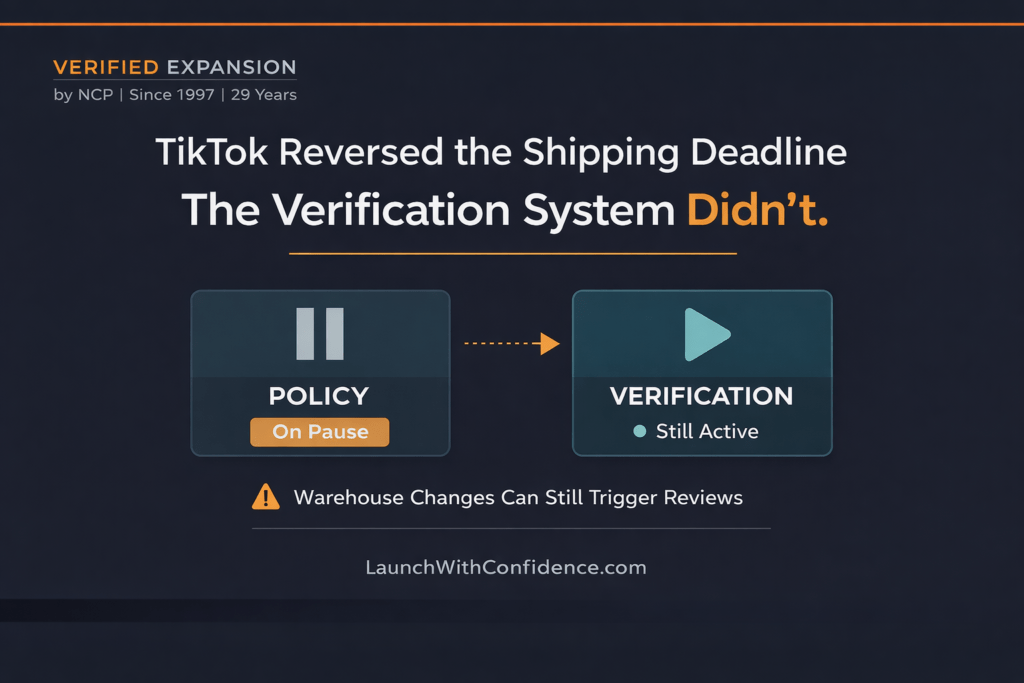
Update (February 18, 2026): TikTok Shop has reversed its Seller Shipping policy change. Previously shared deadlines are not going into effect. Sellers can continue operating as usual. But the verification system didn’t pause with it. This post explains why a simple settings change can still trigger verification requests you cannot satisfy, and how to avoid getting stuck when TikTok asks for proof you cannot produce.
TikTok Shop does not only evaluate what you sell. It evaluates whether your operational footprint looks stable and verifiable.
And one of the fastest ways to trigger scrutiny is to change anything tied to fulfillment, even when you are not doing anything wrong.
If you change your warehouse address, shipping templates, carrier mapping, or fulfillment integration without the required documentation in place, you may trigger a verification request that you cannot satisfy. Your shop may be restricted until you do.
We are already seeing sellers update a single warehouse field and receive a request for:
- Proof of the warehouse address
- A screen recording of the workflow inside Seller Center
- A U.S. government-issued ID
- A selfie holding the ID
All from one settings change.
This post explains what triggers these requests, why TikTok is asking what it is asking, and which seller profiles are most exposed.
What Happened in February 2026
In late January 2026, TikTok Shop announced it would phase out independent seller shipping beginning in late February, with a full transition to platform-managed logistics expected by the end of March. Most U.S. sellers would have been required to route orders through TikTok-controlled logistics services, including Fulfilled by TikTok (FBT), or approved shipping tools fully integrated with TikTok’s systems.
The response was swift. Brands began pulling back. Some narrowed product assortments. Others reduced promotions or were prepared to exit the platform entirely. The pushback was significant enough that TikTok reversed course.
On February 18, 2026, TikTok Shop emailed sellers to confirm that Seller Shipping remains unchanged and that previously shared deadlines are not going into effect.
That sounds like the crisis is over. It is not.
Here is what matters operationally:
The platform’s verification system did not reverse with it.
Sellers who touched warehouse settings during preparation, or sellers who are making fulfillment changes for normal business reasons, are still triggering verification reviews.
So even without a forced migration timeline, the core risk remains:
Shipping changes are not just logistics events. They are compliance events.
The “Trust Reset” Nobody Warns You About
When a TikTok Shop seller changes warehouse settings, shipping templates, or fulfillment integrations, TikTok’s risk systems can initiate what we call a “trust reset.”
 A trust reset is when TikTok re-checks an existing account’s operational legitimacy. It is triggered by change events, not violations. You did not do anything wrong. But your settings change told TikTok’s system: “This seller’s operational footprint just shifted. Re-verify.”
Here is what the trust reset can look like:
- A request for proof of warehouse address (receipt, invoice, agreement, or other document showing business name and warehouse address)
- A screen recording of the page where you are entering the warehouse address
- A valid U.S. government ID such as a driver’s license, state ID, green card, or similar
- A photo of yourself holding the ID
If you have seen this list, you have been through a trust reset.
Why TikTok Asks for an ID Selfie in a “Warehouse” Ticket
This is where most sellers get confused.
When TikTok sends a verification request after a warehouse change, they are asking two separate questions inside one support ticket:
- Warehouse legitimacy: “Is this a real ship-from location tied to the seller’s business?”
- Responsible operator legitimacy: “Is the person behind this shop a real, verifiable individual we can hold accountable?”
These are two distinct proof requirements combined in the same ticket because the warehouse change was the trigger.
TikTok’s support scripts do not always separate “prove the warehouse” from “prove the operator.” The checklist arrives as one list, and sellers assume each item pertains to the warehouse. It does not.
“The 3PL proves the place. The Responsible Person proves accountability.”
If you use a 3PL, TikTok is not asking the warehouse staff to complete identity verification. TikTok is requesting the shop’s Responsible Person (the individual accountable for the shop’s business identity) to complete identity verification.
The 3PL is verified with documentation: agreements, invoices, and receipts that link your business name to the warehouse address.
Fulfillment Is Not Back Office. It Is Distribution.
Most TikTok Shop sellers obsess over ads, creatives, and affiliates. They treat fulfillment like a back-office function. That is a mistake.
TikTok is incentivized to prioritize orders that are easier to fulfill reliably. The more TikTok controls logistics data, the more fulfillment becomes part of distribution, not just delivery.
Even when platforms do not say it publicly, they routinely reward the fulfillment model they can monitor and control.
In our work with U.S.-based TikTok Shop agencies, we consistently see the same pattern: agencies build demand through content and affiliates, then get stuck when inventory discipline, shipping consistency, and scan timing cannot keep up.
Even sellers already using TikTok-managed logistics have reported fulfillment inconsistencies, including shipping delays and inventory errors. Fulfillment discipline matters regardless of which model you use.
If you do not have a handle on inventory and fulfillment, no amount of ads or affiliate volume can save the account.
The Sellers Most Likely to Get Hit
Not every seller triggers a trust reset. But some profiles are significantly more exposed:
- Legacy accounts approved under lighter enforcement that never completed formal identity verification
- Agency Merchant-of-Record setups running U.S. shops on behalf of brands with thin governance documentation
- Non-resident ownership using a U.S. entity and mail-style addresses without a clean U.S. verification story
- Mismatched addresses where mailing, registration, warehouse, and bank addresses tell different stories
- Multiple rapid changes to warehouse, bank, admin roles, and shipping templates in a short window
- Demand-first sellers who scaled volume without building fulfillment discipline
The Mistake That Causes Months of Problems
The most common error: presenting a 3PL warehouse address as your business’s operational presence.
Here is how it typically plays out:
- The seller inputs the warehouse address as their “company location” or primary operational footprint.
- TikTok routes them into a verification workflow assuming the seller operates from that location.
- TikTok requests an ID and a selfie, and the seller interprets it as “someone at the warehouse needs to do this.”
- No warehouse employee is the shop operator. The case stalls. The shop gets restricted.
Clarity about your fulfillment model before you make changes prevents this confusion. But the role assignments, documentation, and proof pack needed to do this cleanly are not obvious. Getting it wrong can create problems that take months to unwind.
Don’t Trigger a Verification Request You Can’t Satisfy
If you are changing shipping settings and you are not sure who TikTok would recognize as your Responsible Person, or whether your documentation will hold up under a trust reset, talk to us before you touch anything.
If You Are a Non-Resident Owner
Everything above applies to all sellers. But non-resident owners face one additional structural risk:
You need a legitimate U.S. Responsible Person who can complete identity verification when TikTok asks.
“It worked before” is not a strategy when enforcement tightens. The fact that your shop operated without a clean U.S. verification story may have been a gap in earlier enforcement, not an exemption.
When TikTok asks for a U.S. government ID and selfie, the question becomes binary: do you have a legitimate U.S. person who can provide that proof, or do you not?
When TikTok Shop gives access to an estimated 170 million U.S. users, walking away is not the answer. Getting your verification story right is.
This is not a problem you solve in the middle of a verification request. It is a problem you solve before you trigger one.
What This Reversal Signals Long-Term
TikTok walked back the timeline. It did not walk back the direction.
Fulfilled by TikTok (FBT) remains the platform’s long-term priority. The infrastructure for tighter fulfillment controls is already built. The verification triggers are already live.
TikTok reversed this policy after significant seller pushback, including brands pulling product assortments and reducing promotional activity. That tells you two things: TikTok listens when enough sellers push back on operational mandates. And TikTok can reinstate or revise these requirements just as quickly when the pressure shifts.
This reversal buys sellers time. It does not buy them an exemption. The sellers who use this window to get their documentation, Responsible Person, and entity structure right will be the ones who survive the next announcement without scrambling.
What to Do Before You Touch Settings
Even without a forced logistics deadline, the risk trigger is still the same: change events.
Before you change anything:
- Plan changes as one controlled event. Avoid multiple partial edits across multiple days.
- Gather warehouse documentation tying your business name to the warehouse address.
- Confirm your Responsible Person is ready to provide U.S. government ID and identity verification if asked.
- Lock down access: one admin, one device, minimal changes for 30 to 90 days.
The specifics of which documentation TikTok will accept, how the Responsible Person should be onboarded, and which governance rules protect your shop depend on your structure: entity type, tax posture, fulfillment model, and current verification status.
That is what we help with.
Whether you need a pre-change readiness check, a plan to stabilize your structure before touching settings, or rescue support because you are already stuck, we can identify the right path quickly.
Stabilize First. Then Change Settings.
The best time to build your proof pack and confirm your Responsible Person is before you trigger a trust reset. The second-best time is today.
This reversal is a window, not a permanent pass.
This post is for educational purposes and is not legal or tax advice. TikTok Shop policies and enforcement practices can change. Always verify current requirements through official TikTok Shop Seller Center documentation.