

The W-9 mistake that can cost your Walmart account and trigger an IRS problem
Expanding to Walmart is a natural next step for non-resident sellers who have built traction on Amazon. But the Walmart onboarding process requires a W-9, and the W-9 requires a U.S. entity that files as a U.S. taxpayer.
Most sellers get bad advice on how to set this up. The result is either an account that fails verification or a tax structure that creates obligations the seller never planned for.
Why the W-9 is different from the W-8
Amazon accepts a foreign entity with a W-8BEN-E. Walmart requires a U.S. entity with a W-9. These are fundamentally different tax classifications.
A W-9 means the entity is a U.S. taxpayer. It will file a U.S. tax return. It will be subject to U.S. tax rules. The type of return and the tax consequences depend entirely on how the entity is classified.
Filing a W-9 is not a form you check a box on and forget. It is a tax election with downstream consequences that affect every filing, every bank account, and every marketplace verification for as long as the entity exists.
The bad advice sellers are getting
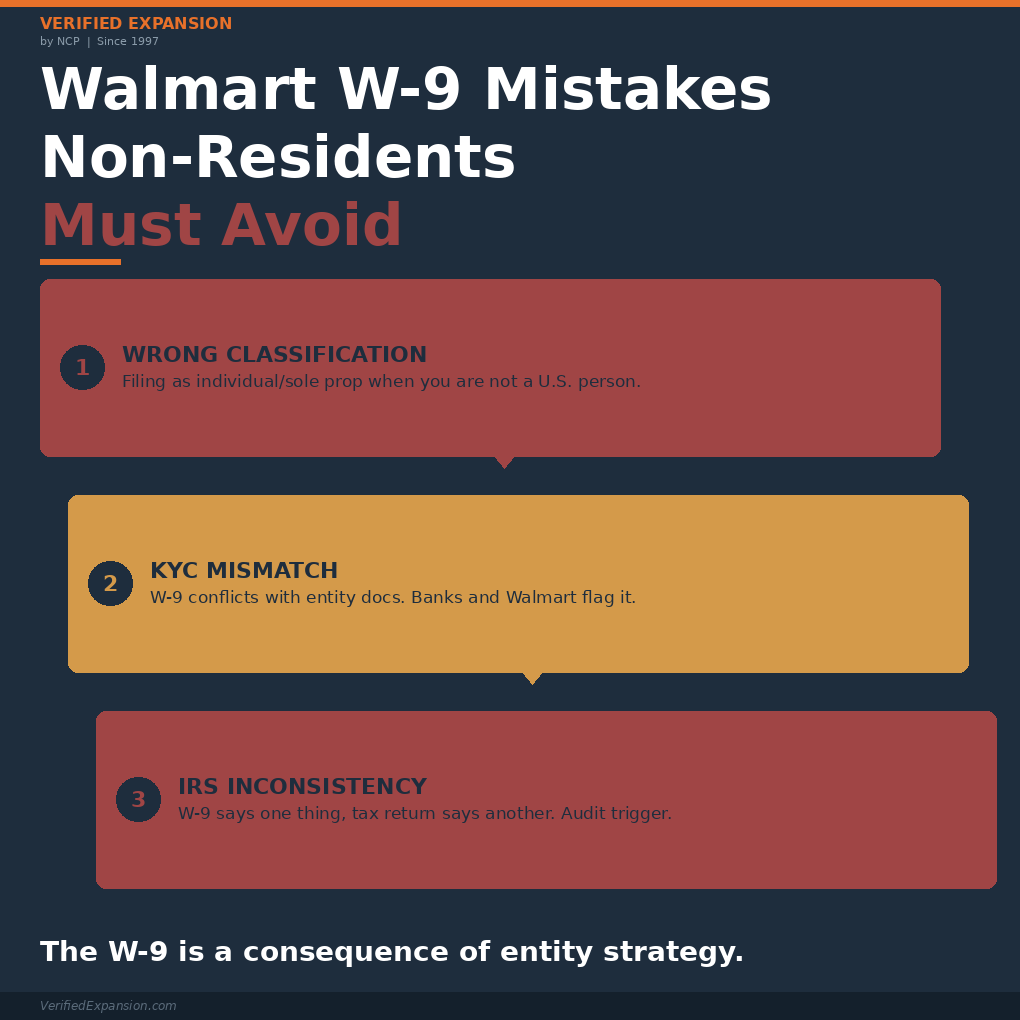
The most common mistake is forming a U.S. single-member LLC disregarded entity and filing a W-9 as an individual or sole proprietor.
If you are a non-resident, you are not a U.S. person. The W-9 certification includes a statement that the signer is a U.S. citizen or U.S. person. A non-resident signing that certification is making a false statement.
This advice comes from agencies, YouTube videos, and formation services that do not understand the difference between entity classification and tax status. It may work long enough to get through onboarding. It will not survive a verification review, a bank KYC check, or an IRS examination.
What goes wrong downstream
When the W-9 classification does not match the entity’s actual tax status, problems compound across every system that touches the account.
Walmart verification. Conflicting information between your W-9 classification, your entity documents, and your address triggers review flags.
Banking. Banks compare W-9 information against entity formation documents during KYC. Mismatches result in account holds or closures.
IRS. If the entity is classified one way on the W-9 and filed differently on tax returns, the IRS sees inconsistency. This is how audits start.
The fix is always more expensive than doing it correctly from the start. Changing entity classification after accounts are open requires new filings, new marketplace applications, and new bank verifications.
The real decision behind the W-9
The W-9 is not the starting point. The entity structure is.
Before you fill out any marketplace form, you need to know: which entity type matches your tax strategy, how that entity will be classified for U.S. tax purposes, and what filing obligations that classification creates.
The W-9 is a consequence of that decision. Getting the decision wrong means every form, every filing, and every verification that follows is built on a broken foundation.
Get the structure right before you apply
If you are an established foreign-owned brand expanding to U.S. marketplaces, we can help you get the entity structure, tax posture, and verification story right before it becomes expensive to fix.
Book a call with our team to find out where you stand.
This post is educational information, not legal or tax advice. Consult a licensed CPA, tax attorney, or enrolled agent for guidance specific to your situation.