
Knowing your customer (KYC) is tighter for Amazon in 2026. Set up choices that worked last year now trigger reviews.
Amazon’s verification standards have shifted. INFORM Act enforcement is stricter. Document requirements are more specific. And the window for making changes to sensitive fields without triggering a review is narrower than ever.
If you are a non-resident seller expanding to Amazon U.S., the decisions you make during setup determine whether you launch smoothly or spend weeks stuck in verification. Most sellers do not find out they made the wrong choice until Amazon asks for proof they cannot provide.
Why non-resident sellers hit KYC walls
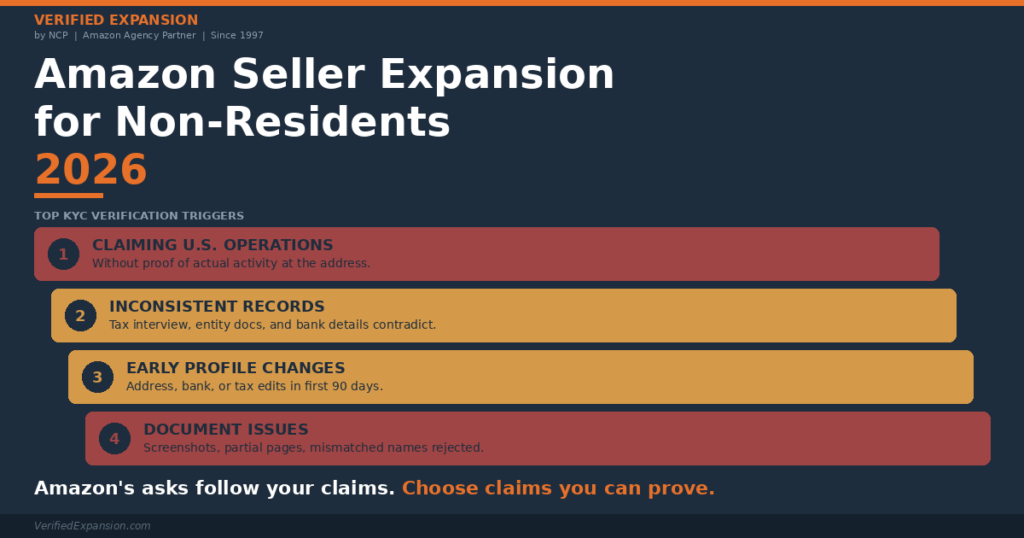
Claiming U.S. operations without proof. If you list a U.S. business address in Seller Central, Amazon may ask you to validate that you actually operate there. Virtual addresses rarely satisfy this requirement. The gap between what you claim and what you can prove is where verification stalls.
Inconsistent records. Amazon compares what you enter in Seller Central against your tax interview, company filings, and banking details. When these tell different stories, the system flags it. Mismatches between your entity name, address, EIN, and bank account are the most common trigger.
Early profile changes. Updating your address, bank details, or tax information within the first 90 days of account creation frequently triggers deeper reviews. Sellers who make changes before their account is fully established often land in verification queues that take weeks to resolve.
Document issues. Screenshots, partial pages, expired documents, and files with mismatched names or addresses get rejected. Amazon expects full-page, recent, readable documents where every detail matches what is on file. One mismatch resets the clock.
What actually causes Seller Performance reviews
The most common triggers are reactivating dormant accounts, upgrading to a Professional selling plan, changing the registered business address, and updating bank details early in the account lifecycle.
Every one of these actions tells Amazon to take a closer look. That is not a problem if your records are aligned. It becomes a problem when your documents, tax interview, and Seller Central profile contradict each other.
Sellers who resubmit the same documents repeatedly after a rejection make it worse. Amazon’s review window has a rhythm. Submitting outside that rhythm signals desperation, not compliance.
The U.S. address reality
If you list a U.S. business address, be ready to prove you operate from that address. Amazon does not accept a mailing address as proof of operations. They want evidence of actual business activity at that location.
A virtual address is not an operational presence. If the address cannot produce utility bills, a lease, or other proof of real activity, verification will stall. The fix at that point is expensive and time-consuming because you are unwinding a claim you already made to Amazon.
This is the single most common trap we see. A seller forms a U.S. LLC, lists a virtual office address, and assumes Amazon will accept it. Months later, they are stuck in verification with no way to prove what they claimed.
Costly assumptions that create weeks of delay
“Any U.S. address is fine.” It is not. Amazon distinguishes between a mailing address and an operational address. If you cannot prove activity at the address, expect verification challenges.
“I can change banks and addresses during setup without risk.” Early changes to sensitive fields are one of the most reliable verification triggers. Every change tells Amazon to re-examine your account.
“Screenshots are acceptable for KYC.” They are not. Amazon requires original, full-page documents with matching details.
“If Amazon asks again, I should upload the same file right away.” Resubmitting rejected documents without fixing the underlying issue wastes your appeals and signals to Amazon that you cannot provide what they need.
What we evaluate for non-resident sellers
Eligibility and risk. We review your residence, entity structure, banking setup, and address plan against current Amazon verification patterns so you know what will pass before you submit anything.
KYC alignment. We match what you plan to claim in Seller Central with what is in your tax interview, company filings, and bank profile. Every field must tell the same story.
Document readiness. We build a clean set of documents that meets Amazon’s format, recency, and visibility standards. The goal is zero back-and-forth.
Change sequencing. When updates are required, we plan the timing and order so you avoid unnecessary reviews and downtime. The sequence depends on your specific facts and current Amazon policies.
Is this you
You live outside the U.S. and are unsure how Amazon expects you to register. You used a U.S. address and are now being asked for more proof. You changed sensitive fields early and landed in a review. Your banking, tax interview, and company records do not match.
If any of these sound familiar, you need a structured fix. Not trial and error.
Get a private compliance plan for your facts
If you are an established foreign-owned brand expanding to U.S. marketplaces, we can help you get the entity structure, KYC story, and verification documents right before it becomes expensive to fix.
Book a call with our team to find out where you stand.
Already stuck in verification? Ask about our Essentials remediation on the call.
This post is educational information, not legal or tax advice. As an Amazon Agency Partner and Amazon Service Provider Network member, we help non-resident sellers navigate verification requirements. Consult a licensed professional for guidance specific to your situation.