

A W-8BEN does not mean you owe zero U.S. tax
This is the most dangerous assumption non-resident sellers make. A marketplace hands you a W-8BEN during onboarding, and you assume that settles the tax question. It does not.
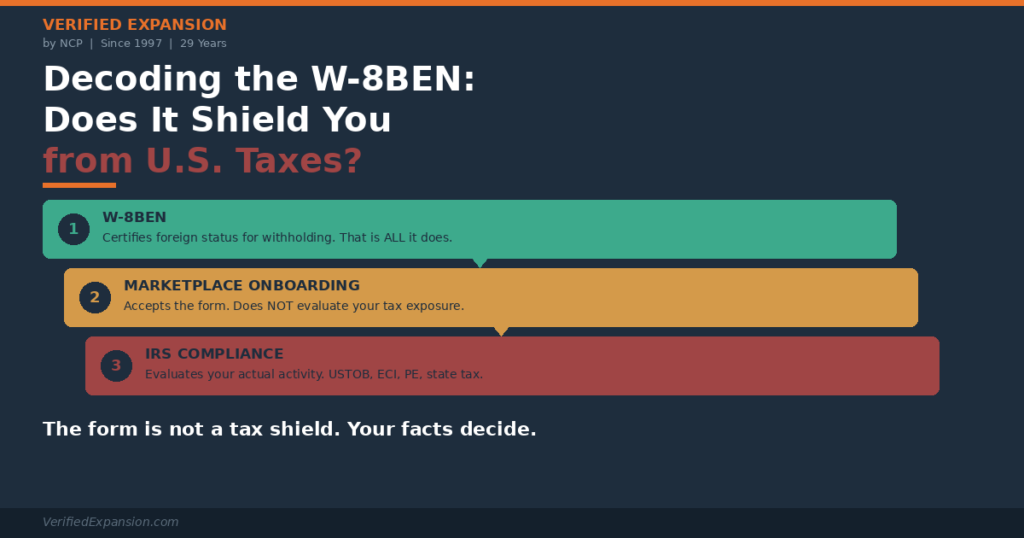
The W-8BEN tells the marketplace how to classify your payments for withholding purposes. It tells the IRS nothing about whether you have a U.S. Trade or Business, Effectively Connected Income, or Permanent Establishment exposure.
What the W-8BEN actually does
The W-8BEN (for individuals) and W-8BEN-E (for entities) certify that you are a foreign person or company. Marketplaces use these forms to determine whether to withhold tax on certain payments.
That is all the form does. It handles withholding classification. It does not analyze your U.S. activity, evaluate your tax exposure, or create any kind of exemption.
When Amazon or another marketplace accepts your W-8BEN, they are not making a tax determination about your business. They are processing a payment form.
Why sellers confuse the form with a tax shield
The confusion comes from the marketplace onboarding experience. You fill out a tax interview. The platform accepts a W-8BEN. No withholding appears on your payments. You assume you are clear.
But the marketplace does not know your operating facts. It does not know whether you have U.S. inventory. It does not know whether your activity pattern meets the “considerable, continuous, and regular” threshold for a U.S. Trade or Business. It does not know whether your income is Effectively Connected.
The marketplace handles payment processing. The IRS handles tax compliance. These are two completely different systems. One does not satisfy the other.
What happens when the W-8BEN is not the right form
If you have a U.S. entity that files with a W-9, submitting a W-8BEN for the foreign entity alongside it creates a mismatch. Marketplaces and payment processors flag conflicting tax profiles. Banks see it during KYC reviews.
If you have Effectively Connected Income and should be filing a U.S. return, the W-8BEN does not eliminate that obligation. The IRS does not look at which form a marketplace accepted. It looks at your actual activity.
The wrong form does not just create a tax problem. It creates a verification problem across every platform and bank that reviews your account.
The real question behind the form
The W-8BEN is a symptom question. The real question is: what is your actual U.S. tax exposure based on your operating facts?
That question requires the three-step domestic and treaty analysis. USTOB first, then ECI, then treaty PE. The form you file with a marketplace is a downstream consequence of that analysis, not a substitute for it.
If you have not completed that analysis, you do not know whether the W-8BEN is even the correct form for your situation.
If you are an established foreign-owned brand expanding to U.S. marketplaces, we can help you get the entity structure, tax posture, and verification story right before it becomes expensive to fix.
Book a call with our team to find out where you stand.
This post is educational information, not legal or tax advice. Consult a licensed CPA, tax attorney, or enrolled agent for guidance specific to your situation.