
Updated March 2026: This post reflects corrected terminology for onboarding resubmissions versus seller policy violation appeals, qualified language for platform mechanics based on practitioner experience versus published rules, and the February 2026 Seller Shipping reversal. The 4 Decisions framework and tax structuring guidance remain current.
Inventory staged. Ads loaded. Revenue forecast at $100K.
Then one bad U.S. business representative submission triggers “Not Verified.”
TikTok Shop does not publish a resubmission cap for onboarding rejections, but sellers consistently report that failed attempts narrow your options fast. Once your resubmission window closes, you are looking at a manual review process or a complete rebuild from scratch.
The cost of guessing is real. And the decisions TikTok locks at submission are permanent.
Over the past year, our office has fielded dozens of these calls. Applications rejected. U.S. business representatives (U.S. authorized representatives) were disappearing when a video was required. Stores that never got off the ground because someone underestimated what verification actually involves.
The pattern is always the same: a preventable mistake on a form that TikTok locks the moment you submit.
This post covers the four irreversible decisions TikTok locks at submission, why they matter even more for non-resident owners, and how U.S. tax rules can quietly erase your margins if you form the wrong entity.
We will not cover every step here. The full methodology is in our U.S. business representative readiness guide.
Why This Matters More Right Now
In late January 2026, TikTok Shop announced it would phase out independent seller shipping beginning in late February, with a full transition to platform-managed logistics expected by the end of March.
On February 18, 2026, TikTok reversed that decision after brands began pulling back, narrowing assortments, and threatening to exit the platform.
But the reversal only paused the policy. It did not pause the verification system.
Sellers who touched warehouse settings, shipping templates, or fulfillment integrations during the confusion are now triggering what we call a “trust reset”: TikTok re-verifies the account’s operational legitimacy based on a change event rather than a violation.
Fulfilled by TikTok (FBT) remains the platform’s long-term priority. The infrastructure for tighter controls is already built. This reversal buys time. It does not buy an exemption.
The sellers who use this window to get their verification story right will be the ones who survive the next announcement without scrambling.
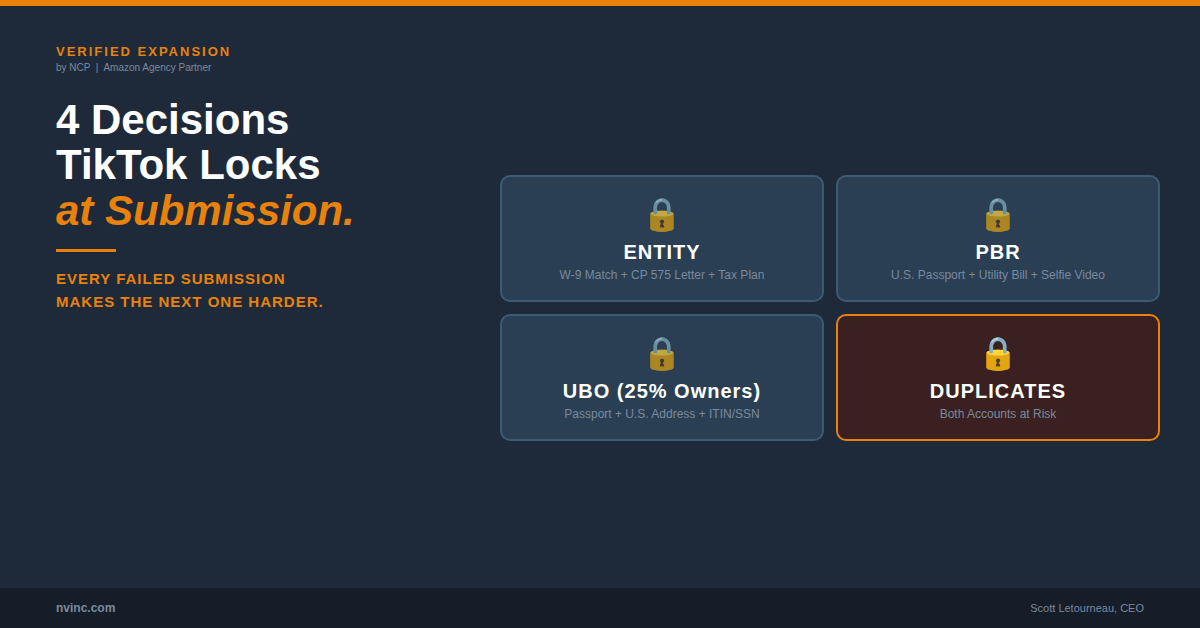 Decision 1: Entity, IRS, and Bank Pairing
TikTok cross-checks three independent data points the moment you submit:
- Your entity record on your Articles or Certificate of Formation
- Your Employer Identification Number on your SS-4 or CP-575 letter
- The legal name on your U.S. bank account
A single mismatch across any of those documents can trigger a review that delays your launch by weeks. And once TikTok locks the data, you cannot simply edit it. You are in their queue.
There is a fourth data point most sellers overlook: TikTok’s business type selection is irreversible. The dropdown offers options like Individual, Sole Proprietorship, Corporation, and Partnership. If your entity is a foreign-owned single-member LLC and you select “Partnership” because someone told you to, you have created a governance mismatch between your actual entity structure and what TikTok has on file. That mismatch alone can trigger a rejection. And you cannot change it after submission. You have to start a new application.
There is a critical nuance here that most sellers miss: TikTok Shop will accept a W-9 from anyone. They do not verify whether you filled it out correctly. That does not mean you are safe. The W-9 is a federal tax document signed under penalties of perjury. It is the seller’s responsibility to read the form and understand what they are certifying. A single-member LLC that is a disregarded entity owned by a foreign company or a foreign individual does not meet the W-9 certification requirements. The foreign owner is the taxpayer, and a foreign person cannot legally certify as a U.S. person on a W-9. TikTok will not catch this. The IRS will.
There are entity structures that solve this. But the choice must happen before your SS-4 is filed. Each option comes with different tax consequences, filing obligations, and withholding requirements. Picking the wrong one creates a different set of problems. This is not a decision to make from a blog post or a YouTube video.
The takeaway: Entity selection, IRS filing, and bank account setup are one coordinated event. Treat them separately, and you create mismatches that TikTok locks at submission.
Decision 2: The U.S. Business Representative (primary representative on TikTok Shop account)
Every TikTok Shop seller must appoint one U.S. person who supplies a government-issued ID (such as a U.S. passport), a utility bill for address verification, and in most cases a live selfie video.
TikTok locks that individual to your shop. Based on current platform behavior, each U.S. business representative appears to be limited to a small number of stores across the platform. If your U.S. business representative fails the video verification, the entire application fails.
TikTok confirmed in March 2026 that the business representative who appears in the verification video must be the same person whose information was used during registration. This is an exact-match requirement. A U.S. business representative who signs the documents but sends someone else for the video will fail.
Even if the selfie video passes, if the U.S. business representative’s ID does not align with the information on file, the account will not be verified.
This is the single highest-failure-rate step in the entire process. And it is the one most sellers treat casually.
There are specific preparation steps, documentation requirements, and liability protections that need to be in place before your U.S. business representative submits anything.
The U.S. Business Representative Is Where Most Applications Die. The 27 steps to properly prepare, vet, and protect your U.S. business representative are in our free guide: The US Business Representative Checklist.
Decision 3: The Ultimate Beneficial Owner (UBO)
Any owner, direct or indirect, holding twenty-five percent or more of the company must be disclosed. TikTok’s form asks for a passport, a U.S. residential address, and an ITIN or SSN. For foreign owners who do not have a U.S. residential address or an ITIN, this creates a structural problem that cannot be solved on the form itself. It requires planning before you submit.
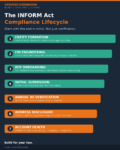
The UBO disclosure must be accurate the first time. Corrections after submission create conflicting records in TikTok’s system that are extremely difficult to resolve. What TikTok requires today and what it enforces tomorrow are rarely the same. The platform is actively tightening KYC requirements, and sellers approved under lighter enforcement are being pulled into re-verification under the INFORM Consumers Act.
Decision 4: The Duplicate-Account Trap
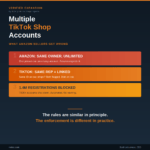
A second application that reuses any locked data point (the legal name, EIN, or owner address) creates a linked-account problem. Based on consistent seller reports, linked applications face significantly stricter scrutiny, and in many cases, both the original and new applications are affected.
Sellers who panic after a first rejection and open a “fresh” shop typically make the problem worse. TikTok monitors shared identifiers across the platform, including phone numbers, email addresses, bank accounts, and device data. There is no clean start if you already submitted.
The only path forward after a failed application is a properly structured resubmission or, if resubmissions are exhausted, a differentiated rebuild. Both require knowing exactly which data points TikTok locked and which can be changed. Guessing makes it worse.
Pass Verification and Still Lose: The Tax Bill That Arrives Later
Getting past TikTok’s front gate is only half the game. The moment you hold a U.S. EIN, you enter the U.S. tax system. TikTok Shop requires a W-9, which means the IRS knows you exist.
| Structure | Tax Reality | Profit Risk |
|---|---|---|
| Multi-member LLC | Files Form 1065. Must withhold tax under IRC 1446 on foreign partners. | Up to 37% cash withheld before you touch it |
| C Corporation | Pays 21% corporate tax, then 5-15% dividend withholding (treaty dependent). | Double taxation can erase ad-credit ROI entirely |
| Single-member LLC (foreign owner, disregarded) | TikTok accepts the W-9 but does not verify it. The foreign owner is the taxpayer. A foreign person cannot legally certify as a U.S. person on a W-9. This is NOT Amazon. | IRS perjury risk. TikTok will not catch this. The IRS will. |
The difference between a tax problem and a tax plan is documentation. The worst-case numbers in the table above are what happens when you form an entity without mapping the tax consequences first. The right structure, the right filings, and the right agreements between your U.S. and foreign companies can change those numbers dramatically. But those decisions must be made before formation, not after you are already selling and the IRS already knows you exist.
Entity selection and tax planning must happen before your SS-4 is filed. Amendments after the fact restart bank KYC, create conflicting records with TikTok, and push your launch out months.
Mistakes We Fix Every Week
You are not alone if any of these led to your TikTok Shop rejection:
- Selected the wrong business type on TikTok’s form. A foreign-owned SMLLC selects “Partnership” or “Corporation,” and the business type does not match the actual entity structure. This creates a governance mismatch that can cause major issues down the road.
- The U.S. business representative (U.S. authorized representative) is marked as both the U.S. business representative and UBO when the foreign owner is the 100% UBO. If all owners are non-U.S. persons, the U.S. business representative is the U.S.-authorized representative, not the owner. Marking the
- the U.S. business representative
- as the UBO when a foreign individual or foreign company owns 100% of the entity is structurally inaccurate and creates a conflict that TikTok’s system flags. (If the brand has a U.S. partner owning 25% or more, that person could be both U.S. business representative and UBO. But that is a different structure with different requirements.)
- The U.S. business representative name does not exactly match the application. The U.S. business representative submits a driver’s license or passport, but the name on the ID does not match what was entered on the application
- U.S. business representative address does not match their ID. The address provided on the application does not match the one on the driver’s licens
- Document quality issues stack against you. A cropped passport photo and a date of birth that do not match between the form and the ID.
- UBO cannot provide a real U.S. residential address or ITIN/SSN. When all owners are non-US persons, the UBO is the foreign owner, not the the U.S. business representative. A virtual mailbox or registered agent address does not satisfy the UBO residential address requirement.
- Business formation documents do not exactly match IRS records. Even when they appear to match, we still see errors and rejections due to formatting differences, abbreviations, or name variations.
- Seller panics after rejection and opens a second application. Both accounts are now linked. Recovery options shrink dramatically.
The Financial Cost of Every Week You Wait
Top-performing TikTok Shop sellers generate $30K to $70K in gross sales per week. Each seven-day verification delay costs real revenue, plus expired ad credits that TikTok only grants during the first weeks of a SKU’s lifecycle.
TikTok Shop is having its Amazon-2010 moment. Cheap traffic. Affiliates willing to post for the cost of a sample. First-mover advantages that compound weekly.
None of that matters if you cannot get verified.
DIY Versus Done-For-You
| DIY Path | Done-For-You with NCP | Verified Expansion |
|---|---|
| Weeks of delays due to CP 575 IRS letter errors | Tax plan before LLC formation. Entity, EIN, and bank aligned from day one. |
| The U.S. business representative bears personal liability with no protection | Signed indemnification agreement. The U.S. business representative vetted and protected. |
| Guess at U.S. tax rates and entity consequences | Tax exposure mapped before you file anything. |
| No support after submission | Advanced email support for 30 days to 6 months, depending on the package. |
| Limited resubmissions. No rehearsal. | We prepare the submission so it passes on the first attempt. |
When TikTok tightens the rules again (and it will), the sellers who prepared properly will already be live, ranked, and review-rich. The others will still be emailing support.
The First Submission Matters Most
We mapped every data point TikTok locks at submission, every document that must align, and the 27 steps to get your The U.S. business representative on board correctly.
Download the free The U.S. business representative Blueprint before you click “Submit”: Get the The U.S. business representative Blueprint: 27 Steps to Get Verified on TikTok Shop
Already stuck? If you have been rejected, are mid-resubmission, or are not sure whether your current structure will pass, the first step is a 15-minute discovery call. We ask about your ecommerce brand, your global structure, and your U.S. expansion goals first, because the right solution depends on the full picture.
This article is for educational purposes only and does not constitute legal or tax advice. TikTok Shop policies change frequently. Always verify current requirements directly with TikTok Shop Seller Center and consult qualified legal and tax professionals for your specific situation.