

The Two Things That Stop the Old Shopify Payments Playbook
If you last researched Shopify Payments US in 2024 or 2025, most of what you learned is now wrong or dangerous.
Two shifts changed the game:
- Shopify’s operational presence enforcement got sharper. The old “form a Wyoming LLC, get an EIN, use a virtual address” formula that used to slip through now gets rejected at higher rates. The friction moved from onboarding into ongoing verification.
- Stripe pushed hard on non-resident approvals and rolled out Adaptive Pricing, Managed Payments, and Optimized Checkout at Sessions 2026. For the first time, “just use Stripe” is a defensible alternative for many D2C sellers. It’s also a trap for the wrong ones.
Result: the question is no longer “how do I qualify for Shopify Payments?” The question is “should I even try, or is there a better path for my specific fact pattern?”
That’s what this post covers.
Who This Applies To
You’re reading the right post if:
- You’re a non-US resident selling on Shopify D2C into the US, or planning to
- You’ve been rejected by Shopify Payments and don’t understand why
- You’re deciding between Shopify Payments, Stripe US, PayPal, or a home-country processor with third-party gateway fees
- You’ve been told “form a US LLC” and want to know if that’s actually enough
You’re reading the WRONG post if:
- Your primary channel is a US marketplace (TikTok Shop, Amazon, Walmart). Those platforms operate under different rules. Shopify Payments is irrelevant to your registration.
- You’re selling digital goods or SaaS only. Stripe Managed Payments is likely your path, not Shopify Payments.
The Real Qualifier for Shopify Payments US (2026)
Shopify hasn’t changed its written policy. It has changed how strictly it enforces one clause.
The clause: To be eligible for Shopify Payments in a given region, you must have either physical presence OR operational presence in that region.
The enforcement: Registering a US LLC and using a registered agent, virtual mailbox, or CMRA address will NOT satisfy operational presence. Shopify has said this in writing. In 2026 they are acting on it more aggressively at initial application and at KYC re-review.
Translation: A cheap online LLC with an EIN and a virtual address will not qualify you for Shopify Payments US. Period. It doesn’t matter what a Fiverr formation service told you.
What Shopify Actually Wants To See
Shopify’s underwriters accept a narrow set of proofs. Most non-residents submit the wrong ones because the platform’s guidance is ambiguous and the correct interpretation depends on your entity structure, not the document type. Getting this wrong burns the application and can flag your entity for extra scrutiny on the next attempt.
Two categories of proof exist:
Physical presence. Rare for non-residents. Requires documentation tied to a real US residential situation. If you’re not physically living in the US, this path is closed to you.
Operational presence. The realistic path for most non-residents. Requires documented commercial activity in the US that goes beyond a formation address. The specific proof requirements shift based on how your entity is structured and what tax classification you elected.
3PL arrangements CAN satisfy operational presence in some cases. Most 3PL contracts do NOT. The difference is in the contract structure, the address use, and how the 3PL represents your operation to Shopify if asked.
What Nobody Tells You About the “Easier” Alternatives
Founders rejected by Shopify Payments often pivot to Stripe US, PayPal, or a home-country Stripe. Each has a hidden cost.
Path A: Stripe US on a US LLC
Upside: Stripe doesn’t enforce operational presence the way Shopify Payments does. Approval is faster. Virtual addresses often pass initial review.
Hidden cost: Higher account-freeze risk mid-flight. Stripe’s KYC tightens over time. Geo-mismatch flags fire when the beneficial owner is in one country and the entity is in another. Funds get held 90 to 120 days when volume spikes or KYC re-review triggers. A rejection at week 1 costs you nothing. A freeze at month 8 with $80K on the platform can end the business.
Watch the fintech trap: Fintech accounts (Mercury, Wise USD, Payoneer) may be accepted for payout, but not equally. Payoneer in particular is not a US bank and carries higher rejection risk with underwriting review. The surface-level advice to “link Mercury or Payoneer” treats them as interchangeable. They aren’t.
Path B: PayPal Business + Shopify third-party gateway
Upside: Sometimes approves foreign owners with US LLCs when Stripe and Shopify Payments won’t.
Hidden cost: Chargebacks and holds. PayPal is aggressive about reserves for foreign-owned accounts. Rolling reserves of 20-30% for 6 months is common.
Path C: Home-country Stripe with Adaptive Pricing
Upside: No US entity required for payments. Stripe operates in 46 countries directly. Adaptive Pricing localizes USD for US shoppers.
Hidden cost: Third-party gateway fee on Shopify (0.5% to 2% on top of Stripe’s 2.9% + $0.30). Settlement in home currency, not USD. FX loss. And if you scale into US-based fulfillment (FBA, 3PL), you’re still on the wrong side of the entity structure for banking, sales tax, and marketplace expansion.
Path D: Qualify for Shopify Payments US properly
Upside: Lowest overall processing cost. Cleanest US treasury and settlement. Highest approval rate on US-issued cards.
Hidden cost: Real operational presence has real dollar cost. Not $50/month. Real dollar cost. AND once you build operational presence, you’ve made your case that you might have a US trade or business, which changes your tax filings.
The “Save on Fees” Framing Is a Trap
Most non-resident sellers hit this decision because someone told them Shopify Payments US will save them 0.5% to 2% in third-party gateway fees. That math is technically correct.
The math also doesn’t matter.
A 1% fee saving on $500K annual revenue is $5,000. The compliance exposure you take on to qualify for Shopify Payments US, if handled incorrectly, ranges from $25,000 per year in missed 5472 penalties to six figures in unaddressed state tax exposure. And that’s before Stripe freezes your funds for 90 days because your fintech payout account triggered a KYC re-review.
The sellers optimizing for fee savings are solving a $5,000 problem while creating a $50,000 problem.
The founders who scale don’t optimize processor fees first. They optimize entity structure, verification readiness, and compliance posture first. The processor decision falls out of that work.
If your current advisor is walking you through Shopify plan upgrades, currency conversion fees, and Payoneer versus Mercury as your primary optimization, you’re getting fee-tool advice on a compliance-first problem. Those are two different jobs.
The Question Most Founders Skip
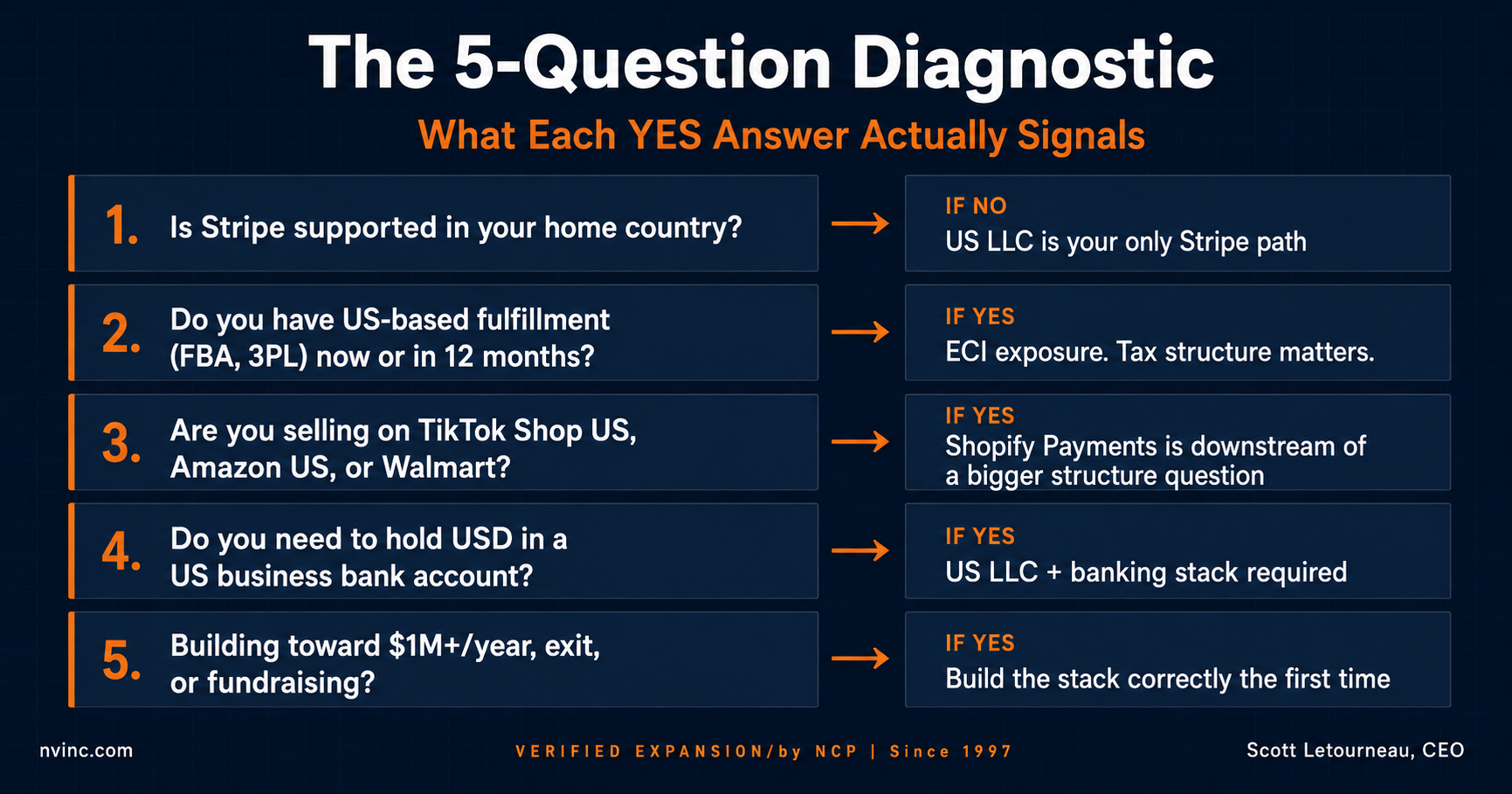
Before you decide WHICH processor to pursue, answer these five. Skip this step and you’ll pick the wrong path.
- Is Stripe supported in your country of residence today?
- Do you have (or will you have in 12 months) FBA, 3PL, or any US-based fulfillment?
- Are you selling on TikTok Shop US, Amazon US, or Walmart in addition to Shopify?
- Do you need to hold USD and settle payments to a US business bank account?
- Are you building toward a $1M+/year business, an exit, or fundraising?
If you answered NO to all five, you likely don’t need Shopify Payments US. Use home-country Stripe with Adaptive Pricing and move on.
If you answered YES to any of them, you’re in the territory where the payment processor decision is downstream of a bigger structural decision.
That structural decision is what most founders get wrong.
Why “Just Form an LLC” Is the Wrong Anchor
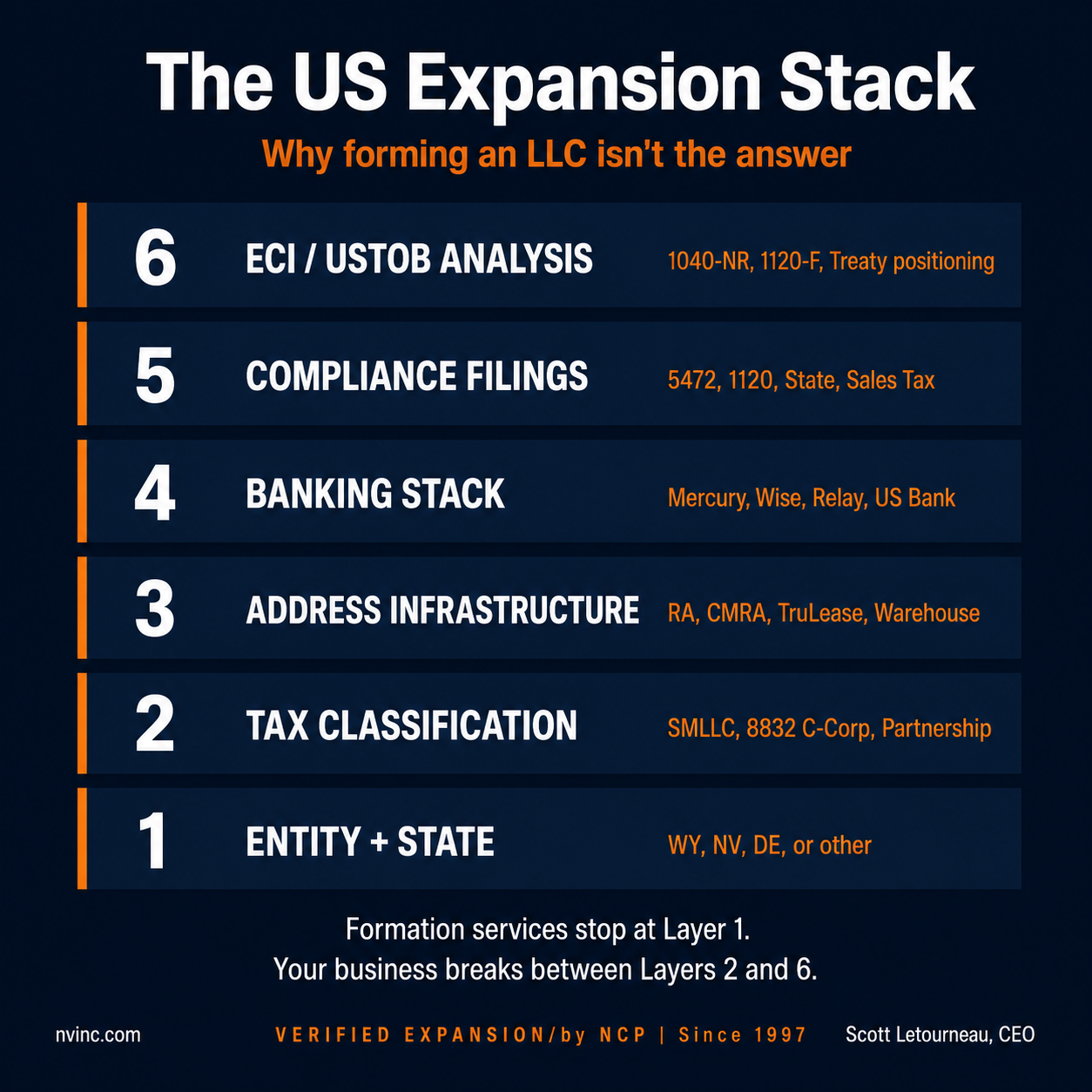
Formation services sell you an LLC as the answer. It isn’t. The LLC is one part of a stack. Get the stack wrong and every payment processor in this post rejects you or freezes you.
The stack has six parts. Each one has a specific right answer for your fact pattern. The wrong combination gets you rejected. The wrong combination also gets you an IRS notice 18 months later, costing more than the processor ever saved you.
The six:
- Entity type and state of formation. Wyoming vs Nevada vs Delaware isn’t a “flavor” question. Each has a specific downstream effect on banking, verification, and tax filings.
- Tax classification. Foreign-owned disregarded SMLLC vs 8832 C-Corp election vs partnership. Each has a different form to give the processor (W-8BEN-E, W-9, or W-9 with 1446 withholding on distributions). Get this wrong, and you either get rejected by the processor OR get a 1099-K mismatch notice from the IRS.
- Address infrastructure. Registered agent vs. CMRA vs. real lease vs. warehouse space. Each satisfies different platforms. Shopify Payments needs the top of this stack. Stripe US often accepts the middle. Marketplace verification (TikTok Shop, Amazon) is a different set of rules again.
- Banking stack. Mercury, Wise USD, Relay, and traditional US banks each get different reactions from Shopify Payments’ underwriting. Virtual banks can be accepted but have a higher risk of payment failures. That’s Shopify’s own words to us.
- Compliance filings. Form 5472 + pro forma 1120 every year. $25,000 penalty per missed form. State income, franchise, and sales tax registrations for FBA or 3PL inventory.
- ECI / USTOB analysis. If you have US fulfillment, US employees, US-based agents, or a US operational presence, your income is likely effectively connected to a US trade or business. That triggers Form 1040-NR or 1120-F filings at graduated rates. Ignore this and the cheap payment processor “win” is wiped out by tax exposure.
Formation services stop at #1. They sell you the LLC and disappear.
Your business breaks somewhere between #2 and #6.
The Stakes If You Get This Wrong
- Rejected by Shopify Payments and you don’t know why. Months of lost momentum trying different documents.
- Approved by Stripe, then frozen at month 8 with $50K to $200K held for 90-120 days. Cash flow crisis mid-scale.
- 1099-K issued in error because you signed W-9 when you should have filed W-8BEN-E. IRS sends CP-2000 notice 12-18 months later assessing tax at single-filer rates plus penalties.
- State tax exposure in California, Washington, Texas, Ohio, or Oregon because FBA or 3PL inventory triggered nexus and nobody registered you. Penalties compound for years.
- Home country audit finds your US LLC. Structure was never defensible. Tax owed in both countries.
- Buyer diligence at exit finds every shortcut. Deal price gets slashed. Or the deal dies.
Each of these is fixable at day 1. Each of them is expensive to fix at year 2.
What Actually Works
The founders who scale on Shopify (or Stripe US, or both) share three things:
- They decided the tax structure before they picked the payment processor. Not after. Not “we’ll deal with it later.” Before.
- They matched their address infrastructure to their platform. Not the cheapest address they could find. The right one for the platform’s actual verification standard.
- They mapped the state tax exposure before triggering it. They knew before their first FBA shipment which states they’d need to register in and when.
That’s it. There’s no secret playbook. There’s no hack. The founders who do this quietly build the boring foundation and then never think about Shopify Payments again because it just works.
The founders who chase shortcuts spend the next 24 months trying to fix problems they created in the first 90 days.
What To Do Next
If you’re a non-resident seller trying to expand into the US Shopify D2C market, the decision isn’t which payment processor to apply to. The decision is which structural path best fits your business, volume, country of residence, and fulfillment plan.
We built the Verified Clearance Plan specifically for this decision. It maps your fact pattern to the right entity structure, tax classification, address infrastructure, banking stack, and processor path (Shopify Payments, Stripe US, or home-country Stripe with cross-border MoR) so you don’t spend 6 months trying to force the wrong answer.
Learn more about the Verified Clearance Plan: https://nvinc.com/verified-clearance-plan/
If your fact pattern doesn’t fit the Verified Clearance Plan, we’ll tell you on the discovery call. We don’t sell founders solutions they don’t need.
Educational only, not legal or tax advice. Shopify Payments approval, Stripe approval, tax elections, and state registrations all depend on your specific facts. Confirm with qualified US tax and legal professionals before relying on any of the above for your structure.
Frequently Asked Questions
Do I need an ITIN to qualify for Shopify Payments US as a non-resident?
No, not universally. Shopify Payments US requires a US tax identification number, which for a business entity is an EIN, not an ITIN. An ITIN is only required in narrow circumstances, such as when Shopify’s system asks for the last 4 digits of the account representative’s SSN or ITIN. Many non-resident sellers qualify without ever obtaining an ITIN. Whether you need one depends on your entity type, tax classification, and how the account representative is entered on the application.
Will a registered agent address or virtual mailbox satisfy Shopify Payments’ operational presence requirement?
No. Shopify has stated in writing that registering a company within a region is not sufficient to establish operational presence. A registered agent address, virtual mailbox, CMRA, or mail forwarding service will not qualify you. Shopify requires proof of actual physical or operational activity in the US, such as a warehouse lease, retail space, or office with employees, all documented in the entity’s name.
Can I use Stripe US instead if Shopify Payments rejects me?
Sometimes yes, but Stripe US and Shopify Payments US have different failure modes. Stripe US approves faster with a US LLC and virtual address but freezes accounts more aggressively mid-flight when KYC re-review triggers, geo-mismatch flags fire, or volume spikes occur. A Shopify Payments rejection costs you nothing. A Stripe US freeze at month 8 with significant funds on the platform can end the business. The choice depends on your fact pattern, not on which one is easier.
Is a foreign-owned single-member LLC eligible for Shopify Payments US?
Eligible in principle, yes. Approved in practice, only if the operational presence requirement is met and the tax form provided matches the entity’s actual tax classification. A foreign-owned disregarded SMLLC should typically provide Form W-8BEN-E, not W-9. Providing the wrong form can create a 1099-K reporting mismatch that may trigger an IRS CP-2000 notice 12 to 18 months later.
What is the difference between Shopify Payments US and Stripe US for a non-resident seller?
Shopify Payments US has lower total processing costs, higher US-issued card authorization rates, and stricter operational presence enforcement. Stripe US offers faster approval, lower initial documentation requirements, and a higher risk of mid-flight freeze. Shopify Payments US is a better long-term fit for sellers with real US operational presence. Stripe US is a common landing spot for sellers who don’t qualify for Shopify Payments but still want a US-based processor.
Does forming a Wyoming or Nevada LLC guarantee Shopify Payments approval?
No. State of formation does not drive Shopify Payments approval. Operational presence, entity documentation, banking stack, tax form matching, and address infrastructure drive approval. Wyoming and Nevada LLCs are common choices for other reasons (privacy, no state income tax, formation costs), but the state itself does not satisfy any Shopify Payments requirement.
Is Payoneer the same as a US bank account for Shopify Payments US?
No. Payoneer provides US receiving accounts through its own banking partners but is not itself a US bank in the traditional sense. Shopify Payments underwriting reviews often treat Payoneer setups with more scrutiny than they do Mercury or Wise USD accounts, and traditional US bank accounts (Chase, BOA) carry the highest approval odds. Substituting Payoneer as your payout destination based on generic Shopify optimization advice can trigger rejection or delayed payouts. Match the payout account to the underwriting standard, not to whichever fintech was easiest to open.
What tax filings do I still owe if I run a foreign-owned US LLC on Shopify?
At minimum, a foreign-owned single-member LLC files Form 5472 with a pro forma Form 1120 every year, regardless of income. The penalty for a missed 5472 is $25,000 per form per year. Depending on your fact pattern, you may also owe Form 1040-NR, 1120-F, state income tax returns, state franchise tax returns, and sales tax registrations. None of these obligations are eliminated by using any specific payment processor.