
Amazon Trained You to Think Verification Is Fixable
If you have been selling on Amazon for any length of time, the platform has conditioned you to believe that verification problems are temporary.
Something goes wrong. You open a case. You upload better documents. Maybe you do a video call. Eventually, it gets resolved.
Amazon gives you room to make mistakes and recover. That is how the system was designed.
The problem? That experience creates a mental model that will destroy you on TikTok Shop.
Because TikTok Shop was not designed for seller recovery.
It was designed for fraud prevention.
And if you approach it the way you approach Amazon, you will not just fail. You will make the problem permanently worse.
 Two Platforms. Two Completely Different Systems.
Here is the simplest way to understand the difference.
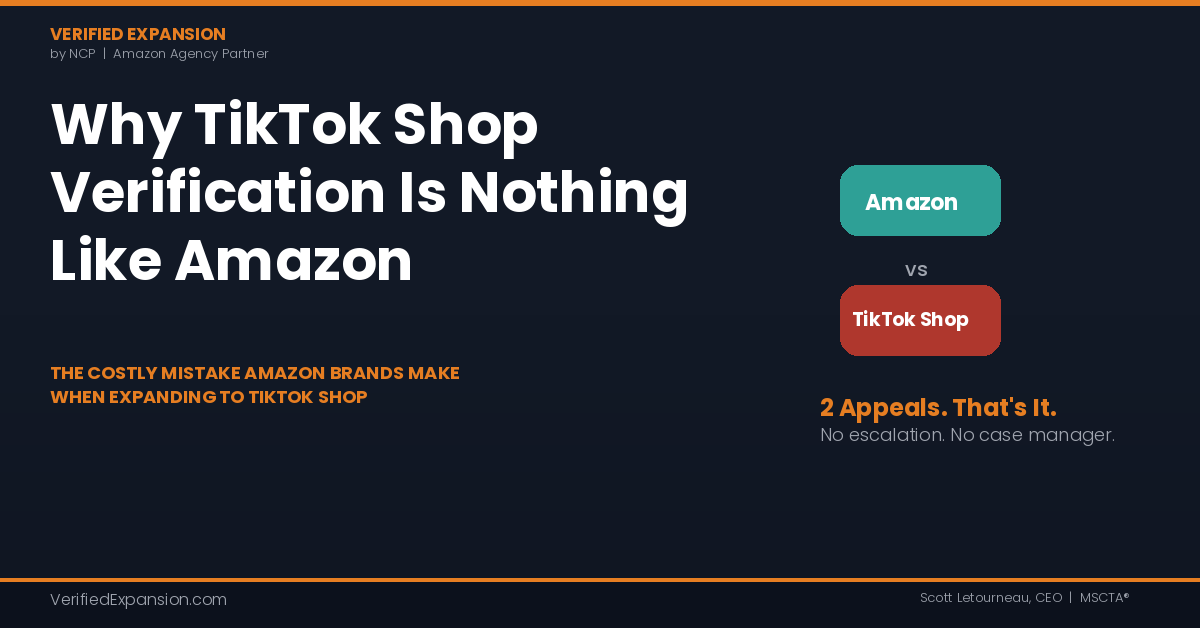
Amazon verification is a conversation. You go back and forth. You fix things. You escalate. Eventually, you get through.
TikTok Shop verification is a verdict. You submit. The system decides. And if it decides wrong, your options shrink fast.
On Amazon:
- Failed documents? Resubmit with corrections.
- Account suspended? Write a Plan of Action.
- Need help? Call Seller Support. Escalate to a case manager.
- Worst case? There is almost always a path back.
On TikTok Shop:
- Failed documents? The rejection is generic. TikTok does not tell you which document or field caused the failure.
- Account rejected? You get two appeals. Total. Each has a hard deadline.
- Need help? There is no case manager. No escalation path. No supervisor review.
- Worst case? Both appeals fail, and the decision is final. Permanently.
And here is the part that catches Amazon sellers completely off guard:
Every failed submission makes the next one harder.
TikTok’s system builds a cumulative risk score tied to your seller identity. Each rejection strengthens that score. Each botched appeal confirms it. The system is not giving you more chances to prove yourself. It is gathering more evidence against you.
On Amazon, persistence is rewarded. On TikTok Shop, persistence without precision is punished.
The Five Traps That Catch Amazon Sellers
We have worked with sellers across dozens of TikTok Shop verification failures. The same five problems keep coming up.
Trap 1: The Name Mismatch You Do Not See
On Amazon, minor name inconsistencies across your LLC registration, bank account, and seller profile are usually fixable through Seller Support.
On TikTok Shop, a single character difference between your entity name on one document and your entity name on another can trigger an automatic rejection. Not a flag for human review. An outright rejection.
And most sellers have at least one mismatch they do not even know about.
Trap 2: The Address That Looks Right But Is Not
Many Amazon sellers use registered agent addresses or virtual offices without issue. Amazon’s system accepts them.
TikTok’s system cross-references your address against multiple databases. Certain address types that work perfectly on Amazon are automatically flagged on TikTok Shop. Sellers do not find out until after the rejection hits.
The specific address matching requirements on TikTok are stricter than anything Amazon has ever enforced. And the rules are not published anywhere in TikTok’s public documentation.
Trap 3: The Tax Document Compliance Trap
This is the one that catches experienced international sellers completely off guard.
Amazon has a clear path for foreign sellers. TikTok Shop does not. The tax document TikTok requires creates a structural compliance problem for certain entity types that are perfectly valid on Amazon.
Sellers who do not catch this before submitting waste both their appeals on a problem that cannot be solved with better documents. It requires changes at the entity level.
By the time most sellers realize this, it is too late.
Trap 4: The Connected Account Death Spiral
Amazon detects linked accounts. But Amazon also provides reinstatement paths for most linked account situations.
TikTok’s connected account system is different. It monitors identifiers you might not think of. And when it flags a connection, enforcement does not just affect one account. It propagates across every account linked to that identity.
The worst version of this: A seller whose first application fails creates a new account to try again. The new account is immediately linked to the first. The risk score transfers. The second account is now harder to approve than the first one was.
We call this the “Fake Qualification” suspension loop. And once you are in it, document-level fixes will not get you out.
Trap 5: The “I Will Just Retry” Fallacy
On Amazon, if a document is rejected for quality, you take a better photo and resubmit. Simple.
On TikTok Shop, each failed submission counts against you regardless of the reason. A blurry scan. A cropped edge. A file format that the system cannot parse. Each one registers as a failed attempt.
The system does not distinguish between “bad document quality” and “suspicious seller.” It just sees another data point.
Sellers who rapid-fire resubmissions, thinking they are fixing a document problem, are actually building a fraud profile.
The “Fake Qualification” Problem
This is one of the most searched topics in TikTok Shop seller communities. And it is one of the least understood.
“Fake Qualification” does not mean TikTok thinks you are a scammer. It means the system has accumulated enough signals to classify your application as high-risk.
Those signals come from places most sellers never consider. Failed submissions. Document inconsistencies. Shared identifiers with other accounts. Address patterns. Device data.
Once the flag is applied, the account enters a loop. Appeal. Temporary reinstatement. Suspension returns. Each cycle strengthens the flag.
Here is what no one tells you: the longer you stay in the loop, the harder it becomes to break out. The system is designed to increase confidence in its assessment with each interaction. Time is not on your side.
The Real Cost of Getting It Wrong
A brand doing $50K or more per month on Amazon is looking at TikTok Shop as a growth channel. The opportunity is real. TikTok Shop surpassed $20 billion in US GMV.
If that seller fails verification and burns both appeals, they are looking at:
- 5 to 8 weeks minimum before they can attempt again (if they can attempt again at all)
- Entity restructuring costs that dwarf what a proper setup would have cost
- A full quarter of lost TikTok Shop revenue while competitors capture the market
- A permanent compliance headache that follows them across connected accounts
The seller who “saves money” by doing it themselves often ends up spending multiples of what professional preparation would have cost. Not on the setup. On the cleanup.
And some of them never get back in at all.
Who Needs to Pay Attention
Amazon Private Label Brands ($1M + revenue). You have a real brand. TikTok Shop is your next growth channel. Being locked out due to a preventable verification failure is not an inconvenience. It is a strategic loss that compounds every month you are not on the platform.
International Brands Selling Through US Entities. Your Amazon entity structure may not be compatible with TikTok Shop. The tax document trap (Trap 3) specifically targets the entity type that most international Amazon sellers use. If you do not catch this before submitting, you will waste both appeals on an unsolvable problem.
Established 3P Sellers Adding TikTok as a Channel. Your Amazon experience is an asset for selling. It is a liability for verification. The mental model Amazon gave you (“fix it later”) is exactly the wrong approach on TikTok Shop.
The Bottom Line
TikTok Shop verification is not harder than Amazon verification.
It is different.
Amazon gives you room to make mistakes. TikTok Shop does not.
Amazon tells you what went wrong. TikTok Shop does not.
Amazon provides escalation paths. TikTok Shop does not.
The biggest mistake Amazon sellers make is treating TikTok Shop like another Amazon. Assuming they can figure it out. Assuming they can fix it later. Assuming the system will work with them.
By the time they realize the system does not work that way, their two appeals are gone.
The first submission is the only one that matters. Not because the second one will not work. But because every failed attempt makes the next one harder.
Getting it right before you submit is not cautious. It is the only strategy that reliably works.
Next Step
If you are an Amazon brand preparing to expand to TikTok Shop, find out where your gaps are before you touch that submit button.
Not after you fail. Before you start.
We run a TikTok Shop Expansion Discovery Call specifically for Amazon brands. On the call, we will:
- Identify the specific verification risks in your current entity structure
- Show you where your documents are likely to fail before TikTok’s system flags them
- Tell you whether your situation requires entity-level changes or document-level fixes
- Map the fastest path to a verified, live TikTok Shop account
No fluff. No generic advice. A specific assessment of your specific situation.
This article is for educational purposes only and does not constitute legal or tax advice. TikTok Shop policies change frequently. Always verify current requirements directly with TikTok Shop Seller Center and consult qualified legal and tax professionals for your specific situation.
Author
Scott Letourneau
As CEO and Founder of Verified Expansion by Nevada Corporate Planners, Scott Letourneau drives the strategy for helping international ecommerce brands expand into U.S. marketplaces through correct entity formation, tax compliance, and platform verification. A licensed attorney practicing in Nevada and Idaho with 29 years of entity formation experience and over 7,000 filings, Scott holds the MSCTA® credential (MainStreet Certified Tax Advisor) and specializes in cross-border compliance for Amazon, TikTok Shop, Walmart, and Shopify sellers.