

What This Post Will Cost You If You Ignore It
A foreign-owned single-member LLC that misses one Form 5472 filing owes the IRS $25,000. Automatically. No warning. No grace period.
A partnership with foreign partners that fails to file on time? $255 per partner, per month, for up to 12 months. That adds up fast.
An S-Corporation that misses March 16? Same penalty. $255 per shareholder, per month.
These are not hypothetical numbers. These are the actual penalties the IRS assesses in 2026 for returns filed late or not filed at all.
This post covers every federal tax deadline, filing requirement, and penalty trigger for the 2026 tax filing season (for the 2025 tax year). If you own a U.S. entity, sell on U.S. marketplaces, or have foreign ownership in a U.S. business, this is your compliance map.
Bookmark this page. Share it with your CPA. Print the deadline table.
 What Changed for the 2026 Filing Season
Filing Season Opened January 26, 2026
The IRS began accepting and processing 2025 individual income tax returns on January 26, 2026. The federal filing or extension deadline is April 15, 2026.
The One, Big, Beautiful Bill Act (OBBBA)
The OBBBA introduced several changes that affect 2025 returns filed in 2026:
No Tax on Tips. Qualified tips are now deductible for eligible workers with income below certain thresholds. Tips must still be reported as income, but the deduction reduces taxable income.
No Tax on Overtime. Premium overtime pay may be deductible for eligible workers. Same reporting requirements apply.
Senior Bonus Deduction. Taxpayers age 65 or older may claim an additional $6,000 deduction on top of the standard or itemized deduction. Phases out at higher income levels.
SALT Cap Expanded. The state and local tax (SALT) deduction cap increased to $40,000, indexed for inflation. This matters if you operate in high-tax states.
Standard Deduction Increased. $15,750 for single filers. $31,500 for married filing jointly.
100% Bonus Depreciation. Restored for businesses. This affects equipment purchases, vehicle acquisitions, and other qualifying assets placed in service during 2025.
Car Loan Interest Deduction. Up to $10,000 deductible on new U.S.-assembled vehicles.
Trump Account. A new type of individual retirement account for children under 18.
Cryptocurrency and Digital Asset Reporting
For 2025 transactions, digital asset brokers are now required to issue Form 1099-DA for cryptocurrency and other digital asset transactions. This is new. Previous years used Form 1099-B or no broker reporting at all.
You still need Form 8949 to report crypto trades, sales, and dispositions on your return. Schedule 1 is used for income from staking, airdrops, or mining. But now the IRS has broker-reported data to compare against your return.
Key Individual Tax Deadlines for 2026
January 15, 2026 — Q4 2025 Estimated Tax Payments Due
The final installment of 2025 estimated tax payments for self-employed individuals or anyone owing more than $1,000 in taxes. This applies to calendar-year taxpayers. Fiscal-year taxpayers have different deadlines.
February 2, 2026 — W-2s and 1099-NEC/1099-MISC Due to Recipients
Employers must furnish W-2s to employees and 1099 forms (including 1099-NEC for contractors) to recipients. The statutory deadline is January 31, but that falls on a Saturday in 2026, pushing the deadline to the next business day.
April 15, 2026 — Tax Day
Individual Tax Returns (Form 1040 or 1040-NR): Required for U.S. residents and non-residents with U.S.-sourced income. Non-residents who received wages subject to U.S. income tax withholding must file by this date.
Digital Asset Reporting: File Form 8949 and report crypto income on Schedule 1. Reconcile against any Form 1099-DA received from brokers.
Q1 2026 Estimated Tax Payments: The first installment for 2026 estimated taxes is also due.
Extension (Form 4868): File for a six-month extension to submit your return by October 15, 2026. An extension to file is not an extension to pay. Taxes owed are still due April 15.
HSA and IRA Contributions: Last day to make HSA and IRA contributions for the 2025 tax year.
June 15, 2026 — Q2 2026 Estimated Tax Payments Due
Also the automatic filing extension date for U.S. citizens and resident aliens living abroad and for non-resident aliens who did not receive wages subject to U.S. income tax withholding (per Form 1040-ES(NR) instructions).
September 15, 2026 — Q3 2026 Estimated Tax Payments Due
October 15, 2026 — Extended Individual Tax Returns Due
If you filed Form 4868, your individual return is due on this date.
Key Business Tax Deadlines for 2026
February 2, 2026 — W-2s and 1099-NEC/1099-MISC Filing with IRS
Employers must file W-2s with the SSA and 1099 forms with the IRS. Same weekend adjustment as above.
March 16, 2026 — Partnership and S-Corporation Returns
March 15 falls on a Sunday, pushing this deadline to Monday, March 16.
Partnerships (Form 1065) and S-Corporations (Form 1120-S) must file returns or request an extension (Form 7004).
Penalty for late filing: $255 per partner/shareholder, per month, for up to 12 months. A 4-partner LLC that files 3 months late owes $3,060. Automatically assessed.
Form 1042 and 1042-S (Calendar-Year Basis). Form 1042 and 1042-S must be filed by any U.S. entity that made payments of U.S.-source income (such as dividends, interest, royalties, or rents) subject to withholding to foreign individuals or foreign entities during the calendar year. These forms are always based on the calendar year (January 1 through December 31), regardless of the entity’s fiscal year-end.
Form 1042 penalties: 5% per month for late filing (up to 25%), plus 0.5% per month for late payment of any tax due.
Form 1042-S penalties (information return): $60 per form if corrected within 30 days. $130 per form if corrected by August 1. $340 per form if later or not filed. $680 per form for intentional disregard with no annual cap. Maximum annual caps of approximately $4,098,500 for large businesses and $1,366,000 for small businesses (Rev. Proc. 2024-40, §6721).
Extensions: Form 1042 can receive a 6-month extension via Form 7004 (to September 15). Form 1042-S can receive an initial 30-day extension via Form 8809, plus a possible additional 30-day extension under special hardship conditions.
Partnership Withholding (Forms 8804 and 8805): Also due March 16. Required when a partnership has foreign partners and ECI. Reports withholding under Section 1446.
April 15, 2026 — C-Corporation and Foreign Entity Returns
C-Corporation Returns (Form 1120): Due for calendar-year C-Corporations. Extensions available until October 15, 2026, using Form 7004.
Form 1120-F: Foreign corporations engaged in a U.S. trade or business must file this return or request an extension with Form 7004.
Form 5472 and Pro Forma 1120 (Foreign-Owned SMLLCs): Foreign-owned single-member LLCs that are disregarded entities must file Form 5472 and a pro forma Form 1120 to report transactions with their foreign owner. This is required for any year with reportable transactions, including capital contributions, loans, management fees, and service provider payments. Even dormant entities that received a capital contribution have a filing obligation.
The penalty for failure to file or filing incomplete Form 5472 is $25,000 per form, per year. Automatically assessed.
Filing mechanics: Form 5472 cannot be e-filed. It must be mailed to the IRS at Ogden, UT. Send via Certified Mail with Return Receipt for proof of timely filing.
Q1 2026 Estimated Tax Payments: Also due for businesses.
Note: The previous version of this blog post listed a June deadline for Form 5472 for entities not engaged in a U.S. trade or business. The correct deadline is April 15, with a possible 6-month extension to October 15 via Form 7004.
September 15, 2026 — Extended Partnership and S-Corporation Returns
If you filed Form 7004, extended partnership (Form 1065) and S-Corporation (Form 1120-S) returns are due.
October 15, 2026 — Extended C-Corporation and Foreign Corporation Returns
For C-Corporations and foreign corporations that filed Form 7004, this is the extended deadline for Form 1120 and Form 1120-F.
Penalty Reference (Quick View)
These are the penalties in effect for returns filed in 2026:
Form 5472 (foreign-owned SMLLC): $25,000 per form, per year. Automatic. No statute of limitations on unfiled returns.
Form 1065 (partnership): $255 per partner, per month, up to 12 months.
Form 1120-S (S-Corporation): $255 per shareholder, per month, up to 12 months.
Form 1120 (C-Corporation): 5% of unpaid tax per month for late filing, up to 25%.
Information returns (W-2, 1099, 1042-S): $60 if corrected within 30 days; $130 if corrected by August 1; $340 if later or not filed. Intentional disregard: $680 per form.
Estimated tax underpayment: Varies by amount and period. Generally assessed as interest on the shortfall for each quarter.
FBAR (FinCEN 114): $16,536 per account per year for non-willful violations. $165,353 or 50% of account balance for willful violations. Note: Under Bittner v. United States (2023), the Supreme Court ruled that non-willful FBAR penalties are assessed per report, not per account.
Case Studies: Filing Obligations by Entity Type
Disclaimer: The following case studies are for illustrative purposes only. A full set of facts must be considered for your specific situation. Consult with a qualified U.S. tax professional to determine your actual filing obligations.
Scenario 1: Foreign-Owned Single-Member LLC (Disregarded Entity)
Case A: The LLC Has a U.S. Trade or Business (USTOB) and Effectively Connected Income (ECI)
Facts: An Australian Amazon seller owns a U.S. single-member LLC selling products via Amazon FBA. The LLC uses U.S.-based warehouses and generates U.S.-sourced income, qualifying as engaged in a USTOB with ECI.
Required filings:
1. Form 5472 + Pro Forma 1120 — to report transactions between the LLC and its foreign owner. Due April 15, 2026. Cannot be e-filed. Mail to IRS Ogden, UT via Certified Mail.
2. Form 1040-NR — to report U.S.-sourced ECI. Due April 15, 2026 (if the owner received wages subject to U.S. income tax withholding), or June 15, 2026 (automatic extension for NRAs who did not receive such wages, per Form 1040-ES(NR) instructions).
3. Form 8833 — if claiming tax treaty benefits (e.g., reducing or eliminating tax liability under the U.S.-Australia treaty). Treaty benefits are not automatic. The income must qualify as business profits under the treaty, and the non-resident must not have a permanent establishment (PE) in the U.S. If these conditions are not met, the treaty does not apply.
4. State Sales Tax — If the business sells on a non-marketplace website (e.g., Shopify), the LLC may need to register and file state sales tax returns where it meets economic nexus thresholds ($100,000 or 200 transactions in many states) or has physical nexus (inventory in FBA warehouses). Sales through Amazon are typically handled under Marketplace Facilitator Laws.
5. FBAR (FinCEN 114) — Required if the LLC has foreign bank accounts exceeding $10,000 at any time during the year. Due April 15, 2026, with automatic extension to October 15.
Case B: The LLC Has No USTOB and Has FDAP Income
Facts: The same seller uses a single-member LLC that owns intellectual property but does not operate within the U.S. The LLC earns royalties from U.S.-based activities classified as FDAP (Fixed, Determinable, Annual, Periodical) income.
Required filings:
1. Form 5472 + Pro Forma 1120 — to report transactions between the LLC and its foreign owner. Same filing mechanics as above.
2. Form 1042-S — to report FDAP income paid to the foreign owner, subject to 30% withholding unless reduced by a tax treaty.
3. Form 1042 — to summarize withholding activities reported on Form 1042-S. Due March 16, 2026.
Scenario 2: Partnership with Foreign Partners
Case A: The Partnership Has USTOB and ECI
Facts: A multi-member U.S. LLC taxed as a partnership has two foreign partners. The LLC sells on Amazon FBA, operates U.S. warehouses, and generates U.S.-sourced ECI.
Required filings:
1. Form 1065 — partnership return reporting income and allocations to each partner. Due March 16, 2026. Late filing penalty: $255 per partner, per month.
2. Forms 8804 and 8805 — partnership withholding on ECI allocated to foreign partners under Section 1446. Due March 16, 2026.
3. Form 1040-NR — each foreign partner must report their share of ECI. Due April 15 or June 15 depending on withholding status.
4. State Sales Tax — same nexus analysis as Scenario 1.
5. Treaty Analysis — foreign partners may be exempt from U.S. tax on business profits unless they have a fixed base or PE in the U.S. Requires Form 8833 and careful analysis.
Case B: The Partnership Has No USTOB and Has FDAP Income
Facts: The LLC has passive income (U.S.-sourced royalties or interest) but no operational U.S. presence. Income is classified as FDAP.
Required filings:
1. Form 1065 — still required even though income is FDAP. Due March 16, 2026.
2. Form 1042-S — to report FDAP income paid to foreign partners, subject to 30% withholding or reduced by treaty.
3. Form 1042 — to summarize annual withholding for FDAP income. Due March 16, 2026.
Note: Forms 8804 and 8805 are not required for FDAP income. Withholding on FDAP is reported via Forms 1042 and 1042-S instead.
Three Levels of U.S. Tax Exposure
Most non-resident sellers underestimate their U.S. tax exposure. Here is how to think about it:
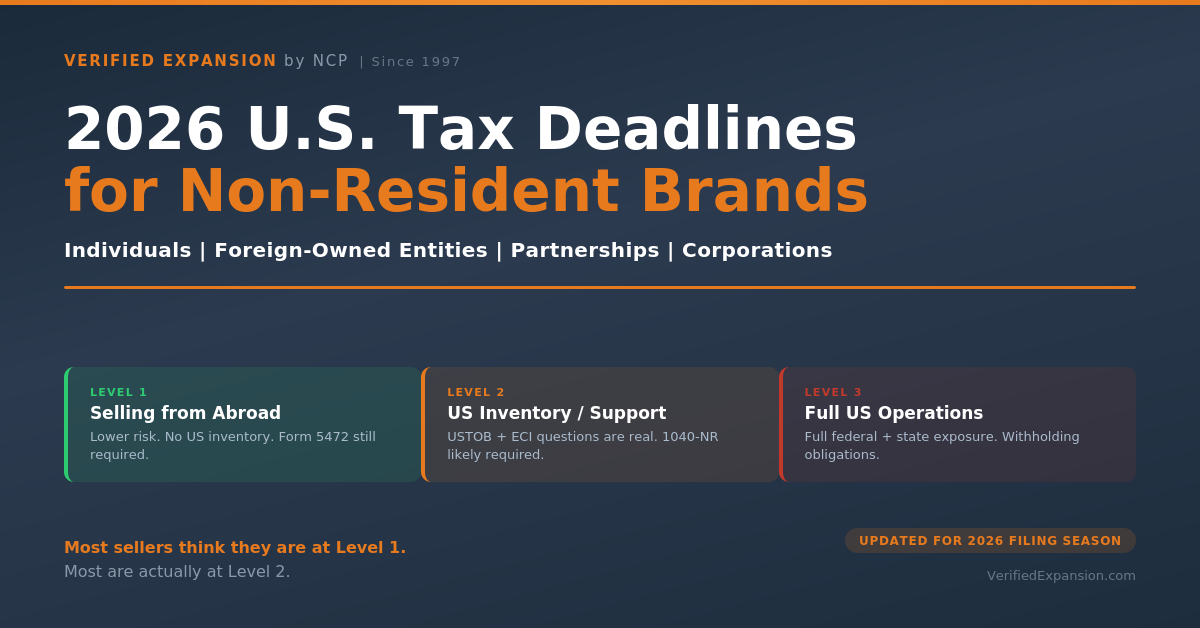
Level 1: Selling from Abroad. No U.S. inventory. No employees or agents in the U.S. Lower risk, but Form 5472 + pro forma 1120 is still required for any year with reportable transactions. $25,000 penalty per year if missed.
Level 2: U.S. Inventory or Support. Using FBA warehouses, a 3PL provider, or any U.S.-based operations. USTOB and ECI questions become real. 1040-NR is likely required. State sales tax obligations trigger. Transfer pricing documentation becomes a best practice for penalty protection under §6662(e).
Level 3: Full U.S. Operations. Employees, office space, or significant U.S. decision-making. Full federal and state tax exposure. Withholding obligations. Estimated quarterly payments. Partnership withholding under Section 1446 if foreign partners are involved.
Most sellers think they are at Level 1. Most are actually at Level 2. Your exposure depends on operating facts, not the platform.
What Should You Do Next?
If you own a foreign-owned U.S. entity or sell on U.S. marketplaces through a U.S. structure, the deadlines in this post are not optional. Missing one triggers penalties that are automatically assessed and difficult to reverse.
The first step is knowing where you stand.
Book a free 15-minute discovery call with our team. We will ask a few questions about your entity type, ownership structure, and current filing status, then tell you exactly which deadlines apply and whether your setup has gaps that need attention. No sales pitch. Just routing.
👉 Book your discovery call here
Or email support@launchwithconfidence.com with a brief description of your situation, and we will point you in the right direction.
Disclaimer: This blog is for informational and educational purposes only. It does not constitute tax, legal, or financial advice. Always consult a qualified professional for advice tailored to your specific situation.