

Navigating U.S. tax for non-resident Amazon sellers
Navigating U.S. tax as a non-resident Amazon seller turns on two domestic tests first, then a treaty filter.
The correct order is simple.
Decide whether you are engaged in a U.S. trade or business (USTOB). If yes, decide whether your profit is effectively connected income (ECI). Only then apply any treaty permanent establishment (PE) relief.
Conflicting advice usually comes from mixing these steps together or skipping one entirely.
The three-level framework
Most non-resident sellers fall into one of three levels. Each level carries different filing obligations, different risks, and different costs if you get it wrong.
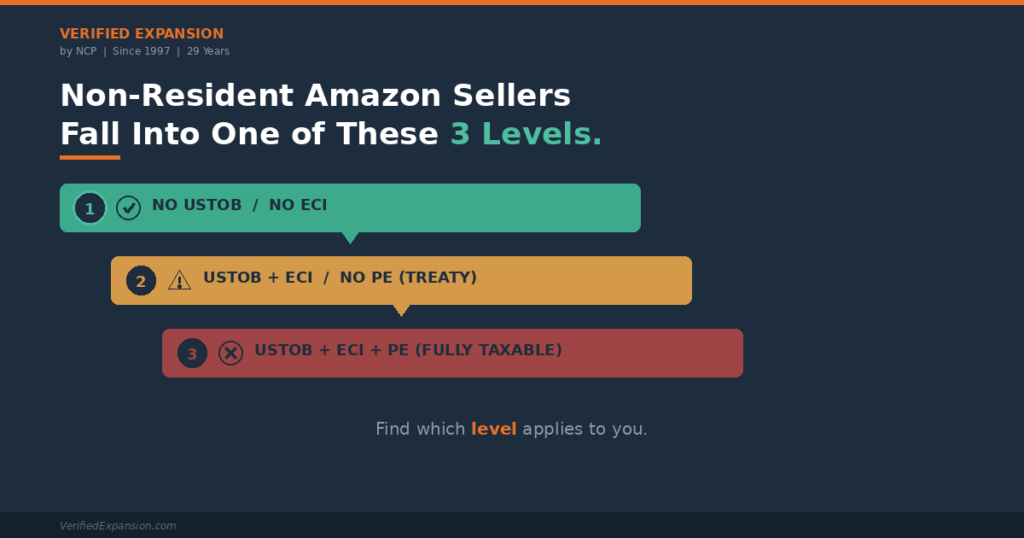 Level 1: No USTOB and no ECI
Your U.S. activity is not considerable, continuous, and regular. You do not have a U.S. trade or business, and there is no ECI.
Typical pattern: You do not use Amazon FBA or a U.S. warehouse. All orders are fulfilled from outside the United States. You have no U.S. office, staff, or dependent agent.
At this level, your filing obligations are limited. But even here, a foreign-owned disregarded LLC has reporting requirements in years with related-party transactions. And some sellers choose to file protective returns as risk management.
The problem? Many sellers assume they are at Level 1 when their facts actually put them at Level 2.
Level 2: USTOB and ECI, but no PE under a treaty
Under domestic rules, you have a U.S. trade or business, and your profits are effectively connected income. But under your tax treaty, you may have no permanent establishment.
Typical pattern: Year-round Amazon FBA with U.S. inventory cycles, continuous restocking, and active selling. This is where most FBA sellers land.
This level carries real filing obligations. The specific returns depend on your entity type (individual, foreign corporation, partnership, or disregarded LLC). Get the filing wrong, and the consequences are serious.
If you do not file a timely return and the IRS later asserts USTOB, you lose the right to claim deductions. The IRS can assess tax on gross income with no offset for cost of goods sold or expenses. The cost of that mistake far exceeds the cost of filing correctly.
Treaty disclosure requirements also apply here. Failure to disclose a treaty position carries its own separate penalty.
Level 3: USTOB, ECI, and a PE
You have a U.S. trade or business, your income is ECI, and you also have a permanent establishment. This happens when you carry on business through a U.S. fixed place of business or a dependent agent habitually concludes contracts on your behalf.
At this level, you are fully subject to U.S. taxation. Foreign corporations may also owe branch profits tax. The default rate is 30%, though many treaties reduce or eliminate it.
States likely require income, franchise, and sales or use tax filings as well.
Why most FBA sellers are not at Level 1
Most FBA sellers sell to U.S. customers throughout the year, place their own inventory in U.S. warehouses, and run pricing, content, ads, and restocking in repeat cycles.
Together, those facts typically meet the USTOB threshold and make profits ECI under domestic law.
The independent-agent argument you may have heard about belongs to the treaty analysis (PE), not the domestic analysis (USTOB). It can support a no-PE claim at Level 2. It does not eliminate the domestic obligation.
There is no bright-line dollar threshold. The pattern controls. Short pilots with no restock, inventory present but no listings or filled orders, or ultra-sporadic seasonal activity are edge cases. But consistent FBA selling with regular restocking is not an edge case.
Why professionals disagree
This is where sellers get caught.
Different tax professionals give different answers because they are mixing the layers. The most common mistakes we see:
Importing treaty logic into the domestic test. The dependent-agent concept belongs to the PE analysis, not the USTOB analysis. When a professional says “Amazon is an independent contractor, so you don’t have USTOB,” they are applying the wrong test at the wrong step.
Underweighting the asset-use test. ECI can be established through the asset-use test alone. If your inventory is in a U.S. warehouse, the asset-use test likely applies. Some professionals skip this and only analyze business activities.
Overlooking state obligations. Treaties do not bind the states. You can owe zero federal income tax under a treaty and still have state income, franchise, and sales tax obligations. This is one of the most frequently missed exposures.
Repeating the myth that “no dependent agent” means “no U.S. tax.” This statement confuses the domestic and treaty analyses. It is incomplete at best and wrong at worst.
The W-9 trigger for TikTok Shop sellers
In 2025, TikTok Shop required every U.S. seller to submit a W-9.
If you are a foreign-owned brand that formed a U.S. entity to meet this requirement, the same three-level framework applies to you.
The W-9 was the front door. What sits behind it depends on your entity type and your level in the framework above.
C-Corps face transfer pricing compliance and quarterly estimated tax payments.
Partnerships face partnership return filings, K-1s to foreign partners, withholding obligations, and quarterly payments.
Single-Member LLCs (disregarded entities) may have a structural problem. The W-9 is designed for U.S. persons. A foreign-owned disregarded entity may not meet the W-9 requirement. That is not a filing gap. That is a structural mismatch.
The W-9 does not create the tax obligation. Your U.S. activity and entity structure do. The W-9 simply made the obligation visible.
Sales tax: a separate system that treaties do not cover
Federal income tax and state sales tax are completely separate.
A treaty that eliminates your federal income tax has zero effect on your state sales tax obligations.
If you have inventory in U.S. FBA warehouses, you have physical nexus in every state where that inventory is stored. Amazon moves inventory across its fulfillment network, which means your products may be in states you have never considered.
Most major marketplaces now collect and remit sales tax as marketplace facilitators in the majority of states. But this does not cover everything.
Direct sales through Shopify, your own website, wholesale, or B2B channels are generally not covered. Some states require you to register and file returns even when the marketplace collects on your behalf. Economic nexus thresholds apply based on sales volume, independent of physical inventory.
This is a separate compliance obligation that requires its own review.
Transfer pricing: the gap that compounds every time you move money
If your U.S. entity is profitable and you are moving money back to your home country, those are related-party transactions.
Management fees. Service fees. IP charges. Distributions disguised as invoices.
Without proper documentation, those payments have no defensible basis. The IRS can reclassify them. Your home country tax authority can tax them again. That is double taxation from both sides.
This is not theoretical. It happens. And it compounds every time money moves.
This applies at every level of the framework. Even if you claim no PE under a treaty and owe zero U.S. federal income tax, the transfer pricing question is separate. The IRS uses Form 5472 data to identify these issues.
If you are repatriating profits without documentation, this is the single highest-risk gap we see for non-resident sellers right now.
The real question
Most non-resident sellers reading this do not know their current level.
They formed an entity. They started selling. Revenue grew. Nobody mapped the entity’s tax position.
The three-level framework is the starting point. But applying it to your specific facts, your entity type, your treaty country, your sales channels, and your profit repatriation method requires an analysis, not a blog post.
CEO Blueprint: get the analysis done
The CEO Blueprint ($1,250) is how we do that analysis.
Two calls with Scott Letourneau, MSCTA®. A written plan up to 10 pages delivered in 3 business days. Specialist matching to the right CPA, tax attorney, sales tax compliance firm, or transfer pricing expert based on your structure and risk profile.
On the first call, Scott will:
Confirm your level. USTOB, ECI, and PE analysis based on your actual facts, entity type, and treaty country.
Flag your exposure. Federal income tax, state sales tax, transfer pricing, and any structural mismatches in your W-9 or W-8 filing.
Map your filing stack. What needs to be filed, in what order, by what deadline, and by whom.
Match you to specialists. Not a generic list. A personal match based on your structure, your risk profile, and the complexity of your situation.
You leave with a recording, a transcript, and a written plan you can execute with confidence.
This blog post is general information for educational purposes. It does not constitute legal, tax, or accounting advice. Consult your licensed CPA, tax attorney, or enrolled agent for guidance specific to your situation.
Frequently asked questions
Do non-resident Amazon FBA sellers owe U.S. taxes?
It depends on whether you have a U.S. Trade or Business (USTOB) and Effectively Connected Income (ECI) under domestic law, and whether a tax treaty provides Permanent Establishment (PE) relief. Most FBA sellers with year-round inventory in U.S. warehouses meet the domestic thresholds. A treaty may reduce or eliminate the federal income tax, but the domestic analysis must come first. State sales tax is a separate obligation not affected by treaties.
Does Amazon FBA create a U.S. Trade or Business?
In most cases, yes. Sellers who place inventory in U.S. warehouses, run pricing and advertising continuously, and restock regularly meet the “considerable, continuous, and regular” threshold. The independent-agent argument applies only at the treaty level when analyzing PE, not at the domestic level when analyzing USTOB.
What is the difference between ECI and Permanent Establishment?
ECI is a domestic U.S. tax concept. PE is a treaty concept. You determine USTOB and ECI first under domestic law, then check whether a treaty reduces or eliminates taxation based on PE. Mixing these two analyses is the most common reason for conflicting advice.
Should I file a protective return even if I believe I’m at Level 1?
Many sellers do, and for good reason. If the IRS later asserts that you had USTOB and ECI, a timely filed return preserves your right to claim deductions and starts the statute of limitations. Without a timely return, the IRS can assess tax on gross income with no offset for expenses. The cost of filing is small relative to that downside.
Do I owe sales tax even if Amazon collects it?
Sales tax is a separate system from federal income tax. Marketplace facilitators collect and remit in most states, but this does not always cover direct sales, wholesale, B2B transactions, or states that require registration and filing even when the marketplace collects. If you have physical inventory in FBA warehouses, you have nexus in every state where inventory is stored.
What happens if I move profits to my home country without proper documentation?
Payments between related entities without a defensible basis can be reclassified by the IRS. Your home country tax authority can also tax them. This creates double taxation risk that compounds every time money moves between the entities.
Does selling on TikTok Shop create the same obligations as Amazon FBA?
The marketplace itself does not create the tax obligation. Your U.S. activity and entity structure do. If you formed a U.S. entity and submitted a W-9, the three-level framework applies regardless of platform.