

Your U.S. company can keep the same LLC, EIN, and TikTok Shop while the people behind it change. Most founders assume that means nothing else has to change. TikTok does not see it that way.
A new shareholder. Your parent company taking over ownership. The U.S. representative who steps away. One tax election. Each can trigger a new review, a document request, or, in one case, a planned sales pause. Here are the five changes, what each one touches, and the question to answer before you make it.
One distinction drives everything below: changing who owns a U.S. company and changing the legal entity that operates the shop are two separate events. Established brands mix them up, usually after the shop is already producing revenue.
Why Ownership Structure Matters Before You Register
An established brand in Australia, the U.K., or Europe already has a company, suppliers, trademarks, and banking at home. When it enters the United States, one decision comes first:
Should the U.S. company be owned by the founder personally, or by the existing foreign company?
Both can work. They are not interchangeable. The choice decides:
- Which individuals must be verified as beneficial owners
- Which identity documents each of them must produce
- How the U.S. company is taxed and what it reports
- How money moves between the U.S. company and its foreign owners
- What a future investor, restructuring, or acquisition will require
The goal is a structure that still works in year three. Month-one approval is the easy part.
The Five Changes
Each one asks a different question. A single transaction can trigger more than one.
1. Direct Ownership Change: Who Legally Owns the U.S. Company?
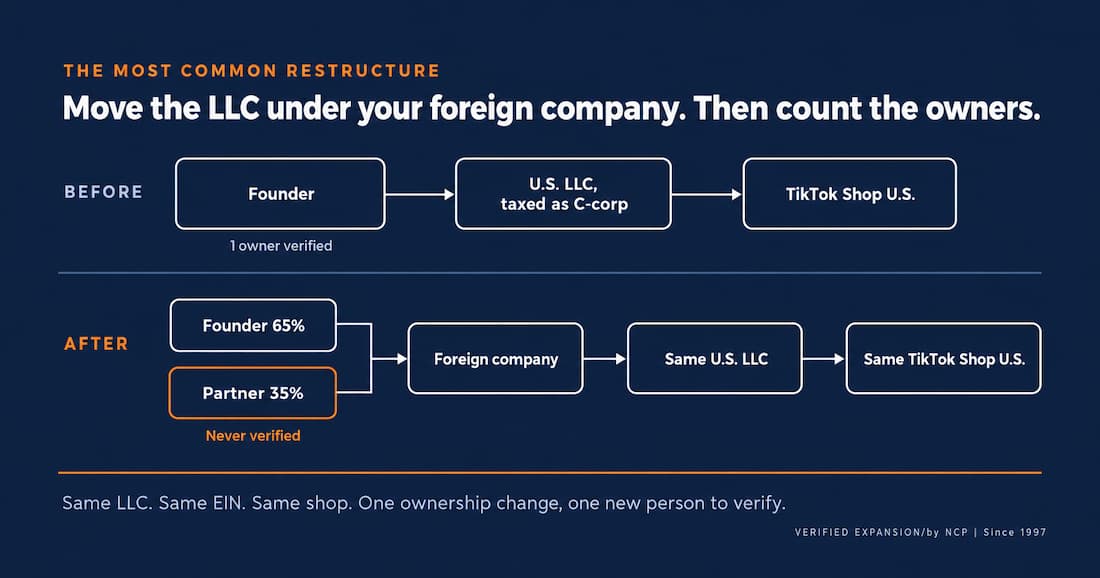
A founder forms a Wyoming LLC, elects C-corporation tax treatment, and owns it personally. A year later the founder moves ownership to the home-country company.
Before: Founder → U.S. LLC → TikTok Shop U.S.
After: Foreign company → same U.S. LLC → same TikTok Shop U.S.
The LLC did not change. The EIN did not change. The seller on record did not change. That is a different event from moving the shop to a new corporation.
It still has consequences. The company’s ownership records change. TikTok’s ownership declaration changes. The transfer itself can carry U.S. and home-country tax consequences, because moving an LLC interest after a corporate election is a transaction with its own tax treatment.
The question: if the seller and EIN stay the same, what ownership information must you update with TikTok, and where? TikTok’s published entity-change guide covers a change of legal seller. It does not publish a standalone procedure for this situation.
2. Beneficial Owner Change: Who Owns the Company Behind the Company?
TikTok Shop defines an Ultimate Beneficial Owner as an individual who directly or indirectly owns 25% or more of the seller. A company can have several. TikTok looks through the foreign parent to find them.
A German founder owns 65% of her GmbH. Her co-founder owns 35%. She sets up the U.S. LLC personally and gets the shop approved with one UBO verified. A year later, the GmbH takes over the LLC.
Founder (65%) + Co-founder (35%) → GmbH → U.S. LLC → TikTok Shop U.S.
Same LLC. Same EIN. Same shop. Two UBOs now, and the co-founder has never been asked for a passport. TikTok accepts non-U.S. passports for UBO verification, so the document exists in theory.
The real questions are whether the co-founder has a valid one and whether the update triggers a fresh review of the whole account.
The same thing happens when an investor buys 30%. The seller on record does not move. The people behind it do.
The question: who will own 25% or more, directly or indirectly, before and after the transaction, and can every one of them clear identity verification?
3. Legal Seller Change: Is a Different Company Taking Over the Shop?
This is the one TikTok has documented. Since mid-2026, eligible U.S. shops can move from one legal seller to another through the Qualification Center without losing sales history. The guide is titled “Changing Your Seller Entity” and was last revised October 23, 2026.
It covers ABC LLC becoming XYZ Inc. It does not cover a shareholder buying into ABC LLC while ABC LLC stays the seller. Those are different events, and only one applies to this process.
The procedure requires new entity details, the new Primary Representative, new UBO information (where required), and a signed novation agreement that moves the contract from the old seller to the new one. What it costs you while TikTok reviews it:
- Sales pause for the length of the review
- Funds frozen from submission until 24 hours after approval
- No pending withdrawals allowed at submission; every prior withdrawal must settle first
- Bank account unbound; payouts wait for an account in the new entity’s name
- Brand qualifications invalid; category approvals re-applied
- Official Shop badge removed and re-applied
- One entity change request allowed every three months
- Novation agreement signed and dated within three months of submission
- Seller Center owner account transferred to the new entity before the request can be filed
For a brand with inventory in a U.S. warehouse and ad spend running, that is a planned outage with a bill attached. Every detail submitted must match Seller Center records exactly, and eligibility isn’t automatic.
The question: are you changing shareholders, or is an entirely different legal entity becoming the seller? The answer decides whether this process even applies.
4. U.S. Business Representative Change: What Happens When That Person Leaves?
The representative is a separate question from ownership. A UBO is identified by equity. The U.S. Business Representative is the U.S.-based individual authorized to act for the company and complete identity verification. They can be different people. A foreign founder can own 100% of the corporation while a U.S.-based person represents it.
Now that representative takes a job elsewhere. The company keeps its name, EIN, shareholders, bank account, and shop. One person needs to change.
Ownership stays the same. The legal seller stays the same. Here is the problem: the only route TikTok documents for naming a different representative on an existing shop sits inside the Seller Entity Change application in section 3. The new person is submitted as part of moving the shop to a different company.
Seller Center has no field to change the person on a company that stays the same, and it’s untested whether TikTok’s flow would accept the same company with only a new representative.
Read that against the cost list above. On the published route, replacing one person carries the same sales pause, fund freeze, and qualification reset as selling the shop to another company.
Our position until TikTok publishes otherwise
Structure every foreign-owned shop as if you can’t replace the U.S. Business Representative without a full review. Choose a real person with a stake in your business. Document the role before registration. Decide now what happens if that person steps away. A representative you keep for five years beats one you replace in five months.
Replacing a representative deserves its own article, including what TikTok’s partnerships team told us and why carefully choosing brands never need the answer. That piece is coming next.
The question: if the company and EIN stay the same, what is TikTok’s approved route to a new representative, and what does the shop go through while it happens?
5. Tax Classification Change: Same LLC, Taxed Differently
A U.S. LLC is a state-law entity. The IRS tax treatment is a separate election. A single-member LLC is disregarded by default and can elect corporate taxation. That election doesn’t create a new company, and transferring ownership of an LLC that already has a corporate election doesn’t erase it.
Why it matters on TikTok: the platform collects U.S. tax information during onboarding. A foreign-owned single-member LLC without an election cannot complete that step cleanly because the tax form must include the owner’s identity, and the owner is foreign. Make the classification decision before registration, while you still have a choice.
The election also changes what the company reports:
- Corporate income tax filings
- Form 5472 reporting on related-party transactions
- Transfer pricing between the U.S. company and the foreign parent
- Tax consequences of any later transfer of the LLC interest
- Home-country treatment of the U.S. entity
The question: does the proposed change touch ownership, tax classification, or both, and will the tax information TikTok already holds still be accurate afterward?
One Decision, Several Consequences
Take an established European brand preparing a TikTok Shop U.S. launch. The founder owns the home company with a co-founder. The plan: a U.S. LLC taxed as a C corporation, with a U.S. Business Representative.
Option A: the founder owns the U.S. LLC personally. One UBO to verify. The U.S. company sits outside the group.
Option B: the home company owns the U.S. LLC. The U.S. company sits inside the group. Every 25% indirect owner gets verified.
Neither is automatically right. The answer depends on tax position, shareholder agreements, financing, and where the profit is meant to land. The mistake is choosing A because it registers faster, then discovering after the shop grows that B was the structure the business needed, and that fixing it means triggering changes one, two, and possibly four at once.
Five Questions to Answer Before You Register or Restructure
- Who should own the U.S. company? The founder, the existing foreign company, or another group entity. Decide for year three, not month one.
- Who are the beneficial owners? List every individual with 25% or more ownership, direct or indirect. Confirm each can produce accepted identification.
- Who represents the company in the U.S.? Confirm they qualify, document the authorization, and decide what happens if they leave.
- Is the tax classification right? For the platform, the parent, and the home country.
- What happens when the business changes? New investor, restructuring, acquisition, representative succession. Which of the five changes does each one trigger?
U.S. Expansion CEO Blueprint
Map the change before you make it.
A written plan for established foreign-owned brands that covers who should own the U.S. company, who must be verified, who represents it, how it is taxed, and what each future change will require. Three levels, starting at $1,250.
You leave with the sequence, the consequences of each change known before you make it, and introductions to the tax attorneys and CPAs who handle the specialist work. The change happens on your schedule, with nothing waiting to surprise you.
7,000+ foreign and U.S. founders served since 1997
Frequently Asked Questions
Can I change the owner of my U.S. LLC without changing the TikTok Shop’s legal entity?
Generally, the LLC stays the same legal entity when its membership interest transfers. Ownership and UBO records still change, and TikTok’s public guidance doesn’t publish a standalone procedure for that update. Confirm the route before the transfer, not after.
If my foreign company owns the U.S. LLC, does every shareholder need a passport?
Only individuals at 25% or more, direct or indirect. TikTok accepts non-U.S. passports for UBO verification. Check each person’s documents before choosing the structure.
Can I replace my U.S. Business Representative without selling the company?
Replacing a representative is a different event from selling a company or moving the shop to a new seller. TikTok has not published a general procedure for replacing a representative without changing the company. Treat the representative decision as a long-term one.
Does a shareholder change force me into TikTok’s entity-change process?
Not by itself. That process applies to a change in the legal seller. A shareholder transaction that leaves the seller on record unchanged is a different event, with its own disclosure questions.
Does renaming my U.S. company count as an entity change?
No. It’s the same company, same EIN; the new name is entered through the Edit function under Company information in Seller Center, alongside the registration document, address, and primary product. It does not touch the representative. An entity change means a different company with its own EIN, even if the same people own it.
Should I form the U.S. LLC before deciding who owns it?
For an established brand, no. Decide the ownership structure first. It sets the UBO list, the tax election, the banking, and the representative plan, and changing it after approval triggers the questions above.
Official TikTok Shop References
- Changing Your Seller Entity (TikTok Shop Academy, revised October 23, 2026)
- What Documents Do I Need to Register as a Corporation or Partnership? (TikTok Shop Academy)
- How to Set Up Your TikTok Shop (TikTok Shop Academy)
This article is educational and is not legal or tax advice. Scott Letourneau holds the MSCTA® (MainStreet Certified Tax Advisor) credential and is not an attorney or CPA. Verified Expansion is not a law firm or an accounting firm and does not provide legal or tax advice. We coordinate with independent licensed professionals for legal and tax execution. TikTok Shop policies, eligibility rules, and verification procedures change; confirm current requirements before acting.
Nevada Corporate Planners is a TikTok Shop Partner. Partner status does not guarantee account approval, reinstatement, or any exception to platform policy.
VERIFIED EXPANSION/by NCP | Since 1997