Someone asked you to be their U.S. Business Representative on TikTok Shop. Before you answer, understand what you are agreeing to.
Or maybe you are the brand owner asking the other version of this question: how do I get a U.S. person to say yes to this role?
Both questions land in the same place. Before anyone provides an ID, a residential address, taxpayer information, or completes TikTok’s identity verification, both sides should understand exactly what the role involves.
Because a U.S. Business Representative is a real position connected to a real business, and it deserves to be treated that way.
Updated August 2026 to reflect TikTok Shop’s current U.S. Business Representative, UBO, identity verification, proof of address, facial verification, re-verification, and business document requirements.
What is a U.S. Business Representative for TikTok Shop?
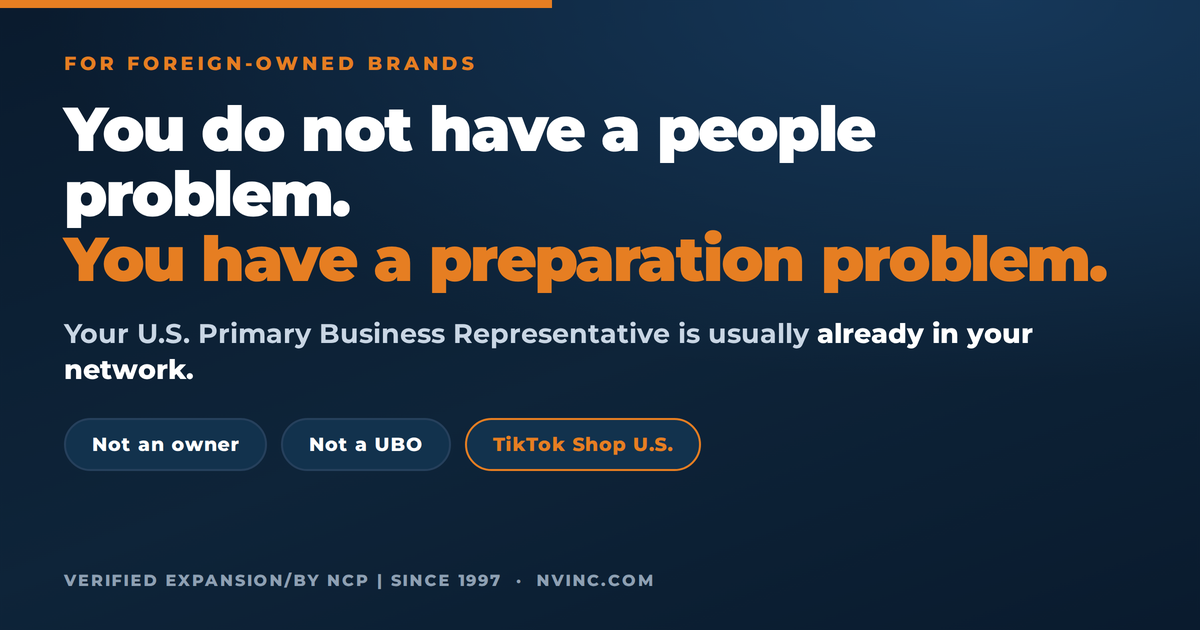 A U.S. Business Representative is a person based in the United States who is authorized to conduct business on behalf of the company operating the TikTok Shop. TikTok’s Seller Center labels this role the Primary Representative, and you will also see it written as Primary Business Representative or PBR. Same role, same obligations, same checks. We use U.S. Business Representative because the requirement that the person be based in the United States is the whole reason the role exists for foreign-owned brands.
This person does not have to own the company. TikTok’s own guidance indicates the role can range from a CEO to an entry-level marketing employee, which tells you something useful: TikTok is looking for an identifiable, U.S.-based individual who has been authorized to act for the business, not a shareholder.
Your legal identity and your U.S. residential address anchor the account to a real person in the United States. That is the function of the role.
You are not a co-signer. You are the identity the account is built on.
Is the U.S. Business Representative the same as a UBO?
No. These are two different roles, and confusing them is one of the most common mistakes on the seller side.
TikTok defines an Ultimate Beneficial Owner (UBO) as an individual who directly or indirectly owns at least 25% of the company. A company can have several UBOs, and those owners may be foreign. TikTok’s current guidance permits a non-U.S. passport for UBO verification.
The U.S. Business Representative is different. That individual is based in the United States and authorized to act for the company.
Here is what that looks like in practice. A U.S. corporation could be owned by three individuals living in Germany. Those three are disclosed as UBOs. A separate person living in the United States serves as the company’s U.S. Business Representative. The two roles sit side by side.
The representative should never be presented as an owner simply because the actual owners live outside the United States.
Does the representative become an owner of the company?
No, and this is the fear that stops most family and friend candidates from saying yes.
Serving as a U.S. Business Representative does not make someone an owner. Not equity. Not voting rights. Not a 25% stake. Not UBO status. The person is an authorized representative of the business, not a partner in it, and the agreements between the company and the representative are where that boundary gets made explicit.
If you are the brand owner and the thing stopping your sister, brother, or friend is “I don’t want a piece of your company and I don’t want responsibility for your business,” that concern is answerable. It is built on a structure that does not have to apply here.
If you are the candidate, this is the first question to get answered in writing before you agree to anything.
What does TikTok actually ask from the U.S. Business Representative?
TikTok requests information used to verify both the identity and the authority of the representative. Depending on the application and the verification flow, that can include:
- legal name
- date of birth
- U.S. residential address
- taxpayer information
- government-issued identification
- proof of residential address
- identity authentication
TikTok currently recognizes U.S. identity documents including certain U.S. passports, driver’s licenses, state IDs, and Permanent Resident Cards for its U.S. business registration identity verification process. TikTok may also request supporting business documentation, and in some situations a Letter of Authorization confirming that the individual has authority to act for the company.
That last item is worth sitting with. A platform that asks for an authorization letter is treating this as an actual representative relationship, not as permission to borrow an ID.
Does TikTok use facial verification?
TikTok’s current Seller Identity Verification policy indicates it may collect a government-issued photo ID, a selfie or photo, and facial data. TikTok uses a third-party identity verification provider, which may use facial-recognition technology to determine whether the identification document matches the person completing verification.
For anyone considering this role, that changes the nature of the ask. The process has moved away from “send a picture of your driver’s license” and toward “the real person connected to this identity may need to participate personally.”
Which means a representative should be someone who understands the role and expects an ongoing relationship with the business, because a person who cannot be reached later is a problem waiting to surface.
One thing to confirm before your ID is uploaded
When your ID is uploaded, TikTok reads it automatically and fills in the name fields for you. That reading is not always right. It can merge a first and middle name, drop a second surname, or split a compound family name in the wrong place.
The consequence lands on you. A mismatch between what the platform filled in and what your documents actually say produces a rejection, and that rejection attaches to your identity record, not only to the company’s application.
Before you agree, ask one question: who is checking those fields against my actual documents before anything is submitted? If the answer is nobody, or if the person asking has not thought about it, that tells you how the rest of this will go.
Will TikTok need the representative again after approval?
Yes, and this is the part almost nobody explains to the candidate.
This is no longer inference. TikTok formalized identity re-verification in a policy published June 30, 2026. Sellers can be asked to verify identity again when TikTok detects risk associated with a shop or its products, with triggers that include increased negative reviews or policy violations. When re-verification happens, TikTok instructs the seller to use the same personal information submitted during onboarding, and failure can result in suspension or closure. Payouts can be held while it is pending.
Read that requirement again from the representative’s side. The same person, the same identity information, potentially a year after they agreed to help.
A representative who assumes “I helped them open the account, my part is finished” has misunderstood the commitment. Re-verification can arrive months after launch, at an inconvenient hour, and it needs the same human being.
What is INFORM Act verification?
The INFORM Consumers Act imposes additional verification requirements on qualifying high-volume marketplace sellers. TikTok currently identifies the applicable threshold as sellers who complete at least 200 qualifying transactions and generate at least $5,000 in gross revenue within the relevant statutory measurement period.
As a shop grows, TikTok may need to collect or reconfirm bank information, business information, contact information, tax identification, identity information, email, and phone details.
The practical lesson is short: TikTok Shop verification is rarely a one-time event. A growing seller should plan for ongoing compliance, and the representative is part of that plan.
Does the representative run the TikTok Shop?
Not necessarily, and the scope should be settled before anyone agrees.
Being named the U.S. Business Representative does not automatically mean the person will:
- run advertising
- manage creators
- ship orders
- handle customer service
- control company money
- make tax decisions
- manage the shop day to day
What the representative actually does depends on the legitimate relationship between that individual and the company. Both sides need clarity: the representative should know what they are agreeing to, and the business should be equally clear about what it is not asking the person to do.
There is also a question of who logs in, from where, and in what order. Account access is its own risk signal, and it is one of the more common reasons a verified account gets flagged during its first 90 days.
How many shops can one representative serve?
A single representative identity can serve a limited number of accounts per ID under current platform policy. The number matters less than what it implies.
Shops sharing a representative are connected in TikTok’s view. If one of those shops gets deactivated, that history attaches to the identity, and the identity is attached to your shop. You did nothing wrong, you have no visibility into the other seller’s account health, and you have no control over their behavior. You inherit their risk anyway.
Now combine that with the earlier point: there is currently no reliable way to swap a representative once a shop is established. You are linked to a problem you did not create and cannot cleanly undo.
This is the real reason to avoid anyone selling representative services
Someone offering to be your representative professionally is, by definition, already on other people’s shops. That is their business model. Every one of those shops is a risk you cannot see, cannot audit, and cannot exit. The cap that lets them serve multiple sellers is exactly what makes them dangerous to you.
The safe version of multiple shops is you, on your own brands, where you control every account in the group. The dangerous version is a stranger, on strangers’ brands, where you control none of them.
For the candidate reading this: if you are being asked to serve on a shop and you already serve on others, both sides should understand that you are the link between them.
The question almost nobody asks
There is a version of this that catches both sides by surprise.
If the candidate’s identity information has already appeared on a TikTok Shop application, including one that was started and abandoned, that history can follow them into a new submission. The platform retains what it has already seen.
Ask it directly before anything is submitted: has your ID or your information ever been used on another TikTok Shop registration, even one that was never finished?
A candidate who forgot about a shop they helped a cousin start two years ago is not being dishonest. They simply have no reason to connect that to today’s request. The brand finds out during review, which is the most expensive time to learn it.
Can a representative be removed later?
Changes to core account identity are difficult. There is currently no reliable way to swap, replace, or remove the named representative once a shop is established, which means both sides should treat this as a durable commitment rather than a temporary favor.
For the candidate: understand the expected duration before agreeing.
For the brand: understand that choosing the wrong person is expensive to correct, which is exactly why the selection deserves more thought than “who has a U.S. driver’s license.”
Should you pay your U.S. Business Representative?
Compensation is a business decision between the company and the representative, and treating it as an afterthought is where most conversations fall apart.
A serious candidate will reasonably ask how much time this requires, how long they are committing, what happens when additional verification is requested, what happens if they want to stop, what responsibility they are accepting, how their information will be protected, and whether the ongoing commitment is compensated.
Those are good questions. A candidate who asks them is the kind of person you want in the role.
There are also three genuinely different compensation structures available, and the one you choose changes the reporting picture for your representative. That is a conversation worth having with real numbers before you make the ask, not after.
Red flags that end the conversation
If you are the candidate, and the person asking you shows any of the following, decline:
- Wants to handle your identity documents over email, chat, or a shared drive
- Has no agreements, no indemnification, and nothing in writing
- Promises you can “just upload a bill and we’re done”
- Already tried this with someone else and it failed
- Cannot explain what happens when TikTok requests re-verification
- Does not know the difference between a U.S. Business Representative and a UBO
- Wants you on camera for verification but will not tell you what information was entered on the registration form
Your identity is not a favor. It is a durable commitment. Treat it like one.
If you are the brand, not the candidate
Everything above is written for the person being asked. If you are the one doing the asking, two things are worth knowing.
The questions on this page are the questions you will be asked. Being able to answer them, confidently and in writing, is what separates a yes from a no.
And the reason qualified people turn brands down is almost never the person you picked. That is a longer subject, and it has its own article: how foreign-owned brands get a U.S. Primary Business Representative on board.
One thing this post does not cover
Getting the representative right and getting the business verified are two different problems. This post is about the person. The entity, the IRS records, the business name and address matching, the tax classification, and the account submission itself are a separate body of work with their own failure points.
If the representative is your open question, keep reading. If the business side is where you are stuck, that is a different conversation and a different engagement.
Where to start
The protections and the sequence that make this role work are specific, layered, and belong in place before anyone touches the TikTok Shop application. They are not in this post, deliberately. Naming what has to happen is useful. Executing it correctly on your particular structure is the part that decides whether the shop stays open, and getting one piece wrong creates exposure that compounds every month the account is active.
Three ways to move forward, depending on where you are.
1. Find out where you stand, free. Score your current setup against the verification stages before you submit anything. Most sellers find gaps they did not know existed.
→ Take the TikTok Shop Verification Scorecard
2. Get the representative piece handled properly. The U.S. Business Representative Readiness Pack ($497) is built for the three situations above: you have a candidate, someone already said no, or you have nobody yet. It covers the role and its boundaries, the conversation that gets a confident yes, the agreements that protect both sides, the compensation structures and what each one means, and what happens when TikTok comes back later. It includes a call with our advanced TikTok Shop team, and your candidate can ask their own questions on it.
→ See the U.S. Business Representative Readiness Pack
3. Talk it through first. If your structure is complicated, or you are not sure whether the representative is even your first problem, start with a short call and we will tell you where you actually stand.
→ Book a 15-minute discovery call
U.S. Business Representative FAQ
Does TikTok Shop require a U.S. Business Representative?
For many U.S. corporation and partnership registrations involving foreign owners, TikTok requires information for a U.S.-based Primary or Business Representative who is authorized to act on behalf of the company.
Should I agree to be someone’s U.S. Business Representative?
Only with the protections in place first. The role attaches your identity and your U.S. residential address to a commerce account you do not control, and TikTok can request re-verification later. A protected yes is entirely possible when the role is bounded, the agreements exist, and both sides understand what happens months from now. An unprepared ask deserves a no.
Does the representative become an owner of the company?
No. Serving as the U.S. Business Representative does not confer equity, voting rights, or UBO status. TikTok treats the representative and the Ultimate Beneficial Owner as separate roles, and the agreements between the company and the representative should state that boundary explicitly.
Is the U.S. Business Representative the same as the UBO?
No. A UBO owns at least 25% of the company. The U.S. Business Representative is the U.S.-based person authorized to conduct business for the company. They are frequently different people, and foreign UBOs may currently use a non-U.S. passport for verification.
Can the owners of the company live outside the United States?
Yes. Foreign individuals can own the U.S. seller entity. Qualifying 25% or greater owners are disclosed as UBOs, and a separate U.S.-based individual serves as the representative.
What documents does a U.S. Business Representative provide?
TikTok may request a government-issued ID, personal identifying information, proof of U.S. residential address, and identity authentication. Accepted identification currently includes certain U.S. passports, driver’s licenses, state IDs, and Permanent Resident Cards. TikTok may also request a Letter of Authorization confirming the person’s authority to act for the company.
Does TikTok use facial verification?
TikTok’s identity verification provider may use facial-recognition technology to determine whether the person completing verification matches the identification document. TikTok’s policy indicates it may collect a photo ID, a selfie or photo, and facial data.
Does the representative need proof of a U.S. residential address?
TikTok may request proof of residential address during registration or verification. Qualifying documentation can include certain utility bills, bank or credit card statements, and insurance records. Address verification is separate from identity verification, so facial verification does not resolve an address discrepancy.
Can TikTok ask the representative to verify again later?
Yes. TikTok maintains an identity re-verification process and instructs sellers to use the same personal information provided during onboarding. Payouts can be held while re-verification is pending, and it can happen months after approval.
What is INFORM Act re-verification?
The INFORM Consumers Act adds verification requirements for qualifying high-volume sellers. TikTok currently identifies the threshold as at least 200 qualifying transactions and at least $5,000 in gross revenue in the relevant measurement period. Qualifying sellers can be asked to confirm bank, business, contact, tax, identity, email, and phone information.
How many TikTok Shops can one representative serve?
A single representative identity can serve a limited number of accounts per ID under current platform policy. Shops served by the same representative are also connected, so an issue on one account can draw attention to another.
Can a U.S. Business Representative be removed from an account?
Changes to core account identity are difficult, and there is currently no reliable way to swap, replace, or remove the named representative once a shop is established. Both sides should treat the role as a durable commitment.
Does the representative run the TikTok Shop?
Not necessarily. Advertising, creator management, fulfillment, customer service, and financial control are separate from the representative role and depend on the actual relationship between the individual and the company. The scope belongs in writing before anyone agrees.
How much should a U.S. Business Representative be paid?
TikTok sets no standard amount. Compensation should reflect the relationship, the expected involvement, the duration, and the future verification obligations agreed between the company and the representative. There are three distinct structures available, and the one you choose changes the reporting picture for your representative.
This article is provided for educational purposes only and does not constitute legal or tax advice. TikTok Shop policies and verification systems change frequently. TikTok makes all seller approval, verification, restriction, and enforcement decisions. Always verify current requirements directly with TikTok Shop Seller Center and consult qualified legal and tax professionals regarding your specific business structure.
Last reviewed: August 2026.