You are a foreign-owned brand. You want TikTok Shop U.S. You have been told you need a U.S. person on the account, and you either do not have one, or you asked someone and they said no.
Here is the direct answer to the question you are actually asking.
Yes. We help foreign-owned brands get a U.S. Business Representative on board.
Not by renting you a stranger. That path fails, and this page will show you exactly why. We do it by making sure the person you already know says yes, understands the role, and is protected well enough to still be there when TikTok comes back a year later.
Updated August 2026 to reflect TikTok Shop’s current Primary Representative requirements, identity verification, UBO disclosure, and seller entity change process.
Quick note if your brand is U.S.-owned
If your business is U.S.-based and U.S.-owned, this is usually straightforward. The owner typically serves as the Primary Representative, and the role is not a separate problem to solve.
This page is for foreign-owned brands, where the owner cannot fill the role and someone else has to.
What is a U.S. Primary Business Representative?
TikTok’s Seller Center labels this role the Primary Representative. You will also see it written as Primary Business Representative, or shortened to PBR. We call it the U.S. Business Representative because the requirement that the person be based in the United States is the entire reason the role exists for a foreign-owned brand.
The role is defined narrowly: a person based in the United States who is authorized to conduct business on behalf of the company operating the shop.
This person does not have to own the company. TikTok’s own guidance indicates the role can range from a CEO to an entry-level employee. What TikTok is establishing is that an identifiable, verifiable person in the United States stands behind the account.
Requirements at a glance
Who qualifies:
- A person based in the United States with a U.S. residential address
- Authorized to act on behalf of the company
- Willing to personally complete identity verification, including facial verification
- Available for re-verification months or years after approval
What they provide:
- One government-issued ID. The live registration flow currently offers US passport, State ID, or US driver’s license
- Legal name and date of birth, which must match the ID
- A U.S. residential address, substantiated by separate proof-of-address documentation
- Personal participation in identity verification
What they are not:
- Not an owner of your company
- Not automatically a UBO
- Not required to run the shop day to day
- Not a one-time signature
The Representative is not the UBO
This distinction causes real problems when brands get it wrong, and it is usually the first thing a nervous candidate wants clarified.
TikTok defines an Ultimate Beneficial Owner as an individual who directly or indirectly owns at least 25% of the company. A business can have several. Those owners may be foreign, and TikTok’s current guidance permits a non-U.S. passport for UBO verification.
The Primary Representative is a different role, filled by someone based in the United States.
In practice: a U.S. corporation could be owned by three individuals living in Germany. Those three are disclosed as UBOs. A separate person living in the United States serves as the Primary Representative. The two roles sit side by side.
Your representative does not become an owner of your company. Not equity, not voting rights, not a 25% stake, not UBO status. That single sentence resolves the fear that stops most family and friend candidates from saying yes, and most brands never think to say it out loud.
Can you buy or rent a Primary Representative?
You can find people online offering to serve. We do not recommend it, we do not broker it, and we do not do it. The reason is mechanical, not philosophical.
A single representative identity can serve a limited number of accounts per ID under current platform policy. Shops sharing a representative are connected in TikTok’s view. If one of those shops is deactivated, that history attaches to the identity, and the identity is attached to your shop.
Now add the second fact: there is currently no reliable way to swap a representative once a shop is established.
Put those together and the problem is complete. You inherit risk from shops you cannot see, cannot audit, and cannot exit.
Someone offering to be your representative professionally is, by definition, already on other people’s shops. That is their business model. The cap that lets them serve multiple sellers is exactly what makes them dangerous to you.
There is a safe version of multiple shops. It is you, on your own brands, where you control every account in the group. The dangerous version is a stranger, on strangers’ brands, where you control none of them.
TikTok’s identity verification also makes the rented arrangement harder to execute. The person on the account is expected to personally complete verification, including facial verification through a third-party provider. A name on a form is not what the platform is checking.
Having the person is necessary. It is not sufficient.
This is the part most brands discover too late.
You can find a willing, qualified, entirely legitimate U.S. person, and the application can still fail at the document step. Not because anyone did anything wrong. Because of what happens when the ID is uploaded.
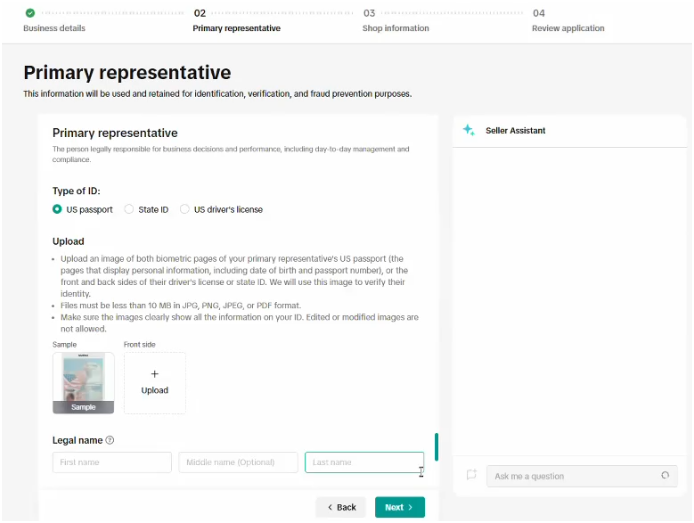
The Primary Representative step in TikTok Seller Center. One ID, three accepted types, and a set of file rules that reject submissions on their own.
At this stage TikTok asks for one government-issued ID. A passport requires images of both biometric pages. A driver’s license or State ID requires both sides. Files must be under 10 MB in JPG, PNG, JPEG, or PDF format, clear, full-color, unexpired, with all four corners visible. Edited or modified images are not accepted.
Then comes the part nobody warns you about.
The mistake the platform makes for you
When the ID is uploaded, TikTok reads it automatically and fills in the name fields. That optical character recognition is not reliable. It regularly merges a first and middle name into a single box, drops a second surname, or splits a compound family name in the wrong place.
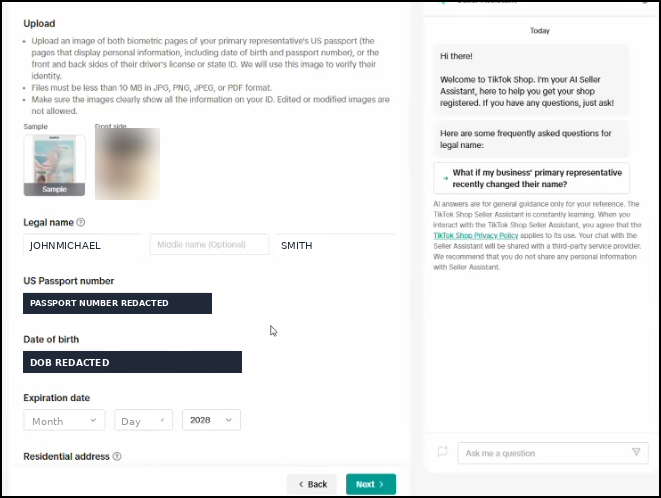
What the platform filled in. The passport upload auto-populated the name fields and merged the first and middle name into a single box. Nothing looks broken, so the seller clicks Next.
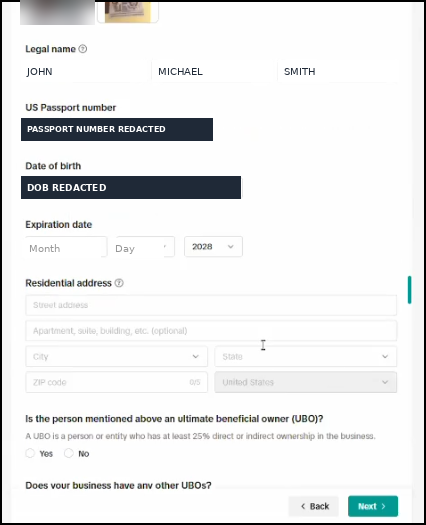
What it should say. Three fields, correctly split.
The rejection that follows weeks later is rarely caused by something the seller typed. It is caused by something the platform typed, and nobody checked.
That is the gap between having a representative and having a verified account. The person was never the hard part.
Identity and address are two separate tests
TikTok’s guidance treats them separately, and getting this wrong causes brands to disqualify perfectly good candidates.
The ID establishes legal name and date of birth. A separate proof-of-address document establishes the residential address. The residential address is typed in manually, in its own section, after the ID upload.
A representative whose driver’s license shows an old address is therefore not automatically disqualified. What matters is that the address entered can be substantiated by qualifying proof, such as certain utility bills, bank or credit card statements, or insurance documents.
What changed in May 2026
Two changes landed together, and reading them side by side shows the direction TikTok is moving.
TikTok added a Persona-powered facial scan to the signup flow, using video and ID checks on desktop and mobile. In the same period, the SSN or ITIN field was removed from the Primary Representative step for corporate sellers.
Those look like one release. Once the platform runs a live check matching the person to the document, a partial SSN becomes redundant as a secondary identity signal at that stage. TikTok traded a data field for a biometric one.
One caution. Some of TikTok’s older Academy pages still reference SSN among the Primary Representative verification fields. Do not treat the removal as permanent or universal. Follow the fields your actual Seller Center flow presents.
That gap is worth knowing about generally. TikTok’s written documentation lags its live product, sometimes by months. Anyone preparing from help-center articles alone is preparing for a version of the process that may no longer exist.
The role does not end at approval
TikTok published formal Identity Re-Verification Requirements on June 30, 2026. Sellers can be asked to verify identity again when TikTok detects risk associated with a shop or its products. When that happens, TikTok instructs the seller to use the same personal information submitted during onboarding, and failure can result in suspension or closure.
Read that from your candidate’s side. The same person, the same identity information, potentially a year after they agreed to help.
This is why a representative recruited casually tends to disappear at the worst possible moment, and why the conversation you have at the start determines whether they are still reachable later.
Why qualified people keep saying no to you
If you have been turned down, the problem is usually not the person you asked.
Qualified candidates decline because they can see the risk and they cannot see the protection. They do not understand their exposure. They have no reason to believe that six months from now, when TikTok comes back for re-verification, anyone will be there to handle it. Faced with that, no is the rational answer.
Which means the question is not “who will say yes.” It is “why does a reasonable person keep saying no to me?”
A brand that can answer these, confidently and in writing, has a completely different conversation than a brand that opens with “I just need someone with a U.S. ID”:
- Which company am I representing, and who actually owns it?
- Am I becoming an owner? Am I liable for the business?
- What information does TikTok receive, and how is it protected?
- What might TikTok ask me to do later?
- What am I responsible for, and what am I not?
- How long is this expected to last, and what if I want to stop?
- Am I being compensated, and how does that get reported?
Same candidate. Same relationship. Opposite outcome.
“I do not know anyone in the United States”
This is where most brands get stuck, and it is usually a misdiagnosis.
You probably know the right person already. The reason it does not feel that way is that you are evaluating candidates on whether you trust them, when the question that decides it is whether you can answer what they will ask.
You do not have a people problem. You have a preparation problem.
The three situations we see:
You already have someone in mind. A friend, family member, employee, business associate, or U.S. partner. Finding the person was never the hard part. Explaining the role clearly enough that they feel safe saying yes is the hard part.
You asked someone and they said no. That is often reversible. Ask why. Did they think they were becoming an owner? Did they believe they would be running the shop? Did nobody discuss compensation? Were you unable to answer their questions? Frequently the solution is not a different person.
You have nobody yet. Start by understanding the role rather than searching for a person. A qualified candidate will ask questions, and knowing those answers before the first conversation is what determines whether you get a yes.
Finding someone willing to say yes is not the first step. Understanding what you are asking them to say yes to is.
Before the representative: the check most brands skip
There is a mistake that costs more than the representative decision, and it sits upstream of it.
A brand says: “We just need the U.S. person and then we are ready.”
Maybe. But before anyone’s identity goes into an application, the company should also know which U.S. entity is operating the shop, whether that entity is correctly structured for TikTok’s U.S. tax requirements, how the W-9 will be completed and by whom, who owns the company, and who must be disclosed as a UBO.
The real sequence looks like this:
U.S. entity → tax classification → W-9 → ownership → UBOs → Primary Representative → business verification → banking → TikTok Shop
If something upstream is wrong, a U.S. person does not fix it.
Foreign-owned single-member LLCs deserve a closer look
A U.S. EIN by itself does not mean the tax structure is ready for TikTok Shop.
TikTok’s U.S. tax and business registration process needs to align with the actual federal tax classification of the seller. That becomes especially important with foreign-owned single-member LLCs that may be disregarded for U.S. tax purposes. It is the most common structure foreign sellers form, because it is the fastest and cheapest, and it is the one most likely to create a mismatch underneath an account that otherwise looks fine.
If that describes your setup, the representative was never your first problem.
Fixing the entity later is now possible, and expensive
TikTok introduced a formal Seller Entity Change process in June 2026. Before that, a brand that launched under the wrong entity often had to register a new shop and lose its sales history and performance.
The process exists now, and the cost of using it is worth understanding before you need it. To submit a change, the shop must be in Normal status with no pending withdrawals, and it must go into Holiday Mode, which means it cannot make sales while the request is processed. Funds are frozen until 24 hours after approval. A Novation Agreement is required to transfer contractual rights to the new entity. Bank accounts are unbound, and brand and category qualifications can be invalidated, which can deactivate affected products.
The cheapest time to get the entity right is before the first listing. The correction is now possible, and it is a live-business event.
What we do, and what we do not
We help foreign-owned brands get the right U.S. Business Representative on board.
We do not rent, sell, broker, source, or recommend individual representatives. We do not keep a list of strangers who will provide an ID for a fee.
Our role is to help you understand what the role involves, prepare for the questions a serious candidate will ask, work out compensation and boundaries, put the right protections in place, and confirm the representative fits your broader U.S. seller structure, so that when you have the conversation, you get a confident yes.
Three ways to move forward
1. Find out where you stand, free. Score your current setup against the verification requirements before you spend an attempt finding out the hard way.
Take the TikTok Shop Verification Scorecard
2. Get the representative piece right. The U.S. Business Representative Readiness Pack ($497) is built for the three situations above. It covers the role, the boundaries, the compensation paths and what each means, the protections both sides need, and the questions your candidate will ask, plus a call with our advanced TikTok Shop team so your candidate can ask their own questions directly. Applies as full credit toward the $2,497 Verified Path within 30 days.
U.S. Business Representative Readiness Pack
3. Talk it through. If your structure is complicated, or you are not sure whether the representative is even your first problem, book a short call and we will tell you where to start.
Book a 15-minute discovery call
Sending this to your candidate? They will have questions about what they are agreeing to. This article answers them from their side.
Frequently asked questions
Can Verified Expansion provide a U.S. Business Representative for my TikTok Shop?
We help foreign-owned brands get the right U.S. Business Representative on board, but we do not rent, sell, broker, source, or recommend individual representatives. The representative should be someone with a genuine existing relationship to your business.
Is the Primary Representative the same as the U.S. Business Representative?
Yes. TikTok Seller Center labels the role Primary Representative, also written as Primary Business Representative or PBR. We use U.S. Business Representative because the person must be based in the United States, which is the whole reason the role exists for foreign-owned brands.
Does my Primary Representative become an owner of my company?
No. The role does not create ownership. Not equity, not voting rights, not a 25% stake, and not UBO status. The representative is authorized to act for the business, not a partner in it.
Can the owners of the company live outside the United States?
Yes. Foreign individuals can own the U.S. seller entity. TikTok requires qualifying 25% or greater owners to be disclosed as UBOs and currently permits a non-U.S. passport for UBO verification. The Primary Representative is a separate role filled by someone based in the United States.
What ID does the Primary Representative provide?
The live registration flow currently offers US passport, State ID, or US driver’s license. A passport requires both biometric pages, and a license or State ID requires both sides. Files must be under 10 MB in JPG, PNG, JPEG, or PDF format, and edited or modified images are not accepted.
Does the representative’s driver’s license address have to match the application?
Not necessarily. TikTok treats identity and address as separate tests. The ID establishes legal name and date of birth. A separate proof-of-address document establishes the residential address, using qualifying records such as certain utility bills, bank or credit card statements, or insurance documents.
Does TikTok require facial verification of the representative?
TikTok’s identity verification may collect a government-issued photo ID, a selfie or photo, and facial data, and its third-party provider may use facial recognition to confirm the ID matches the person. New sellers complete a facial scan as part of the signup flow. The named representative is expected to participate personally.
Can TikTok ask my representative to verify again after approval?
Yes. TikTok published formal Identity Re-Verification Requirements on June 30, 2026. Sellers can be asked to re-verify when TikTok detects risk, using the same personal information submitted during onboarding, and failure can result in suspension or closure.
How many TikTok Shops can one representative serve?
A limited number of accounts per ID under current platform policy. Shops served by the same representative are connected, so a deactivation on one can affect another. This is why we do not recommend using anyone who serves as a representative professionally.
Can I change my representative later?
There is currently no reliable way to swap, replace, or remove the named representative once a shop is established. Treat the selection as a durable decision rather than a temporary favor.
What if I asked someone and they said no?
A previous no is often reversible. Candidates decline when they believe they are becoming an owner, taking on liability, or committing to operate the shop, or when compensation was never discussed and their questions went unanswered. Once the role, boundaries, protections, and compensation are clear, the same person may reconsider.
What if my TikTok Shop is already set up under the wrong entity?
TikTok introduced a formal Seller Entity Change process in June 2026, so starting over is no longer the only option. The process requires the shop to enter Holiday Mode, freezes funds until 24 hours after approval, requires a Novation Agreement, and can invalidate brand and category qualifications. The first question is whether your shop is eligible.
This article is provided for educational purposes only and does not constitute legal or tax advice. TikTok Shop policies and verification systems change frequently. TikTok makes all seller approval, verification, restriction, and enforcement decisions. Always verify current requirements directly with TikTok Shop Seller Center and consult qualified legal and tax professionals regarding your specific situation.
Last reviewed: August 2026.