
Most foreign brands start this search with one question. How much will U.S. insurance cost me?
Your home insurer said no. Or it said yes, at a number that hurt.
Next you look up U.S. product liability quotes. Somewhere along the way you learn that a U.S. policy needs a U.S. company, and a formation site offers an LLC for $350.
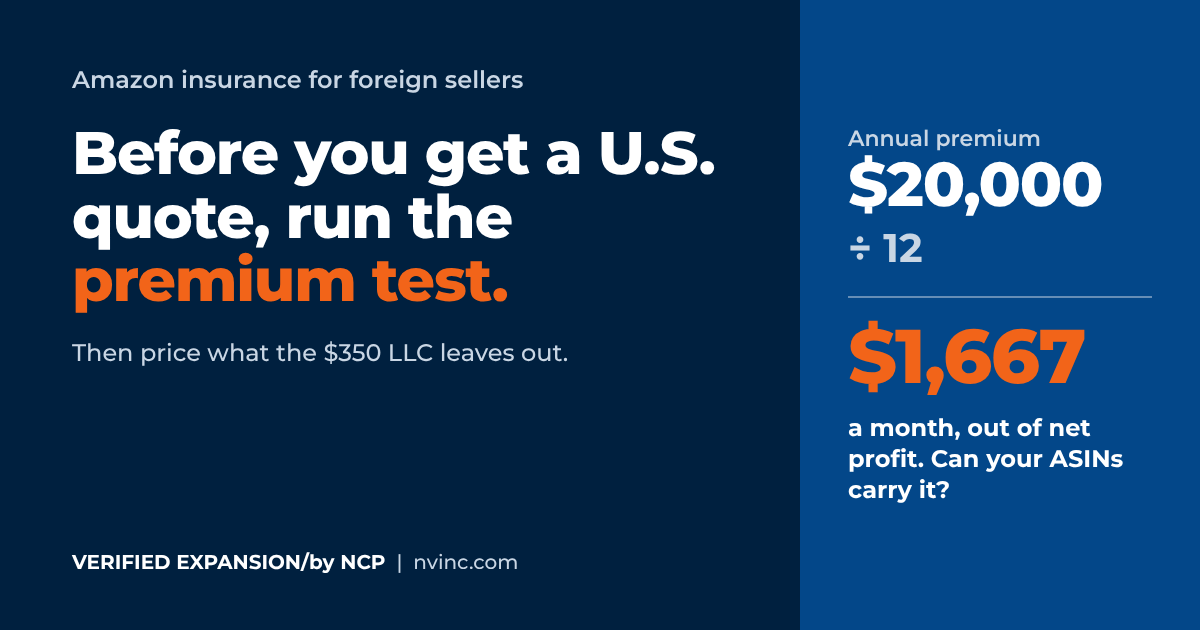
It feels simple. If the premium is reasonable, form the LLC, buy the policy, keep selling.
That math leaves out three things: whether the premium fits your profit, what a U.S. policy actually covers, and what the switch costs. The $350 LLC is the cheapest line on the bill.
Read this before you ask anyone for a quote.
Written for owners and CEOs of foreign-based brands doing seven and eight figures on Amazon.com through a company registered outside the U.S., with listings in Amazon’s enhanced-safety categories. Updated November 2026 for Amazon’s November 2 rule.
The short answer
At seven or eight figures, the premium is not the risk. The gap is. Every week your enhanced-safety listings sit inactive costs sales, rank, and Buy Box share that a premium never would.
Run the premium test first. Divide the annual premium by 12 and compare it with monthly net profit on the affected ASINs. If the premium eats the profit, no company structure fixes that.
Declined and too expensive are different answers. A decline points you to a specialist market. Too expensive is a budget decision.
A U.S. quote means a U.S. company becomes the seller. In our experience, U.S. carriers will not write a foreign company as the named insured on enhanced-safety products.
Compare three years of total cost. The home policy on one side. The U.S. policy plus the switch on the other.
Avoid changing your Amazon legal entity in the fourth quarter. Plan any move for Q1.
What changed in Amazon’s insurance rule on November 2, 2026?
Amazon announced two changes on September 3, 2026.
- Enhanced-safety categories lose the $10,000 threshold. Children’s products, supplements and other ingestibles, cosmetics and skincare, lithium battery products, small kitchen appliances, helmets and safety gear, mattresses, tires, and more need $1 million per occurrence and $1 million aggregate coverage from the first listing. Any sales level. New and existing listings.
- Mainland China sellers must buy new policies through the Amazon Insurance Accelerator. Everyone else keeps their choice of insurer. The Accelerator’s carriers write U.S.-based sellers, so it is rarely a route for a brand registered in the UK, Australia, or the UAE.
The policy must name the legal entity on your Seller Central account and list Amazon.com Services LLC and its affiliates and assignees as additional insured. Amazon does not require that entity to be American. For the full category list, see our guide to Amazon insurance requirements for non-resident sellers.
Why is Amazon doing this now?
In July 2024, the U.S. Consumer Product Safety Commission ruled that Amazon is a “distributor” of products sold through Fulfillment by Amazon. That makes Amazon responsible for recalls of hazardous third-party goods. The case covered more than 400,000 units, including carbon monoxide detectors, hair dryers, and children’s sleepwear. Amazon challenged the ruling in federal court in March 2025.
Read the enhanced-safety list with that case in mind. It covers every category where a product can burn, choke, or injure. Amazon expects to be named in those claims, and a seller under $10,000 a month carried no policy that could answer the claim. November 2 closes that gap.
Amazon is insuring itself. Plan accordingly.
Can a foreign seller get a U.S. insurance quote for Amazon?
Yes, for a U.S. company. A U.S. carrier quotes and covers a U.S. business. For the policy to pay a claim, the business must be the one selling on your Amazon account.
Matt Lovell of Well Insurance has placed Amazon product liability since the 2021 rollout. His position today: if the name on the Amazon account is a foreign company or a foreign individual, a U.S. policy will not cover the business correctly, and he will not write one just to satisfy Amazon.
He needs four things in place.
- A U.S. LLC or corporation
- A U.S. business address
- A U.S. tax ID (EIN)
- That U.S. company as the legal entity on your Amazon account
The first three are easy to buy. The fourth decides whether the policy pays, and it is where the real cost sits.
In 2021, many foreign brands formed a U.S. LLC, put it on the certificate, and kept selling through the foreign company. The upload passed. The LLC sold nothing and owned nothing. On a real claim, a carrier insures the named insured’s operations, and that named insured had none.
What happens to your ranking and the Buy Box if your listings go inactive?
For a brand doing $20 million a year, the premium is a rounding error. The real exposure is a gap: weeks where the enhanced-safety ASINs that carry the business sit inactive while the insurance gets sorted.
Amazon’s stated mechanism is listing-level. Listings in enhanced-safety categories may be deactivated until compliant proof is on file. The account keeps running. Those ASINs stop selling.
Here is what an inactive listing does to the business behind it.
Organic rank starts sliding. Amazon’s search ranking leans heavily on recent sales. Seller-tool data puts the slide at days, not weeks, on competitive ASINs, and the climb back at weeks to months once the listing returns. Amazon does not publish these numbers, and your category sets the speed.
The Buy Box can go to someone else. If resellers or distributors sell your ASIN and carry their own coverage, the Buy Box moves to their offer the day yours goes inactive. If you are the only seller, shoppers see the product as unavailable.
FBA inventory becomes stranded. Units behind an inactive listing cannot sell, and storage fees keep running. Storage is most expensive in the fourth quarter. Amazon sends notice and a window before it removes stranded units.
Your ads go dark while competitors keep bidding. Sponsored ads stop serving on an ASIN with no live offer. The shoppers who searched for your product buy the next one on the page.
Reviews and the detail page survive. The ASIN, its reviews, and your Brand Registry stay with the product. What you lose is momentum, and ranking runs on momentum.
Price the gap on your own numbers. Here is a brand doing $20 million a year on Amazon.com, with half of it in enhanced-safety ASINs.
| Amount | |
|---|---|
| Sales in enhanced-safety ASINs | $10,000,000 a year, about $833,000 a month |
| Sales at risk for each week inactive | about $194,000 |
| Sales at risk over four weeks | about $775,000 |
| Time to rebuild rank afterward | Weeks to months, by category |
Illustration only. These are sales, not profit. Rebuild time is a seller-tool estimate, not an Amazon figure.
Against that number, a $20,000 premium, a $50,000 premium, or a properly built U.S. company is cheap. A wrong first move that adds four more weeks is not.
That changes the work order for a large brand. A policy on the company already on your account, if any market will write it, is the fastest way to keep those ASINs live. If none will, the U.S. route starts now, and the plan has to cover which ASINs carry the business through the change, what inventory goes in, and when the account moves. That plan is the work, and it belongs on paper before anything gets formed.
How much does Amazon product liability insurance cost in enhanced-safety categories?
There is no published rate. The price depends on the product, your sales, your claims history, and the market writing it.
What we have seen: in 2021, quotes for supplements, children’s products, cosmetics, and sporting goods ran $1,000 to $10,000 a year, with about $3,500 typical. Specialist pricing today can sit at the top of that range or above it. Ingestibles and lithium batteries price highest because they carry the most claim risk.
That same risk is why so many first applications come back declined. Amazon put your product on the list because it can hurt someone. A standard carrier is paid to avoid exactly that.
One trap: a quote built on a vague product description. Amazon’s review checks the name, limits, dates, and additional insured. It does not read the exclusions. The underwriter does, on the day of a claim. Describe what you actually sell, and expect the honest quote to be higher than the vague one.
Can your Amazon business afford the premium?
For a brand doing $20 million, this answer takes ten seconds. For a brand doing $500,000, it decides everything. Run it before you request any quote, home or U.S.
The premium test: annual premium ÷ 12, compared with monthly net profit on the affected ASINs.
Here is the test for two hypothetical supplement brands, each quoted $20,000 a year, about $1,667 a month.
| Brand A | Brand B | |
|---|---|---|
| Monthly sales on affected ASINs | $60,000 | $8,000 |
| Net margin | 15% | 15% |
| Monthly net profit | $9,000 | $1,200 |
| Monthly premium | $1,667 | $1,667 |
| Share of profit the premium takes | about 19% | more than 100% |
| Verdict | Painful. Workable. | The listing cannot carry it. |
Illustration only. Your quote, your margin, and your sales decide the real numbers.
For Brand B, a U.S. company, nothing changes. Even a cheaper premium on a new company has to cover that company’s own costs. The honest options are raising the price, cutting the listing, or selling that product somewhere other than Amazon. Leaving Amazon removes Amazon’s requirement. The product liability risk stays.
Then run the other side of the test. What does no policy cost?
Sales at risk each week = monthly sales on affected ASINs ÷ 4.3. Brand A puts about $14,000 of sales at risk for every week those listings are down. That is sales, not profit, but lost ranking and ad momentum take longer to rebuild than the listing does.
Did your home market say no, or did it say too much?
The two answers lead to different places.
Declined. The carrier you asked does not write your product. A specialist broker in your own country may, including brokers with access to the Lloyd’s market in London. Ask before you look abroad, and get every answer in writing.
Too expensive. You have a price. Now it is a budget decision. Compare that price with the full three-year cost of the U.S. route, not just a U.S. premium.
Home comes first for one reason: a policy on the company already on your Amazon account changes nothing structural. The expensive home policy is often the cheap option.
The broker quoted the premium. The formation site quoted the LLC. Nobody quoted the change.
What does the $350 LLC leave out?
Take a hypothetical UK brand. A specialist broker at home quotes $12,000 a year on the UK company. A U.S. broker quotes $7,000 a year on a U.S. company that becomes the seller. The premium gap is $5,000 a year, $15,000 over three years.
Now add what the U.S. route brings. Put your own numbers in the right-hand column.
| Cost line | Pay the home policy | Make a U.S. company the seller |
|---|---|---|
| Insurance premium, three years | Your quote x 3 | Your quote x 3 |
| Formation, registered agent, U.S. address | None | One-time cost plus annual fees |
| Amazon legal entity change | None | New tax interview, re-verification, risk of a listing gap |
| U.S. corporate tax return | None for this purpose | Every year |
| Related-party reporting (Form 5472) | None for this purpose | Every year, $25,000 penalty per missed form |
| Pricing between your two companies | Existing setup | A written basis for every intercompany sale |
| U.S. tax on the U.S. company’s profit | Depends on your current U.S. position | 21% federal, plus state where it applies |
| Tax on profit sent home | None | Dividend withholding, set by treaty or 30% without one |
| Home-country review | None | Your home adviser signs off on the new structure |
| Banking and payouts | No change | U.S. bank account in the new company’s name |
Illustrative premiums only. Your quotes, your tax position, and your home country decide the real numbers.
Add up the right-hand column on your own facts. For many brands, it passes the premium gap before the first U.S. tax bill. For some, a U.S. company is still the right answer for reasons unrelated to insurance: wholesale, retail, U.S. employees, or a second marketplace.
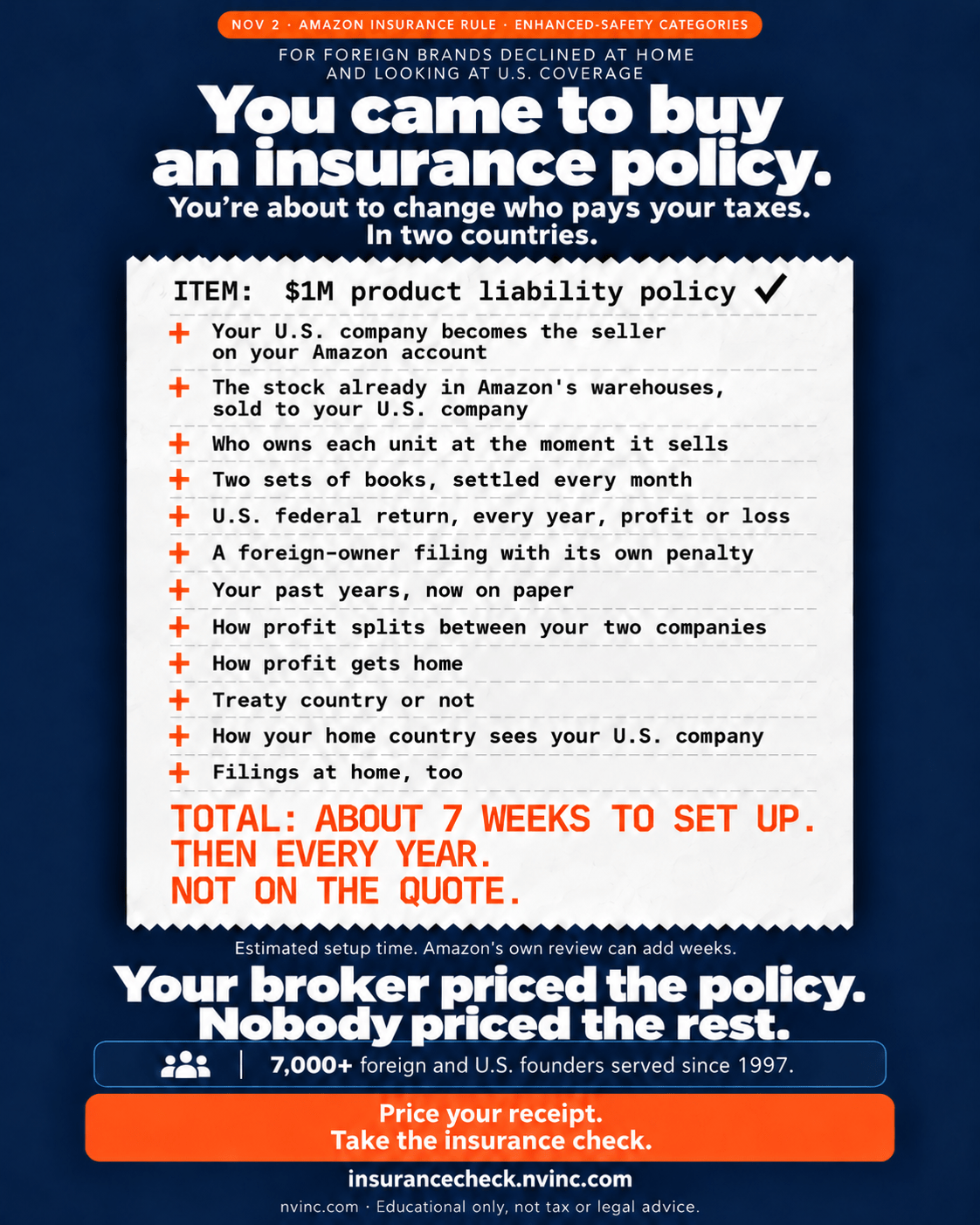
How does your tax position change when a U.S. company becomes the seller?
The day a U.S. company becomes the seller on your account, Amazon reports every sale to that company. The profit on those sales lands in a new U.S. taxpayer.
Three facts decide what that costs.
- Where your company is registered. A brand in a country with a U.S. tax treaty (the UK, Australia, Germany, Japan, and many others) may owe little or no U.S. tax on its Amazon profit today. Forming a U.S. company for insurance alone can create a U.S. tax bill that did not exist. A brand in a country with no treaty (the UAE, Hong Kong, Singapore) often carries open U.S. tax exposure already, and a properly built U.S. company can put a ceiling on it. Same rule, opposite answers.
- How profit splits between your two companies. The 21% U.S. rate applies to the U.S. company’s taxable income, not to your group’s profit. How much stays in the U.S. depends on how the two companies price the goods between them, decided before the switch and written down.
- How your home country treats a U.S. company you own. Some home countries treat a foreign company run from home as a local taxpayer. Where the real decisions get made matters.
Can a disregarded single-member LLC avoid the tax impact?
No. A single-member LLC that is disregarded for U.S. tax has no tax identity of its own. The IRS looks through it to the owner, and the owner is still your foreign company. Amazon’s tax interview sees the same thing, so your account stays with a foreign taxpayer wearing a U.S. company’s name. The LLC also adds its own annual filing, Form 5472, with a $25,000 penalty for missing it.
How the U.S. company is classified for tax is the decision that makes the switch work or fail. It belongs before formation, with the cost in both countries in front of you.
When is your actual deadline?
November 2 starts the rule. Your deadline is the date in your own notice.
Amazon’s September 3 Seller Central notification says sellers who need new or updated coverage receive an email asking for proof within 45 days of that email, and that listings in enhanced-safety categories may be deactivated until compliant documentation is on file. Other versions of the notice give November 2 as the date. Read yours and write down the date it names.
Amazon has not said whether it will enforce in one sweep or notice by notice. In 2021, many sellers ignored their notices and kept selling. This rule attaches to specific ASINs, and enhanced-safety ASINs already sit behind a document gate. Adding proof of insurance to that gate costs Amazon very little.
Should you change your Amazon legal entity in Q4?
In most cases, no.
Moving the account to a U.S. company means a new EIN, a new tax interview, a new legal entity on Seller Central, and Amazon validating the new taxpayer on its own clock. The IRS letter alone can take up to four weeks. Nobody outside Amazon knows whether enhanced-safety listings stay live while a new entity validates.
The order that protects your fourth quarter.
- Insure the company already on your account through your home market or a specialist market, if any insurer will write it.
- Price the U.S. route on paper now, so the decision is ready in January.
- Make any account change in Q1, on a date you choose, with the tax structure already decided.
If no insurer anywhere will write your current company, the U.S. route starts now, and the order of steps decides which listings stay protected. Have that conversation before anything gets formed.
Which route fits your brand?
Pay the home or specialist premium and keep your company. Fits when an insurer will write the company on your account, the premium passes the profit test, and you have no other reason for a U.S. operation. Most treaty-country brands land here.
Make a U.S. company the seller. Fits when no market will write your current company, when your country has no U.S. treaty, and your U.S. exposure is open, or when you want U.S. operations anyway.
Reprice or pull the affected listing. Fits when the ASIN cannot carry any premium. A listing that fails the profit test fails it under every structure.
What should you know before you request a U.S. quote?
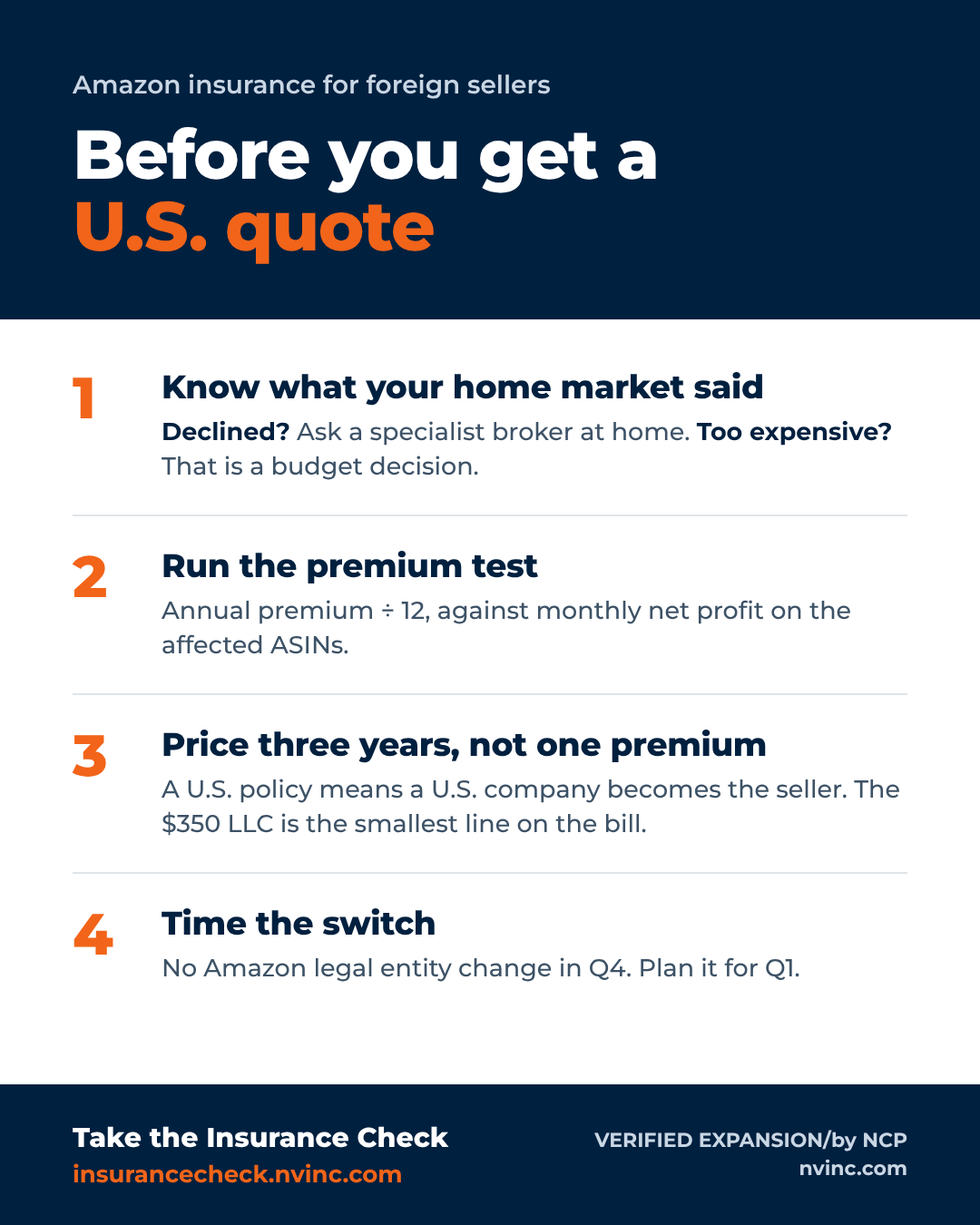
Bring these to any quote conversation.
- The exact legal entity name on your account: Seller Central, Settings, Account Info, Legal Entity.
- Your enhanced-safety ASINs, from Account Health, with each one’s monthly sales and net profit.
- The date in your Amazon notice.
- Your home market’s answer in writing, and whether it was a decline or a price.
- Your premium test result. The most you can pay before the listing stops making money.
- An honest product description, so the quote covers what you actually sell.
- The three-year cost of the U.S. route, before anything gets formed.
Prefer to watch? The short version, including the order that keeps the switch from costing more than the policy.
| Insurance Check Know your number before you ask for the quote. Three minutes. It tells you whether your ASINs are affected, whether your current policy matches your account, and which route you are likely on, and why. Free. |
What we do
We handle the structure and tax side of this decision. We do not sell insurance. We work with Matt Lovell at Well Insurance on the policy, and with tax attorneys and CPAs on every step that needs one.
Nevada Corporate Planners has served 7,000+ foreign and U.S. founders across 60+ countries since 1997, and is listed in Amazon’s Service Provider Network under Taxes.
When the Insurance Check points to a decision, these are the paid next steps.
Strategy Call with Scott: Your structure, your account, and your route, on your numbers. The full $500 credits toward Amazon Insurance Verified or the CEO Decision Review if you move forward within 14 calendar days. Book the Strategy Call
CEO Decision Review: Learn more. One written answer: pay the home premium and keep your company, or move the Amazon business to a U.S. company, in what order, and at what tax cost in both countries.
Amazon Insurance Verified: Learn more. We build the U.S. side so the policy covers the business that actually sells: the U.S. company, its tax setup, and the Amazon account changes that make the certificate valid. State fees, the address service, and premiums are separate.
TikTok Shop Expansion: Learn more. For foreign brands looking to also expand to TikTok Shop.
Not sure where you fit? Book a free 15- to 30-minute discovery call with our team. We learn your situation and tell you which service fits and what it costs. Strategy happens inside the paid steps, not on the discovery call.
Frequently asked questions
Will I lose the Buy Box if my listing is deactivated for insurance?
If other sellers offer your ASIN and carry their own coverage, the Buy Box moves to them while your offer is inactive. If you are the only seller, the listing shows as unavailable. When your proof is accepted and the offer returns, you compete for it again, from a weaker sales position.
How long does ranking take to recover after an inactive period?
Amazon does not publish a number. Seller-tool data suggests weeks for a short gap and months for a long one, faster in quiet categories and slower in competitive ones. Reviews stay with the ASIN. Sales momentum is what you have to rebuild.
What happens to my FBA inventory if the listing goes inactive?
It becomes stranded: it sits in Amazon’s warehouse unable to sell while storage fees continue. Amazon gives notice and a window to fix the listing before removal. Hold inbound shipments of affected ASINs until you have an answer to your coverage question.
How much does Amazon insurance cost for supplements or lithium battery products?
There is no fixed rate. These categories cost the most because they carry the highest claim risk. In 2021, we saw quotes from $1,000 to $10,000 a year across enhanced-safety products, and specialist pricing today can run at the top of that range or above it. Get a real quote on an honest product description.
What if I cannot afford the premium?
Run the premium test: annual premium divided by 12, against monthly net profit on the affected ASINs. If the premium takes most or all of that profit, a new company will not fix it. Raise the price, cut the listing, or sell that product outside Amazon.
Can a foreign company buy insurance that meets Amazon’s requirements?
Yes, if an insurer will write it. Start with your home market, then a specialist broker in your country, including brokers with access to the Lloyd’s market in London.
Can I get a U.S. insurance quote without a U.S. company?
A U.S. carrier writes a U.S. company. Ask the broker what they need to quote. A policy that pays a claim requires that U.S. company to be the legal entity on your Amazon account.
Can I form a U.S. LLC just to hold the policy?
You can get a certificate that way. You will not get coverage. The policy covers the company that sells the product, and if your foreign company still sells every unit, the claim falls outside the policy.
Can a foreign-owned single-member LLC become the seller on my Amazon account?
Not as a disregarded entity. The IRS and Amazon’s tax interview both look through it to your foreign company. How the U.S. company is classified for tax purposes determines whether the switch works, and you should settle it before formation.
Do foreign sellers have to use the Amazon Insurance Accelerator?
Only sellers based in Mainland China. Everyone else can choose their own insurer. The Accelerator’s carriers write U.S.-based sellers, so most foreign-based brands outside China will not find a route there.
Does the rule apply if I sell under $10,000 a month?
Yes, for products in enhanced-safety categories, new and existing listings. Other categories keep the $10,000 monthly trigger.
My certificate was rejected. Do I need a new company?
Not necessarily. Find out which check failed. If the insured name does not match the legal entity on your account, the fix is on the account or the structure. If the limits, dates, form, or additional insured fell short, a broker who works with Amazon sellers can correct the policy.
How long does the U.S. route take?
Longer than the formation. The IRS letter alone can take up to four weeks, and Amazon validates a new taxpayer on its own clock. That is why the account change belongs in Q1, planned now.
Will Amazon deactivate my listings?
Amazon says it may deactivate listings in enhanced-safety categories until it has compliant proof on file. That is a listing-level action. How consistently Amazon enforces it is still unknown, and the fourth quarter is a poor time to find out.
What if my U.S. sales are under $300,000 a year?
Take the Insurance Check. You get a straight answer by email, usually a broker referral, and nothing to restructure. At that size, the premium test decides the route.
This article is educational and is not legal, tax, or insurance advice. The examples are simplified and do not recommend an entity, insurer, or tax position. Coverage depends on the policy terms and the insurer. Amazon makes every seller verification and enforcement decision; confirm current requirements in Seller Central. Scott Letourneau holds the MSCTA® credential, and we work with tax attorneys and CPAs to execute legal and tax matters. Tax rules and platform policies change.
VERIFIED EXPANSION/by NCP | Since 1997