
You are one of many Australian brands selling on Amazon.com through a Pty Ltd, and TikTok Shop U.S. is next. Amazon has your W-8BEN-E on file. Your stock sits in Amazon’s U.S. warehouses. It works.
Now you want TikTok Shop U.S. The domestic seller route asks for a U.S. company, a Form W-9, and a U.S. Business Representative. Your Pty Ltd cannot sign a W-9, so you’ll need to form a U.S. company.
Here is the direct answer to the question most Australian founders never ask before they form.
Adding a U.S. company changes your tax in two countries. The 21% U.S. rate can rise to about 60% by the time profit reaches you, and Australia may also treat your new U.S. company as Australian.
None of that is a reason to stay off TikTok Shop. It is a reason to decide five things before the company exists, not after the first profitable year.
Updated October 2026 for Australian brands already selling on Amazon.com through a Pty Ltd, reflecting TikTok Shop’s W-9 requirement, the capital gains changes enacted in June 2026, and the trust tax bills introduced in October 2026.
Two companies, two forms, one pool of stock
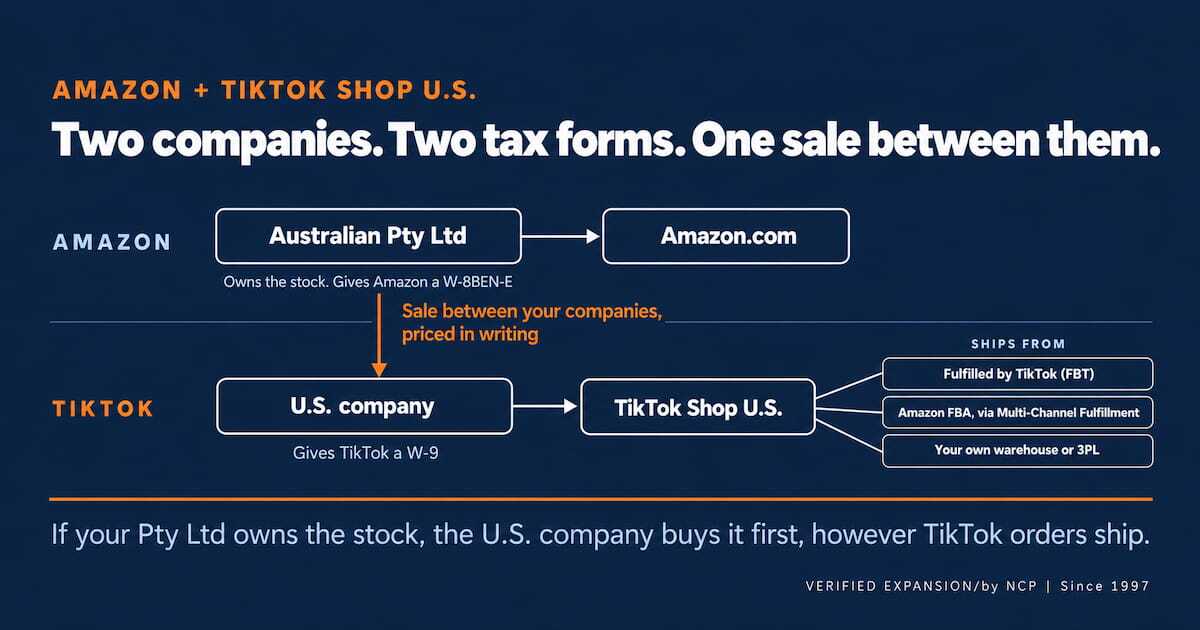 However TikTok orders are fulfilled, stock that starts with the Pty Ltd has to be sold to the U.S. company.
After you add TikTok Shop, the picture looks like this:
- Your Pty Ltd keeps selling on Amazon with its W-8BEN-E. It owns the inventory in FBA.
- Your new U.S. company sells on TikTok Shop with its W-9. It needs goods to sell.
There are three common ways to get stock to TikTok customers:
- Fulfilled by TikTok. You send stock to TikTok’s own warehouses. That stock can only fill TikTok orders.
- Amazon Multi-Channel Fulfillment. TikTok orders ship from the stock already in FBA. TikTok’s carrier, delivery speed, and dispatch rules still apply, and Amazon’s packaging and timelines have to meet them.
- Your own 3PL, shipping under TikTok’s approved-carrier rules.
TikTok has pushed U.S. sellers toward its own fulfillment, announced a requirement for most of them in early 2026, and then paused it. Plan for the possibility that some stock ends up in a TikTok warehouse, and check TikTok’s current fulfillment rules before you choose.
Whichever route you pick, the tax question is the same, and the dashboard never shows it to you: the goods started out belonging to the Pty Ltd, and the U.S. company is the one selling them.
With Multi-Channel Fulfillment, every TikTok order is really two transactions. With TikTok’s warehouses or a 3PL, the sale between the companies happens when stock moves to the U.S. company’s account. The Pty Ltd sells the goods to the U.S. company, and the U.S. company sells them to the customer. Both countries expect that first sale to exist on paper, at an arm’s-length price, with a clear answer to who owned the goods and when. That price between your own companies is called transfer pricing, and it determines how much profit is earned in the United States.
- Whose inventory is it, and where does ownership change? That decides which company earns what.
- Who is the importer? U.S. Customs tests the price between related companies under its own rules.
- Whose Amazon account pays the fulfillment fees, and is that cost recharged to the company that made the sale?
The platforms will move your stock wherever you tell them. That does not mean the IRS and the ATO see the sale the way the dashboard does.
The halo works in both directions
Most brands add TikTok Shop for the sales it drives everywhere else. A video takes off, and the Amazon listing lifts the same week.
If content run by the U.S. company drives sales for the Pty Ltd’s Amazon business, the Pty Ltd has received something of value from a related company. Tax authorities on both sides expect that work to be paid for. The reverse applies too. If the Pty Ltd builds the brand, the product, and the creative, the U.S. company owes the Pty Ltd for using them.
Running TikTok Shop “at break-even for marketing” is not a tax position. It is a pricing question with no answer on file. Once cross-border dealings between the companies exceed A$2 million a year, the Pty Ltd also reports them, along with its transfer pricing compliance, on an International Dealings Schedule with its Australian return.
What the U.S. company costs when profit comes home
A U.S. company pays 21% federal tax. Your Pty Ltd pays 25%. On the surface, the U.S. looks cheaper. Here is one illustration on $400,000 of profit, with the U.S. company owned by the Pty Ltd and the Pty Ltd owned by you.
| $400,000 profit | Earned in the Pty Ltd, paid to you | Earned in the U.S. company, kept there | Earned in the U.S. company, paid through to you |
|---|---|---|---|
| Total tax, both countries | $188,000 | $84,000 | $240,894 |
| Effective rate | 47% | 21% | 60.2% |
Illustration only. Assumes all $400,000 of profit is earned in the U.S. company, no state tax, the treaty’s 5% dividend rate, the Pty Ltd’s dividend exempt in Australia, no existing franking credits attached, an owner at the 47% marginal rate on this income, and a U.S. company that is not an Australian tax resident. Your numbers will differ.
On these assumptions, that is about $52,900 more tax every year the money reaches you.
The table is about what happens to profit once it sits in the U.S. company and is paid out as dividends. Transfer pricing decides how much profit gets there in the first place. If the price between your companies leaves the U.S. company only the return its actual work supports, the 60% applies to that slice, not to the whole $400,000. The rest stays in the Pty Ltd, where franking still works.
Why the gap exists. When your Pty Ltd pays Australian tax, it banks a franking credit. The credit travels with the dividend and counts against your personal tax, so company and personal tax together land near 47%. U.S. corporate tax creates no Australian franking credit. The dividend reaches you unfranked and you pay again.
Two things follow from that.
- The 21% is deferral, not saving. Australia’s controlled foreign company rules can still reach some retained profit, and state tax sits on top wherever inventory is stored.
- How much profit lands in the U.S. company matters more than the rate. The transfer pricing split must follow what each company actually does, owns, and risks, and it must be documented in both countries. A U.S. company that only resells on TikTok is a very different file from one that owns the brand.
Australia may claim your U.S. company
A company formed in the United States can still be an Australian tax resident. Australia applies this test to a foreign company that carries on business in Australia and either:
- has its central management and control in Australia, or
- has its voting power controlled by Australian residents.
An Australian-owned U.S. company meets the second limb on day one. The live question is whether it carries on business in Australia. The ATO views a company whose high-level decisions are made in Australia as carrying on business here, even when its sales happen overseas.
That raises one decisive question: who runs the U.S. company, and from where? Strategy, budgets, pricing, contracts, and banking count. Posting videos and answering customers do not. A founder who makes the real decisions from Brisbane raises a serious residence question, regardless of what the operating agreement says.
If the U.S. company is an Australian resident, the table above stops applying. It owes Australian company tax on its worldwide profit, its dividends may lose their exempt treatment, and you have to redo the whole calculation. Moving into or out of Australian residence later can carry its own tax cost.
The U.S. Business Representative does not change this. The role is limited by design. Moving the real decisions to the United States means placing a real decision-maker there, which brings its own consequences.
There is more than one route
The table shows the common route: a U.S. company taxed as a corporation, owned by the Pty Ltd. It is not the only one.
Depending on who owns what, some Australian groups use a structure where the Australian owners are taxed on U.S. profit as it is earned, with a credit for the U.S. tax. That can bring the effective rate down to near 47% instead of 60%, with no deferral. It has its own conditions, treaty tests, and Australian classification questions. Whether it fits you depends on your ownership chain and your plans.
The route also changes your exit. Selling a U.S. company taxed as a corporation is taxed very differently from selling a flow-through structure. If you might sell the brand one day, the U.S. structure you choose now changes the tax on that sale.
What changed in Australia this year
- CGT, law since June 2026. From 1 July 2027, individuals, trusts, and partnerships lose the general 50% discount on new gains. The small-business concessions remain, but they have their own tests.
- Trusts, bills before Parliament. From 1 July 2028, many discretionary trusts would pay a 30% minimum tax, with some elections and exclusions.
- Restructure window. Proposed rollover relief from 1 July 2027 to 30 June 2030.
None of this turns U.S. tax into a franking credit. If you are restructuring the trust that owns your Pty Ltd, decide who owns the U.S. company in the same conversation.
The question nobody asks: were the Amazon years clean?
Your W-8BEN-E told Amazon not to withhold. It did not decide whether your Pty Ltd has a U.S. trade or business.
That turns on what the company, and people acting for it, actually do in the United States. With your own inventory stored and sold in U.S. warehouses at scale, it is a serious question that deserves its own file. The treaty may protect the profit, but you claim that protection on a U.S. return. A year with no return filed never closes, and the states do not automatically follow the treaty.
Adding a U.S. company makes this more important, not less. Once a U.S. company with a U.S. representative works on the same brand, the line between the two businesses has to be clear on paper and in practice.
Forming a U.S. company for TikTok Shop does not clean up your Amazon years. January does not un-earn November.
Five decisions before you form
- Who owns the U.S. company? The Pty Ltd, you, your trust, or a partner.
- Who owns the inventory TikTok sells, and how it moves between the companies.
- How the companies pay each other for goods, fulfillment, brand, and content.
- Who manages the U.S. company, and from where.
- What your Pty Ltd’s U.S. filing position has been on the Amazon business so far.
Each one has an answer for your business. None of them is on the formation form.
Australian tax professionals and U.S. CPAs who read any of this differently are welcome to weigh in below.
| CEO Blueprint Expanding from Amazon to TikTok Shop U.S.? Get the structure right in both countries before you form. Which structure fits, who should own the U.S. company, how inventory and fulfillment run between your two companies, where decisions sit, and what each route costs. Starts at $1,250. |
What we do
We help Australian brands expand to TikTok Shop U.S. with a structure that works in both countries.
The CEO Blueprint maps your expansion on your facts: which structure fits, who should own the U.S. company, how your inventory and fulfillment should run between the two companies, where decisions should sit, what each route costs, and which questions go to your Australian accountant. We work with tax attorneys and CPAs and connect you with the right professionals for the work that follows.
Frequently asked questions
Can my U.S. company fulfill TikTok orders from my Pty Ltd’s FBA stock?
Often, through Amazon’s Multi-Channel Fulfillment, as long as the orders meet TikTok’s carrier, dispatch, and delivery rules. Many brands also keep some stock in TikTok’s own warehouses, and TikTok has signaled it may require that for some sellers. Either way, the U.S. company is selling goods owned by the Pty Ltd. That only works cleanly with a documented sale between the companies, at an arm’s-length price, with a clear owner at each step. Set that up before the first order ships, not after the first year’s returns.
Do I have to move my Amazon business into the U.S. company?
No. Amazon does not require it. Your Pty Ltd can keep selling on Amazon with its W-8BEN-E while the U.S. company sells on TikTok Shop. Whether moving makes sense later is a two-country tax decision, not a platform requirement.
The U.S. rate is 21%. Why isn’t the U.S. company cheaper?
Because 21% stops being 21% when the money reaches you. U.S. tax creates no franking credit. In the illustration above, profit paid through to a top-rate owner lands near 60% via the U.S. company and near 47% via the Pty Ltd. The first question is whether Australia also treats the U.S. company as resident, because that changes the whole calculation.
Does my U.S. Business Representative run the U.S. company?
No. The representative verifies identity for TikTok and is authorized to act for the company within a defined role. Where high-level decisions are actually made is a separate question, and that is what Australia asks.
This article is provided for educational purposes only and does not constitute legal or tax advice. The examples are simplified and do not recommend an entity, an election, an inventory arrangement, or a profit allocation. Australian conclusions require a qualified Australian adviser, in writing. Scott Letourneau holds the MSCTA® (MainStreet Certified Tax Advisor) credential, and we work with independent tax attorneys, CPAs, and Australian registered tax agents for legal and tax execution. Platform policies and tax rules change in both countries. The CGT changes described were enacted in June 2026; the trust measures were bills before Parliament at the time of writing.