

Your home insurer said no. Maybe it said no to supplements, children’s products, or anything with a lithium battery. Maybe it said yes, at a price your margins can’t carry.
Now Amazon wants $1 million of coverage on those listings. The only policy left is a U.S. policy, and a U.S. policy covers a U.S. company.
Most sellers budget for the premium. In the high-risk categories, it will be the biggest insurance bill you’ve ever seen.
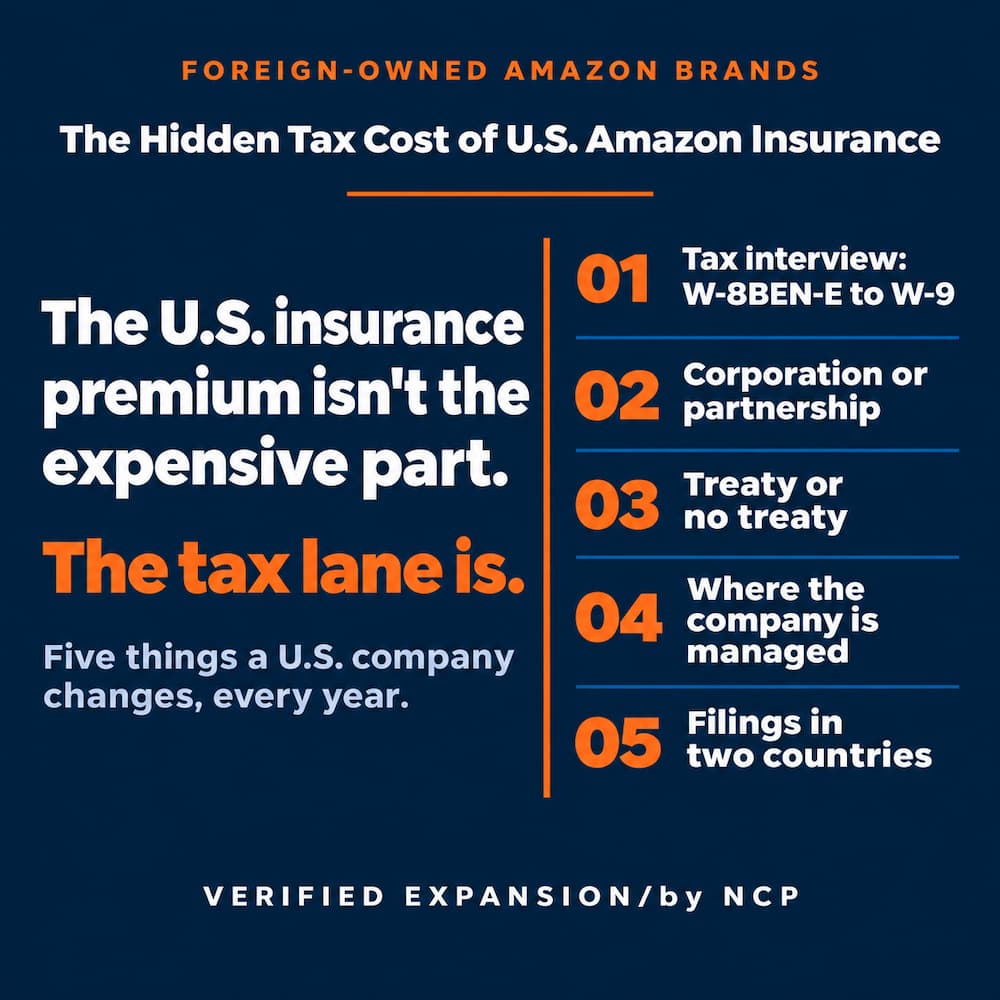
It’s still not the expensive part. The expensive part is what a U.S. company does to your taxes, in two countries, every year.
Our guide on what to know before you get a U.S. quote covers the first decision: home first, the premium test, and the three-year cost. This article picks up where that one ends. Your home market said no, and the U.S. route is the only route left.
Here’s what the U.S. company does to your taxes, what each option costs a foreign owner, and the questions to settle before anything gets formed.
Written for owners and CEOs of foreign-based brands selling on Amazon.com through a company registered outside the U.S., in Amazon’s enhanced-safety categories, who can’t get coverage at home. Every number here is an illustration, not a quote or tax advice.
The short answer
A U.S. policy only covers the company on your Amazon account. That U.S. company becomes the legal entity on your account and retakes Amazon’s tax interview as a U.S. taxpayer.
That switch puts you in one of two U.S. tax lanes. A corporation pays a flat 21% federal rate. A partnership withholds up to 37% from foreign individual owners every quarter.
Your country decides a lot. Treaty or no treaty can swing the total tax bill by tens or hundreds of thousands of dollars a year at the same profit.
Your home country may tax the U.S. company too. If you run it from home, some countries treat it as a local company.
Decide the structure before you form anything. A cheap formation now can lock in the expensive lane for years.
Why does a U.S. insurance policy force a U.S. company onto your Amazon account?
A U.S. carrier quotes a U.S. company, and the certificate has to name the business exactly as it appears on your seller account. Matt Lovell of WELL Insurance won’t write a policy just to satisfy Amazon: if a foreign company is the name on the account, the policy won’t cover the business correctly.
The U.S. company has to be the company that sells. That means it becomes the legal entity on your Amazon account, and that is where the tax story starts.
For the rule itself and the case for staying home, see our guide to Amazon insurance requirements for non-resident sellers and our pre-quote checklist.
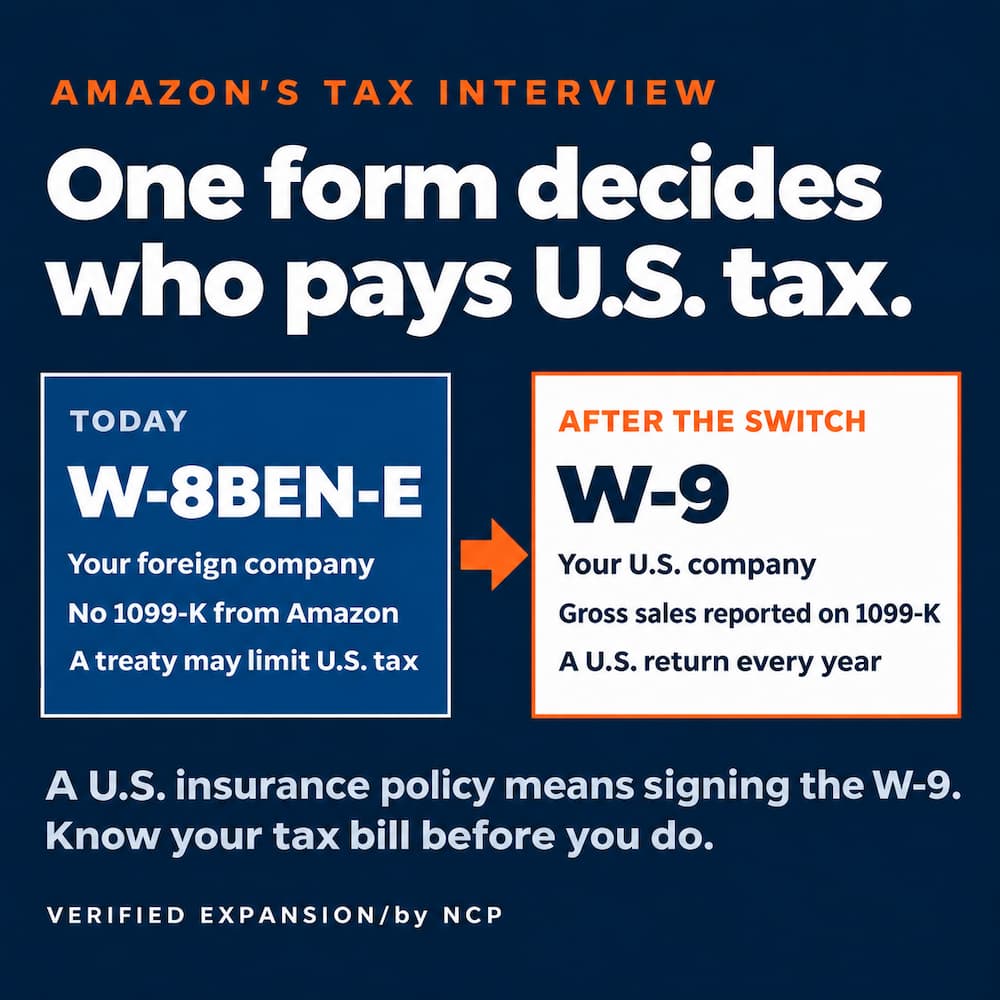
What changes when your Amazon tax interview moves from a W-8BEN-E to a W-9?
Today your foreign company answers Amazon’s tax interview on a W-8BEN-E. That form tells Amazon and the IRS you are a foreign business. Amazon issues no 1099-K in your name, and your U.S. tax position rests on your home country and any treaty it has.
When a U.S. company takes over the account, it retakes the tax interview on a W-9. That is a certification, under penalty of perjury, that the company is a U.S. taxpayer.
From that day forward:
- Amazon reports the U.S. company’s gross sales to the IRS on Form 1099-K, under its EIN.
- The U.S. company files a U.S. federal return every year, profit or loss.
- Amazon’s payouts go to a U.S. bank account in the U.S. company’s name.
- In a corporation, profit paid to you or your home company as a dividend faces U.S. withholding.
- Your home country has a new company to look at, and its own view of it.
Amazon also matches the company name and EIN against IRS records. A brand-new EIN can take a few weeks to show up in that match, and the IRS letter that confirms the EIN can take up to four weeks to arrive for an owner without a U.S. Social Security number.
Why doesn’t a single-member LLC work if you’re already selling on Amazon?
Already selling on Amazon? The default single-member LLC fails. Left on its default tax treatment, the IRS ignores it for income tax. The IRS and Amazon’s tax interview look straight through it to you, the foreign owner, and the interview lands back on a foreign form. It still files Form 5472 with a pro forma Form 1120 every year, and the $25,000 penalty applies.
To answer the tax interview as a U.S. taxpayer, the company has to be a corporation for tax, or a partnership with two or more owners. Each lane has a very different price.
Corporation or partnership: what does each U.S. tax lane cost a foreign owner?
Both lanes can complete the tax interview. They tax the same profit in very different ways.
The corporation lane
- The company pays the tax. 21% federal on its own taxable profit, plus state income tax where your inventory or sales create a filing obligation.
- Profit sent home is taxed again. Dividends paid to a foreign owner face 30% U.S. withholding, unless a tax treaty lowers it. Many treaties cut it to 5% for a home company that owns at least 10% of the votes, and to 15% in most other cases, including individuals. A few treaties allow 0% for a parent with a large, long-held stake, but the conditions are strict.
- Profit that stays in the U.S. company is not taxed again in the U.S. until it is distributed. Very large retained profits with no business need can face an extra U.S. tax.
- The returns are corporate. A Form 1120 every year, plus Form 5472 reporting its dealings with each foreign related party.
The partnership lane
- The owners pay the tax, not the company. Each foreign owner is taxed on their share of the profit, whether or not any cash is distributed.
- The partnership withholds it in advance. Every quarter, it pays the IRS up to 37% of each foreign individual’s share and 21% of each foreign company’s share.
- Withholding is a prepayment, not the final bill. Each foreign owner files a U.S. return and claims the withholding as a credit. That means a U.S. return for every owner, every year.
- A foreign company as a partner can owe a second U.S. tax. On top of the 21%, the branch profits tax can add 30% on profit treated as sent home, unless a treaty lowers it.
- Your home country may see it differently. Some countries treat a U.S. LLC partnership as a transparent partnership. Others treat it as a company. The UK and Canada generally treat a U.S. LLC as a company. An owner can pay U.S. tax on the profit as it is earned, then home tax again on distributions, with little or no credit for the U.S. tax. The UK consulted in 2026 on changing this for individual owners, but no change is law yet. A mismatch can mean tax in both places with no credit to match.
- Selling later costs more in this lane. A foreign owner who sells a partnership interest can owe U.S. tax on the gain, plus 10% withholding on the sale price.
Side by side
| Corporation | Partnership | |
|---|---|---|
| Who pays U.S. tax | The U.S. company | Each foreign owner, on their share |
| Federal rate | 21% flat | Withheld at 37% for individuals and 21% for a foreign company. The final rate is set on each owner’s return. |
| When the IRS gets paid | With the company’s return and estimates | Withheld quarterly, even if no cash is paid out |
| Tax when profit goes home | Dividend withholding, 30% or the treaty rate | For a foreign company partner, branch profits tax, 30% or the treaty rate |
| U.S. returns each year | Form 1120 and Form 5472 | Form 1065, withholding forms, plus a U.S. return for every foreign owner |
| How your home country sees it | Usually a separate company | Varies by country |
Simplified for illustration. State income tax can apply in either lane. Treaty rates depend on ownership and on qualifying under the treaty’s limitation-on-benefits test.
Which lane fits depends on who owns the U.S. company, where they live, what your home country does with each lane, and how profit is split between your two companies. That decision belongs before formation, on paper, with both countries in front of you.
Does it matter whether your country has a tax treaty with the U.S.?
It matters more than almost anything else on this page. Here are two worked examples with identical numbers: $5 million a year on Amazon.com and $1.25 million of profit. One is an Australian company. One is a Dubai free zone company. Both are illustrations, not client results.
Worked example: an Australian brand (treaty country)
An Australian Pty Ltd sells a high-risk product on Amazon.com. Its broker finds coverage, but the carrier wants a U.S. company as the seller and named insured. The number that matters is the cash that reaches the founder.
Australia gives shareholders franking credits for the Australian tax their company paid. U.S. tax creates none. That one rule drives the result.
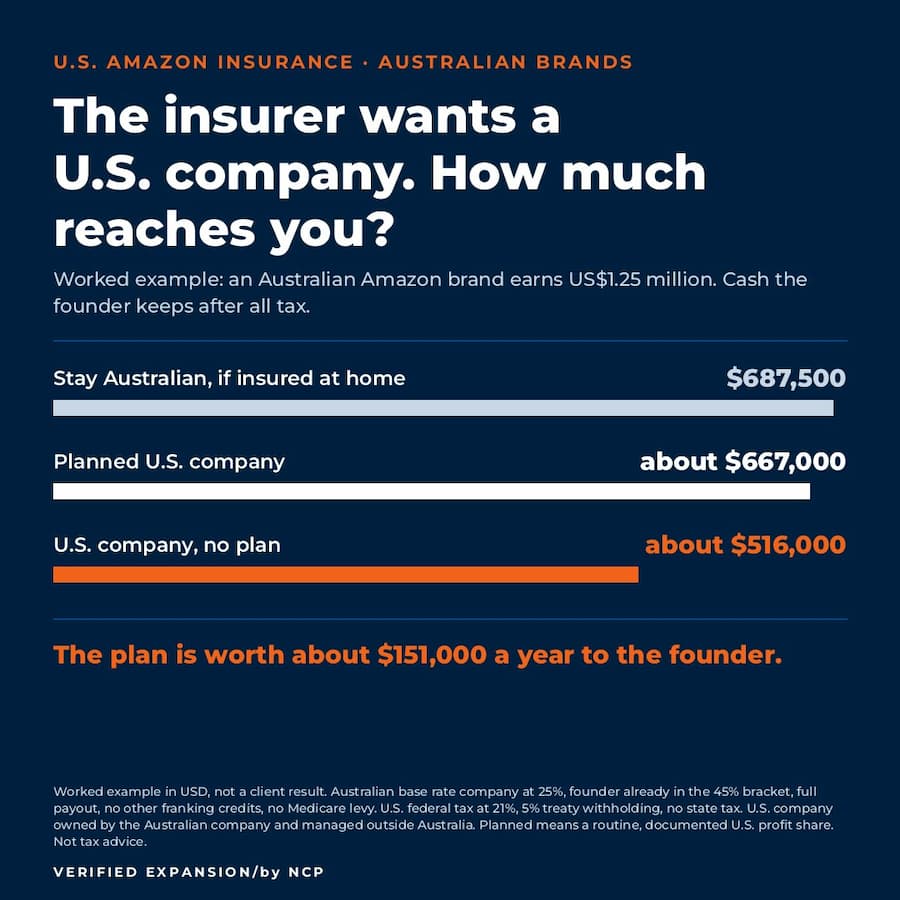
| Route | Tax through the company | Cash the founder keeps |
|---|---|---|
| Stay Australian, if insured at home | 25% | $687,500 |
| Planned U.S. company | about 25% | about $667,000 |
| U.S. company, no plan | about 25% | about $516,000 |
Worked example in USD, not a client result. Australian base rate company at 25%. U.S. company owned by the Australian company and managed outside Australia. U.S. federal tax at 21% with no state tax, 5% treaty withholding, full payout, founder already in the 45% bracket, no other franking credits, no Medicare levy. Planned means a routine, documented U.S. profit share, and both the IRS and the ATO must accept the split as arm’s length. A larger U.S. share narrows the gap. The 5% rate assumes the Australian company qualifies under the treaty’s limitation on benefits rules. The treaty’s 0% rate has stricter conditions that most private groups do not meet. If the U.S. company is run from Australia, the ATO can treat it as an Australian resident, which can change the 5% rate and every number here. An Australian accountant should run your actual numbers.
The lesson for treaty brands: at the company level, all three routes cost about the same. At the founder level, the unplanned route costs about $171,500 a year, and the planned route recovers about $151,000 of it. The difference is where the profit is earned and how it comes home, and both are decided before the first sale.
Every treaty country has its own version of this. In the UK, the trap looks different. The UK gives no credit for company tax, U.S. or British, so the routes can come out close. The risks sit elsewhere: who owns the shares, U.S. estate tax, and where the company is run.
A Dubai brand: no treaty
The UAE has no income tax treaty with the U.S. A Dubai company holding inventory in Amazon’s U.S. warehouses may already carry U.S. tax exposure it has never filed.
| Route | Total tax | Share of profit |
|---|---|---|
| Stay as a Dubai company, as most report it | about $103,000 | 8% |
| What the U.S. may say is owed on the same profit | about $559,000 | 45% |
| U.S. corporation, set up and priced in advance | about $121,000 to $157,000 | 10% to 13% |
| U.S. corporation, set up without a plan | about $559,000 | 45% |
Illustration only. Assumes FBA sales are not qualifying free zone income, U.S. federal tax only with no state tax, a routine documented U.S. profit share in the planned rows, and U.S. profit paid home at 30%. The lower planned figure applies when that profit stays in the U.S. company. The U.S. exposure figure includes the 30% branch profits tax. It leaves out state tax, interest, and penalties, and assumes the IRS allows the deductions, so it can be higher. It is a position the IRS may take, not a certainty.
The lesson for non-treaty brands: a U.S. company can be the right move, but only planned, and only after past years are resolved. Forming a U.S. company does not close earlier years. Unfiled years never close on their own.
Same Amazon rule. Opposite tax answers. That’s why nobody should hand you a structure before they know your country.
Do you already have U.S. tax exposure without knowing it?
Many foreign sellers assume they owe the U.S. nothing because they have no U.S. company. That isn’t always true.
- A U.S. trade or business. Inventory in Amazon’s U.S. warehouses, sold to U.S. customers, can be treated as a U.S. trade or business.
- Effectively connected income. Profit tied to that business is taxed at 21% for a foreign company, plus state tax. A foreign company also owes the branch profits tax: 30% of the after-tax profit treated as sent home, unless a treaty lowers it. If no U.S. return is filed on time, the IRS can also deny the company’s deductions.
- Treaty protection. A treaty usually limits U.S. tax to profit from a permanent establishment in the U.S., such as an office or dependent staff. A warehouse used only to store and deliver goods usually isn’t one. The company must also qualify under the treaty’s limitation-on-benefits article. Many advisers file a protective U.S. return each year that discloses the treaty position. Brands in treaty countries are often protected. Brands in non-treaty countries are not.
The switch to a U.S. company puts all of that on paper. For a treaty brand, it can create a U.S. tax bill that didn’t exist. For a non-treaty brand, it can cap an exposure that already did.
What happens if you run the U.S. company from your home country?
The U.S. taxes a company because it was formed in the U.S. Many home countries tax a company because of where it is managed. A U.S. company run from your office at home can end up claimed by both.
The tests have different names:
- Central management and control (CM&C). Used by the UK, Canada, and Australia. It asks where the board makes the real decisions. Australia also looks at whether Australian residents control the voting power. Either Australian test applies only if the company carries on business in Australia.
- Place of effective management (POEM). Used by India and in many tax treaties. It asks where the key management and commercial decisions are made.
- Effective management and control. The UAE applies this test. Singapore uses a similar test called control and management.
| Home country | May treat a U.S. company run from home as its own taxpayer? | What it usually means |
|---|---|---|
| Canada | Under its own law, yes | The treaty treats a company formed only in the U.S. as a U.S. resident. Work done in Canada can still matter. |
| United Kingdom | Yes | No automatic tiebreaker. Plan for a UK return every year and a possible top-up after credit for U.S. tax. |
| Australia | Yes, by management or voting control | No tiebreaker in the treaty. A company resident in both countries can lose treaty benefits in both. Franking credits can be lost at the owner level. Confirm with an Australian adviser. |
| Germany | Yes, by place of management | No automatic tiebreaker. If the two tax authorities do not agree, the company can lose treaty benefits. Confirm with a German adviser. |
| Japan | Generally no | Japan uses a head-office test. Lower risk on this point. |
| UAE | Yes | No U.S. treaty. Credit for U.S. tax usually removes the cash cost, but registration and filing follow. |
| Hong Kong | Not by residence | Territorial system, no U.S. treaty. Hong Kong can still tax profits from business carried on in Hong Kong, so work done there matters. |
Simplified for illustration. Your home adviser confirms how your country applies its test to your facts.
Where decisions get made, who signs, and where the directors sit are planning questions. Answer them before formation, not after your home tax authority asks.
What does the U.S. company add to your tax calendar every year?
Form 5472. A U.S. corporation that is at least 25% foreign-owned reports its dealings with foreign related parties. The penalty is $25,000 per missed form, with no cap.
Pricing between your two companies. The price your home company charges the U.S. company decides how much profit lands in the U.S. The IRS, customs, your home tax authority, and your insurer all read it. It needs a written basis before the first sale.
State income tax. Inventory in Amazon’s U.S. warehouses can create state filing obligations, even for a Wyoming company. U.S. states are not bound by tax treaties. Most do not follow them.
Home-country filings. Your home company now owns a foreign subsidiary. Expect new disclosures at home, and possibly tax on the U.S. company’s profit.
For the full three-year cost comparison against keeping your home policy, see the cost table in our pre-quote guide.
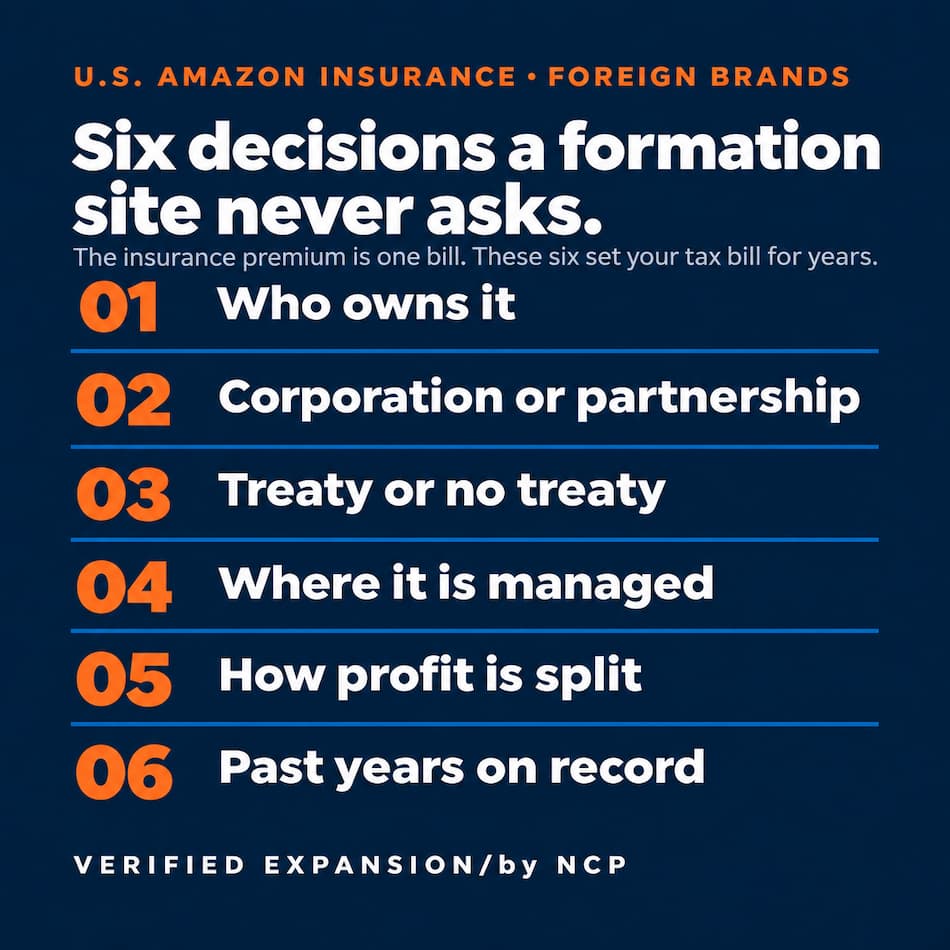
What should you decide before the U.S. company is formed?
A formation site will file your company in ten minutes and never ask a single one of these. Each answer changes the tax bill, and some are hard to undo once the company exists.
- Who owns it? You personally, your home company, or a holding company. Dividend rates, treaty access, home-country tax, and U.S. estate tax all follow the owner.
- Which lane? Corporation or partnership, and how your home country reads that choice.
- Which country’s rules apply? Treaty or no treaty, and whether you qualify for the treaty’s benefits.
- Where is it managed? Who decides, who signs, and where the directors sit.
- How is profit split? The price between your two companies, written down before the first sale.
- What about past years? Any U.S. exposure your foreign company already carries.
Your broker quotes the policy. Nobody quotes the tax lane, the treaty, or the second country. That bill runs every year.
Settling these before anything is formed is the first step of Amazon Insurance Verified.
How we help foreign brands with the U.S. route
We handle the structure and tax side of this decision. Matt Lovell at WELL Insurance handles the policy. We work with tax attorneys and CPAs on every step that needs one. NCP is an Amazon SPN Partner, listed in Amazon’s Service Provider Network under Taxes, and has served 7,000+ foreign and U.S. founders across 60+ countries since 1997.
Where to go next:
Amazon Insurance Strategy Call with Scott. Your lane, your country, and your route, decided on your numbers. Learn more
Amazon Insurance Verified. We build the U.S. side: the company, its tax election, the EIN, and the Amazon account change, in the right order. Learn more
CEO Decision Review. The tax decisions in this article, mapped on your own numbers, in writing. Learn more
Expansion Blueprint. For brands restructuring more than Amazon: several marketplaces, a holding company, or a full U.S. operation. Learn more
Not sure the U.S. route applies to you? Take the free 3-minute insurance check.
Frequently asked questions
Is the 37% partnership withholding my final U.S. tax?
No. It is a prepayment. Each foreign owner files a U.S. return, reports their share, and claims the withholding as a credit. For most individual owners, the final tax is the same or lower. A foreign company partner can owe more, because the branch profits tax is not withheld. The cash still leaves every quarter, whether or not the partnership distributed anything.
Does it matter whether I own the U.S. company personally or through my home company?
Yes. Dividend withholding, treaty rates, home-country tax on dividends, the management test, and U.S. estate tax all change with the owner. Shares of a U.S. corporation held by a foreign individual can face U.S. estate tax at death. A founder who owns the U.S. company personally pays U.S. withholding on dividends. It is 30% without a treaty and often 15% with one. Home-country tax follows, and credit usually covers only the withholding, not the 21% corporate tax. That choice is part of the structure decision.
My country has no U.S. tax treaty. Is a U.S. company worse for me?
Often the opposite. Without a treaty, a foreign company with U.S. inventory may already have U.S. exposure. A planned U.S. company can put a ceiling on it. Past years still need to be dealt with first.
What is POEM, and does it apply to me?
POEM stands for place of effective management. It’s one of the tests countries use to decide where a company is tax resident. The UK, Canada, and Australia use a similar test called central management and control. If you run a U.S. company from home, ask your home adviser how your country applies its test.
I’m not on Amazon yet. Is this different for me?
Yes, and it’s simpler. There’s no existing account to change. The lane, the owner, and the management questions are the same, and they still get decided before you form the company.
Do I need a U.S. CPA after the switch?
Yes. The U.S. company files federal returns every year, and the partnership lane adds a return for every foreign owner. We work with a CPA who prepares one-off returns without requiring a monthly bookkeeping retainer, and we make the introduction.
This article is educational and is not legal, tax, or insurance advice. The examples are simplified illustrations and do not recommend an entity, insurer, or tax position. Rates and rules change, and treaty benefits depend on ownership and qualification. Amazon makes every seller verification and enforcement decision. Coverage depends on the policy terms and the insurer. Scott Letourneau holds the MSCTA® credential, and we work with tax attorneys and CPAs to execute legal and tax matters.
VERIFIED EXPANSION/by NCP | Since 1997