
By Scott Letourneau, CEO, Verified Expansion by NCP
Last updated: November 19, 2026
You can reapply to TikTok Shop after a rejection. A new account doesn’t automatically start clean, though.
TikTok can connect it to the old one through much more than an email address or a phone number. Its published guidance names shared ownership, representatives, account access, devices, business information, and shared operations.
TikTok also asks sellers to explain the status of earlier rejected, closed, or deactivated stores honestly.
On discovery calls, we most often hear that a new login, a new U.S. company, or a new representative wipes the slate clean. It may not. For a foreign-owned brand expanding into the United States, most of the outcome gets decided before anyone submits.
Blog summary
- Does TikTok Shop remember a rejected application?
- What can connect a new application to an old one?
- Separate devices, a separate LLC, someone else set it up: does any of that separate you?
- Sent back, closed, or restricted: which one do you have?
- Why do first-time applications get rejected?
- Who does TikTok verify on a foreign-owned application?
- Can you open a new shop while the old one is restricted?
- What does a second attempt look like from the inside?
- Where does your account stand today?
- What should you do before anyone opens an account?
- Can anyone guarantee a TikTok Shop approval?
- Your next application deserves more than a second guess
- Frequently asked questions
Does TikTok Shop remember a rejected application?

It can. TikTok’s guide to connected account risks says: “Opening a new account does not erase the history of the old one.”

From TikTok’s Understanding Connected Account Risks guidance, June 29, 2026. Read TikTok’s guide.
That line sits in TikTok’s discussion of sellers who open another shop after an earlier one was restricted. The same guidance covers rejected shops and historical account records.
TikTok doesn’t publish a rule that every unfinished signup becomes a permanent mark, or that every second application gets scored down. It does make clear that a new account isn’t a clean slate by default.
What can connect a new application to an old one?
TikTok’s connected-account guide and its Seller Enforcement Policy describe the kinds of overlap TikTok reviews. This table summarizes them, including what each can mean for a second application.
| What TikTok can consider | What it can mean for a second application |
|---|---|
| Email address or phone number | TikTok requires one not already used for another TikTok Shop. |
| The owner | The same beneficial owner behind two applications may be considered in a review. |
| The U.S. representative | A representative tied to another shop may bring that shop into the review. |
| Company name and tax ID | An earlier entry can stay associated with the company. |
| Payout bank account | A shared bank account can contribute to a connected-account review. |
| Device, browser, or account access | Shared devices or shared access may be considered. |
| Home or business address | A shared address may contribute to a review. On its own, it doesn’t prove a connection. |
TikTok says it generally weighs several signals together. One shared detail rarely settles anything. Several together can.

TikTok’s own table of common risk scenarios. The highlighted row matters most if you have a restricted shop. Read TikTok’s guide.
Separate devices, a separate LLC, someone else set it up: does any of that separate you?
Experienced sellers often tell us they’ve already handled linkage. They’ve run multiple Amazon accounts for years and know the tools. Some of what they do is right.
TikTok’s guide opens its list of mistakes with this one: don’t assume “I did nothing wrong” means there’s no risk. Some cases come from overlooked overlap in how the business runs, not from intentional misconduct.
Four beliefs come up on almost every call.
“I use separate devices and IP addresses.”
Good. Keep doing it. TikTok’s own guide tells sellers to use separate devices, browsers, and network environments for different stores.
That covers one signal. The owner, the representative, the company, the bank account, and the registration details are others, and TikTok weighs them together. Separate devices don’t separate an owner from the owner’s own history.
“Someone else opened the account for me.”
TikTok’s connected-account guide is direct about this. If the store is under your name, you’re responsible for how it was registered and operated. A shop a freelancer opened is still your shop’s history, including whatever identity was used to open it.
That’s one reason freelance marketplaces sit on our ruled-out list for finding a U.S. representative.
“I’ll use a different LLC.”
A separate company is one layer. TikTok’s guide says different legal entities may help show separation, but they don’t automatically remove the risk. Accounts can still appear related when they share the same team, devices, networks, warehousing, logistics, or operating model.
“The problem was the SSN.”
Check that against the notice before you build a plan around it. Some restriction notices say the shop was identified as part of a group associated with elevated risk patterns. That wording points at connections between shops, and a number on a form won’t answer it.
TikTok’s current process verifies a real person with a government ID and a facial scan. It can ask that person to verify again after approval.
Which layer caused a particular restriction depends on the facts behind that shop. A review answers that. A guess won’t, and neither will a second shop built on the same setup.

From TikTok’s Don’t list on connected accounts. Read TikTok’s guide.
Sent back, closed, or restricted: which one do you have?
Owners call all of these “rejected.” They’re different states, and each one calls for a different response. Go by the button on the screen, not the wording, and keep a screenshot.
| State | What you see in Seller Center | What it means |
|---|---|---|
| Unfinished | A registration someone started and never submitted | TikTok offers a way to end it and release the email or phone. Resolve it before anyone applies again. |
| Sent back for correction | A reason, with a Fix Issues or Submit button | A resubmission inside the same registration. It can loop if the real cause isn’t fixed. |
| Identity check failed | An Appeal button on a shop that was never approved | A registration appeal. The check on the representative as a person failed, not a business document. |
| Closed | No button to act on | Final for that account. TikTok’s published guidance doesn’t set out a way to reopen it. |
| Approved, then restricted | A violation record on a live shop, with an appeal option | TikTok’s enforcement appeal process. It applies to live shops, not to a failed first registration. |
Two very different answers can look almost the same. Both of these real TikTok emails say “Verification failed.”

Email one asks for documents: the ID, the proof of address, and the IRS letter. That usually means a correction inside the same registration.

Email two cites “risk and safety concerns” and points to an Appeal button. A better document won’t answer that one.
Same headline, same artwork, different problems. Read past the headline before anyone touches the account.
Approval isn’t the last check
A shop can be approved and still fail verification afterward. TikTok’s registration guidelines say it may require additional verification documents after initial registration.

An approved shop, deactivated. The reason: “Seller Registration – Unable to Verify Business or Individual.”
That moves the shop onto the enforcement track. The shop is closed and withdrawals are suspended while the appeal deadline runs.

The same record: TikTok asks for additional information, with the appeal clock counting down.
Approved and verified are two different milestones. The same documents have to hold up both times.
Mixing these up costs the next attempt too. A closed shop handled like a correction is how one closed door becomes two.
Why do first-time applications get rejected?
Most often for ordinary reasons. TikTok’s own onboarding guidance points to unsuitable documents and name or address mismatches as common causes.
Ordinary causes can usually be prevented.
When we review a rejection, we sort the cause three ways. This is our own diagnostic framework, not a TikTok classification.
- A mismatch. One field doesn’t match the document. A name, an address, a date.
- A document or identity problem. The ID, IRS letter, or proof of address doesn’t pass, or the identity check isn’t complete (the CP 575 is different from the 147C letter, same business info, but different letter).
- An account-integrity concern. Something connects this application to other account history.
Different causes call for different responses. Some can be corrected with documents. Some need an account-integrity review. Some may not be recoverable.
The notice rarely tells you which one you have. Guessing wrong turns a correctable problem into a second rejection.
How much do we check before anything reaches TikTok?
Our team runs nearly 150 internal checks across nine areas of a setup. They cover document quality, identity eligibility, cross-document consistency, and account history.
Take one step: the representative’s ID. We run 21 checks on it alone. Five examples:
- An expired ID
- A learner’s or probationary license
- A screenshot of the ID, or a photo of a screen
- A photo that was cropped, filtered, or brightened
- A name that differs from the typed name by one middle initial
Through September, every rejection on a setup our team guided arrived with one of three things already in place: an earlier attempt, a VPN, or a problem with the representative’s documents.
That’s a small sample. It shows what was present, not why TikTok decided.
Who does TikTok verify on a foreign-owned application?
At least two people, plus the business.
- The ultimate beneficial owner. Anyone who owns 25% or more of the company. A foreign owner can verify with an eligible foreign passport.
- The U.S. primary representative. A person in the United States, authorized to act for the company, who verifies their own identity.
- The business. Its legal name, EIN, registered address, and an accepted IRS letter such as the CP 575 or 147C.
That’s why replacing the representative or forming another U.S. company doesn’t remove the original owner from the picture.
Identity verification is more than an ID upload now. TikTok’s October 2026 Policy Pulse announced enhanced identity verification for new sellers, using facial scanning and ID checks on desktop and mobile. The representative completes it personally.
TikTok also published Identity Re-Verification Requirements on June 30, 2026. It can ask a seller to verify again after approval. Here’s what that means for the person in the role.
A valid company and a genuine IRS letter can’t make up for a representative who can’t complete verification. TikTok is looking for an eligible U.S. business, registered accurately, with its real foreign owners and an authorized U.S. representative.
Can you open a new shop while the old one is restricted?
It’s risky, and TikTok’s own guidance says why.
A restricted shop can stay open with limits in place: a daily order cap, reduced visibility, paused withdrawals, and no access to campaigns or platform-funded discounts. Owners often stop using it and turn to other channels.
TikTok’s connected-account guide says opening a new shop after a restriction may be viewed as an attempt to bypass earlier enforcement, and can create even higher risk. It also asks sellers to explain the status of any active, deactivated, closed, or previously rejected stores honestly.
TikTok’s own advice in this case: resolve the issue with the original account first, rather than continuing the same business through another shop.
Whoever becomes your U.S. representative will be asked about the old shop. It has to be part of the plan from the start.
Changing the representative or the company doesn’t settle it on its own. TikTok verifies the owner, the representative, and the business. Change one, and the other two can still carry the earlier history.
Sometimes a new application is the right move. That decision belongs after someone reviews what the first attempt left behind. That review is the Verified Diagnostic.
What does a second attempt look like from the inside?
Here’s a composite of what we hear on discovery calls. The details change. The order rarely does.
A seven-figure Amazon brand decides to add TikTok Shop U.S. Someone on the team opens the account on a weekend, with whichever documents are closest. A contact in the United States agrees to be the representative and sends a photo of a license.
TikTok returns the application. The team replaces the ID photo and submits the same day again. The second answer comes back faster.
Next, someone suggests a new company. It gets formed. A third application goes in under the new name, with the same owner and the same representative.
By the time that brand calls us, the question has changed. It began as “how do we start?” It has become “can this still be approved?”
Compare that with one recent guided registration. A foreign-owned brand was approved while our team was still on the setup call. We had reviewed the company information, the representative’s details, and the brand’s application history beforehand.
TikTok alone decides approval, so we can’t credit the result to any one step. Nothing in that application was left to guess.
Where does your account stand today?

| What you see | Where you stand | Your next step |
|---|---|---|
| No account and no registration | First-time account | Start here, before anyone registers. |
| A registration someone started and never submitted | Unfinished | Stop there. Tell our team on a discovery call before anyone logs in again. |
| A Fix Issues, Submit, or Appeal button | One attempt so far | Verified Diagnostic first. |
| No button, or a restricted live shop | Closed or restricted | Verified Diagnostic, if it was your only shop. |
| Two or more failed shops | Outside our intake | We’re just not able to help. |
The last row is our own intake policy, not a TikTok rule. With that much history behind a brand, we’d rather say so up front.
What should you do before anyone opens an account?
- Don’t start a registration until the owner, the representative, and the company are ready. That goes for your representative too.
- Don’t let a freelancer, or anyone outside the company, open the account for you.
- Avoid VPNs, proxies, or remote access that hides where the registration actually happens. Never misstate the representative’s location or identity.
- Ask everyone tied to the brand whether they ever started an application: owners, staff, a past agency, and your representative candidate. Bring the answers to your first call.
- Choose your representative first. Our standard is a representative who isn’t on another shop, because shared people can bring another shop’s history into yours.
- Settle your tax position before you form the U.S. company. A company formed first can leave you with a structure that doesn’t meet TikTok’s tax form requirement.
Do those six and you apply once, with every document checked first.
Can anyone guarantee a TikTok Shop approval?
No. TikTok Shop makes every approval decision, and no legitimate provider controls it.
Preparation changes what TikTok has to decide. A first application with matched documents and a prepared representative gives TikTok one clean question. A third application gives it a history.
Your next application deserves more than a second guess
A foreign-owned brand can have a valid U.S. company, a genuine IRS letter, and a qualified representative, and still run into verification problems.
The business, the owner, the representative, and any earlier account history all count.
TikTok can recognize connections between shops, even across different companies and representatives. Not every connection is a violation, and not every rejection points to an account-integrity problem.
The costly mistake is assuming a new login or a new LLC solves a problem nobody has diagnosed.
You’ve probably asked AI about this already. It will give you the rules. It won’t tell you what those rules do to your owner, your representative, your companies, and your old shop, or which one to fix first.
Before anyone starts, settle the structure, confirm the representative, prepare accurate ownership and identity records, and check for earlier applications. If you’ve already been rejected, find out what happened before you take another step.
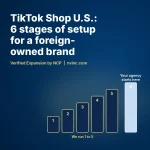
We’re a registered TikTok Shop partner for shop registration in the U.S. market, and we’ve served 7,000+ foreign and U.S. founders since 1997. We don’t grow shops, and we don’t compete with agencies. Our work comes first: the company, the representative, and an application checked before TikTok sees it. See the six stages and who runs each one.
The Verified Path
No U.S. company yet, or a structure that doesn’t meet TikTok’s tax form requirement.
Verified Ready
Your U.S. company already meets the requirement, and your representative is ready.
Verified U.S. Representative
You’re still choosing the person for the role.
Verified Diagnostic
One earlier attempt. Find out what happened before anyone touches the account again.
Frequently asked questions
Q: Can I reapply to TikTok Shop after a rejection?
A: Yes. A new application doesn’t automatically start clean, though. TikTok can connect it to the earlier one through the owner, the representative, the company, and other shared details.
Q: Can I apply again with a different email?
A: A different email doesn’t make the business, the owner, or the representative new. TikTok can consider several connections together.
Q: I use separate devices for each shop. Isn’t that enough?
A: It covers one signal. TikTok weighs the owner, the representative, the company, the bank account, and the registration details together.
Q: Someone else opened my shop. Is it still my history?
A: Yes. TikTok’s guide says that if the store is under your name, you’re responsible for how it was registered and operated.
Q: Does forming a new U.S. company give me a fresh start?
A: Not necessarily. The owner and the representative can still carry the earlier application. TikTok says different legal entities don’t automatically remove the risk.
Q: Is a VPN safe for TikTok Shop registration?
A: We never use one, and we advise every client against it. Anything that hides where the registration actually happens works against you.
Q: We’ve been rejected twice. Can you help?
A: That’s our own intake line, not a TikTok rule. With two or more failed shops, we’re just not able to help.
Author

Scott Letourneau
Scott Letourneau is the CEO and founder of Nevada Corporate Planners, Inc. and Verified Expansion. Since 1997 his team has served 7,000+ foreign and U.S. founders. He holds the MainStreet Certified Tax Advisor® credential (2023 to 2025), and Verified Expansion is a registered TikTok Shop partner for shop registration in the U.S. market. He helps foreign-owned brands expanding into the United States get the structure, the tax position, and the marketplace verification in the right order.
This page is educational and is not legal or tax advice. TikTok Shop makes every approval decision. Scott Letourneau holds the MSCTA® credential. We work with tax attorneys and CPAs for legal and tax execution.